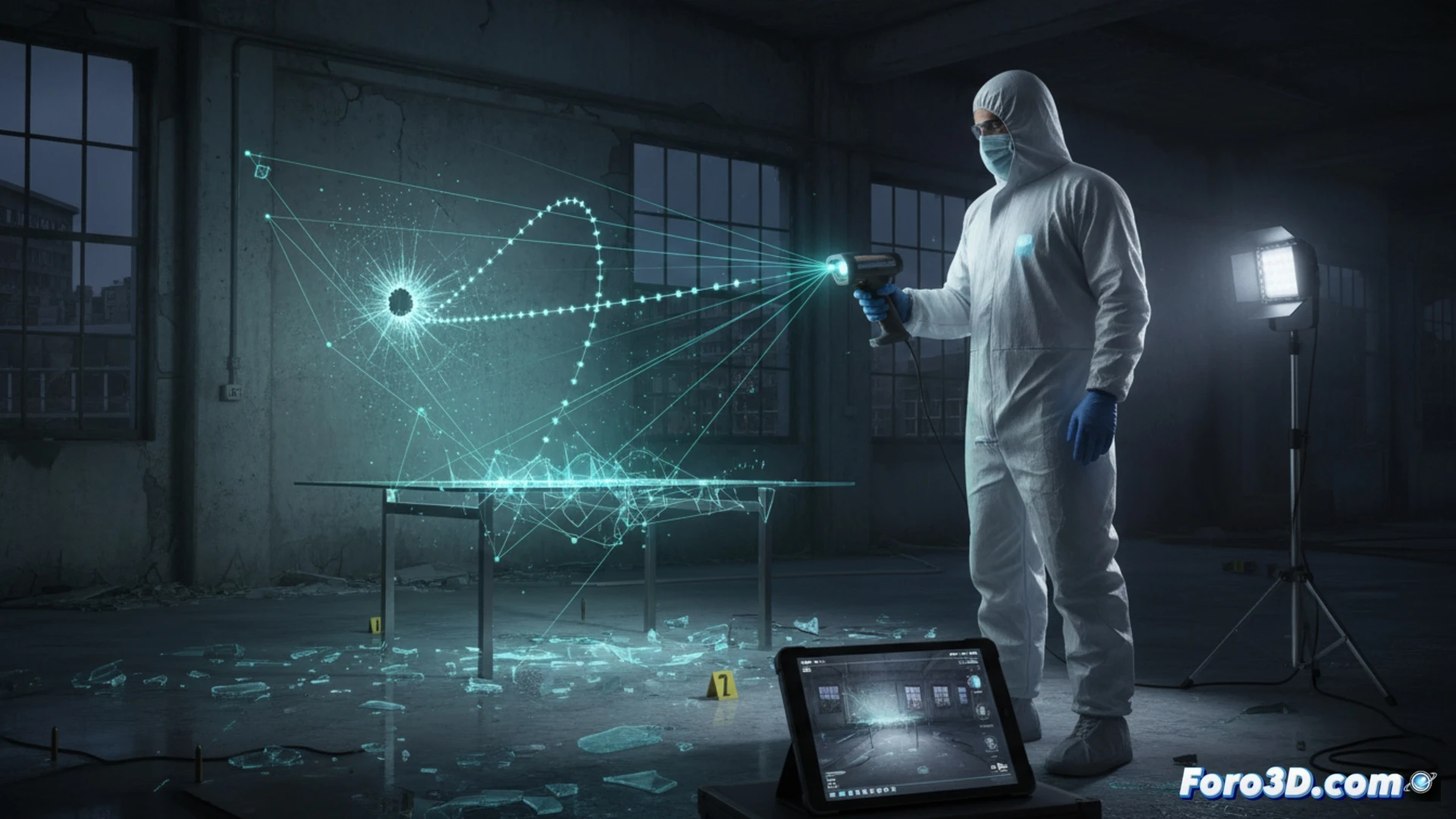
Modern criminology no longer relies solely on the magnifying glass and instinct. 3D technology allows crime scenes to be documented with millimeter precision, creating virtual reconstructions that preserve every detail for later analysis. A clear example: analyzing the trajectory of a bullet in a room without altering evidence.
Virtual reconstruction: the software that changes the rules 🖥️
Programs like FARO Scene or Leica Cyclone capture point clouds using laser scanners. With Agisoft Metashape, models are generated from photographs. Then, in Blender or 3ds Max, movements, impacts, or witness perspectives are simulated. This allows the criminologist to test hypotheses without stepping foot on the actual scene or contaminating evidence.
Sherlock Holmes is out of a job (and without his magnifying glass) 🔍
Sure, now any intern with a scanner can do in two hours what Sherlock achieved after three pipes and a monologue. The downside is that if the software crashes, the only clue will be the smoke from the computer. Good thing we still need someone to interpret those 3D models, because the machine doesn't know if the suspect lied when saying he didn't remember anything.