A team of specialists, in collaboration with Cadena SER, has completed the three-dimensional scanning of the Cristo de la Lanzada in Jaén, one of the most venerated religious images of Andalusian Holy Week. This process captures every fold of the carving, every microscopic crack, and the original polychromy with millimeter precision. The result is a digital twin that eliminates the risks of physical contact, opening a new era for the study and protection of this unique cultural heritage. 🖼️
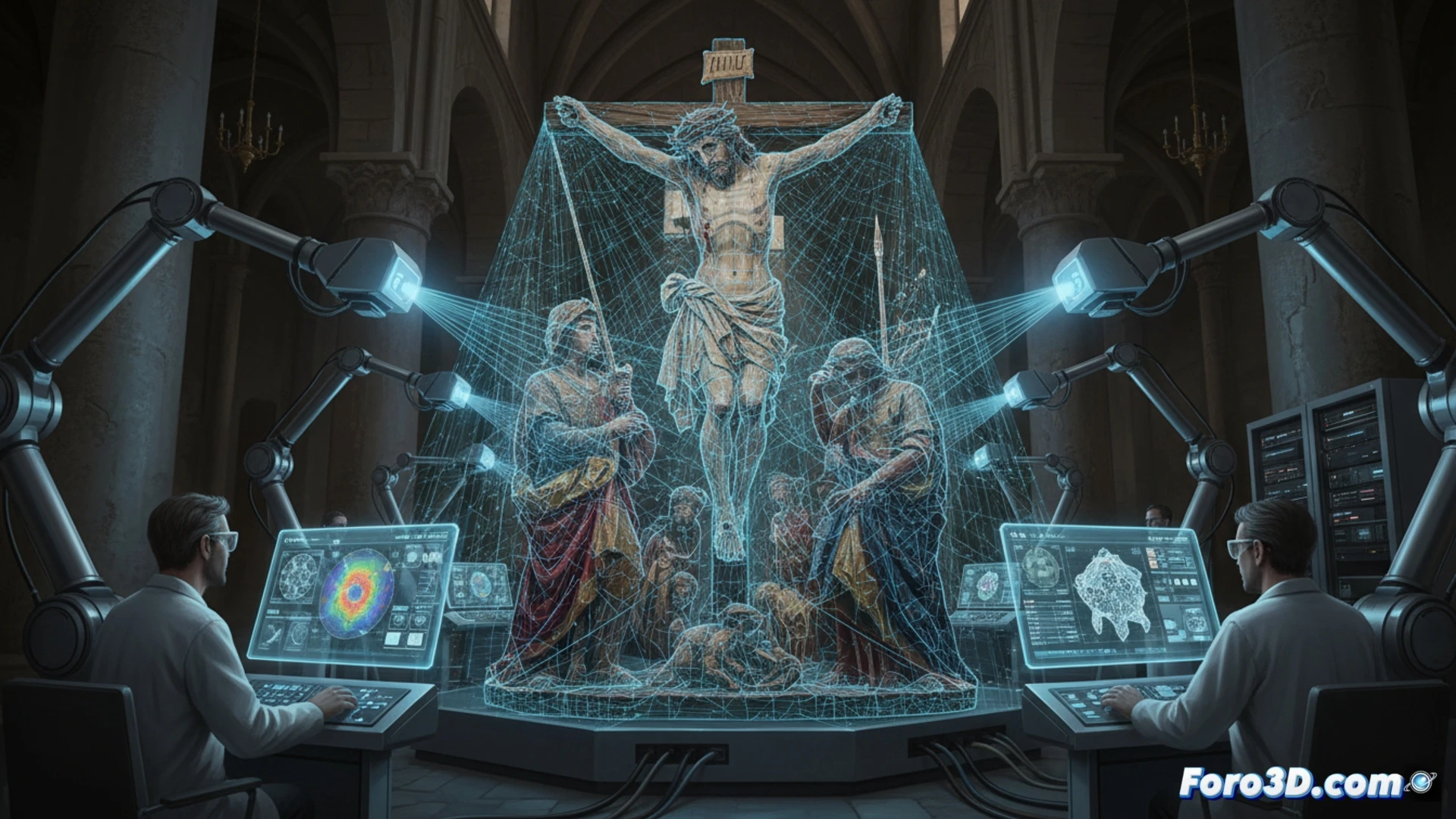
Non-invasive documentation: technical advantages of the digital twin 🔍
Conservators highlight that 3D scanning overcomes the limitations of traditional methods such as manual tracing or basic photogrammetry. While physical contact with polychrome wood can accelerate deterioration or dislodge particles from the paint layer, the laser scanner works remotely. It generates a point cloud that records textures, wear from historical handling, and chromatic alterations invisible to the human eye. This digital file allows restorers to analyze the current state of the artwork without moving it from its niche, plan surgical interventions, and monitor the evolution of pathologies such as woodworm or humidity over time.
From sacred carving to immortal archive 💾
Beyond restoration, this 3D model transforms museum outreach. Any institution can print exact replicas for tactile exhibitions or generate virtual tours that bring the artwork closer to devotees and researchers without the risk of looting. The experts consulted emphasize that this technology does not replace the restorer's craftsmanship, but rather provides an infallible roadmap. The Cristo de la Lanzada no longer depends solely on visual memory; it now exists as pure data, preserved for future generations.
What advantages does 3D scanning offer over traditional documentation methods for the restoration of sacred art pieces like the Cristo de la Lanzada?
(PS: Restoring virtually is like being a surgeon, but without blood stains.)