The digitalization of critical components such as vehicle wheels has revolutionized design and manufacturing processes in the automotive industry. Through three-dimensional scanning, engineers and designers can capture the exact geometry of tires and rims with micrometric precision. This technique allows for analyzing real wear, verifying manufacturing tolerances, and creating digital twins for advanced vehicle dynamics simulations, optimizing both safety and performance on the asphalt.
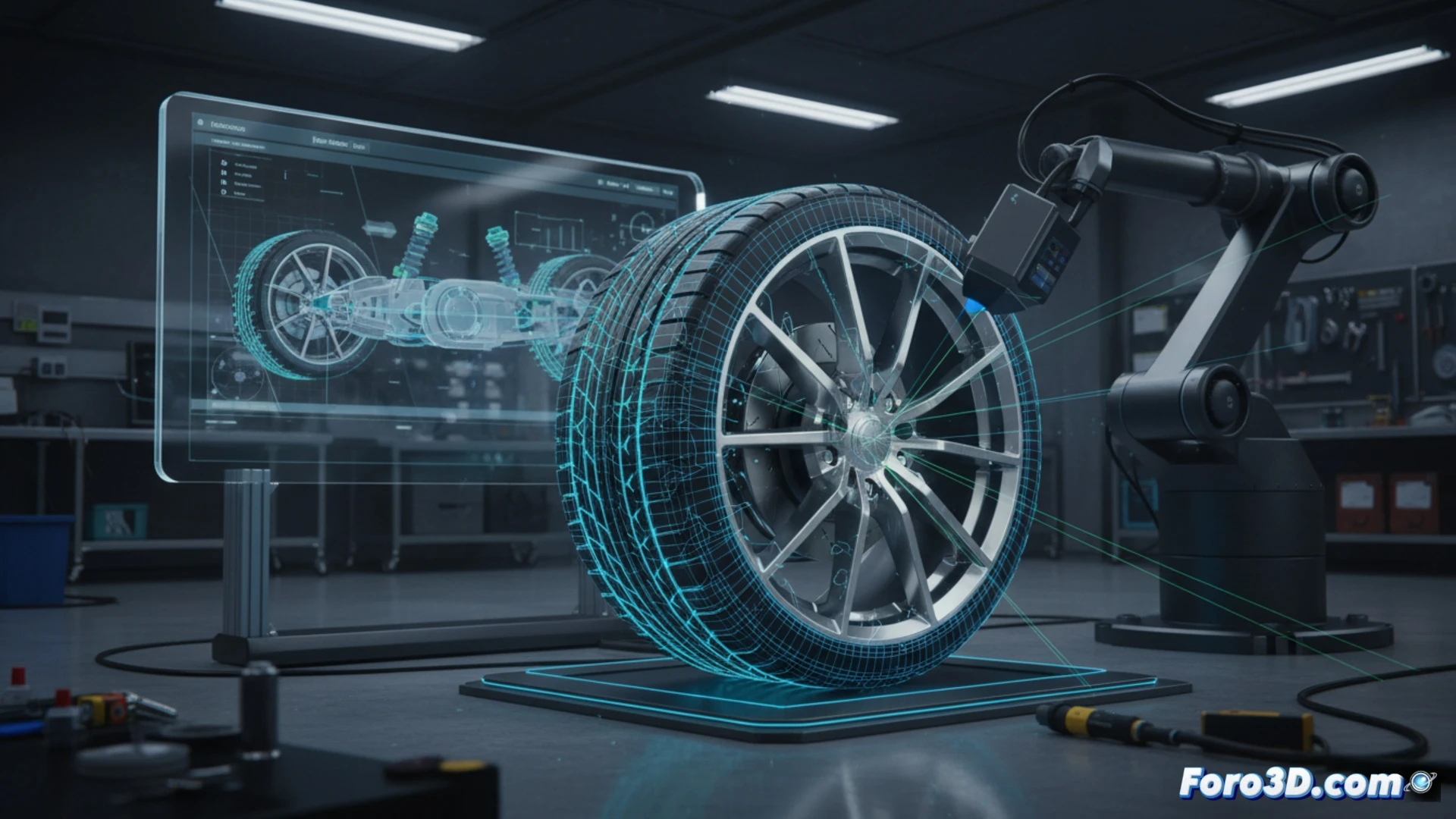
Technical Methodology of Capture and Processing 🔧
The process relies on structured light or laser triangulation scanners, capable of recording the complex surface of a wheel, including tire treads and rim details. For moving parts, synchronized rotational scanning systems are employed. The resulting point cloud is processed in specialized CAD software, where noise is removed and a high-fidelity polygonal mesh is reconstructed. This digital model enables finite element analysis (FEA) to predict deformation under load, temperature distribution during extreme braking, or the aerodynamics of the wheel-arch assembly.
The Qualitative Leap in Customization and Competition 🏎️
In the realm of competition and tuning, 3D scanning eliminates guesswork. It is no longer necessary to rely on generic specifications; a racing wheel can be scanned to design perfectly fitted aerodynamic fairings or manufacture monoblock light alloy rims with an exact fit to the vehicle's hub. The ability to measure asymmetric tire wear after a stint of laps provides critical data to adjust suspension geometry, translating into faster lap times and longer compound life.
How does the choice between structured light and laser scanning influence the accuracy of digitizing automotive wheels for competition applications?
(PS: modeling a car is easy, the hard part is making sure it doesn't turn into a cube with wheels)