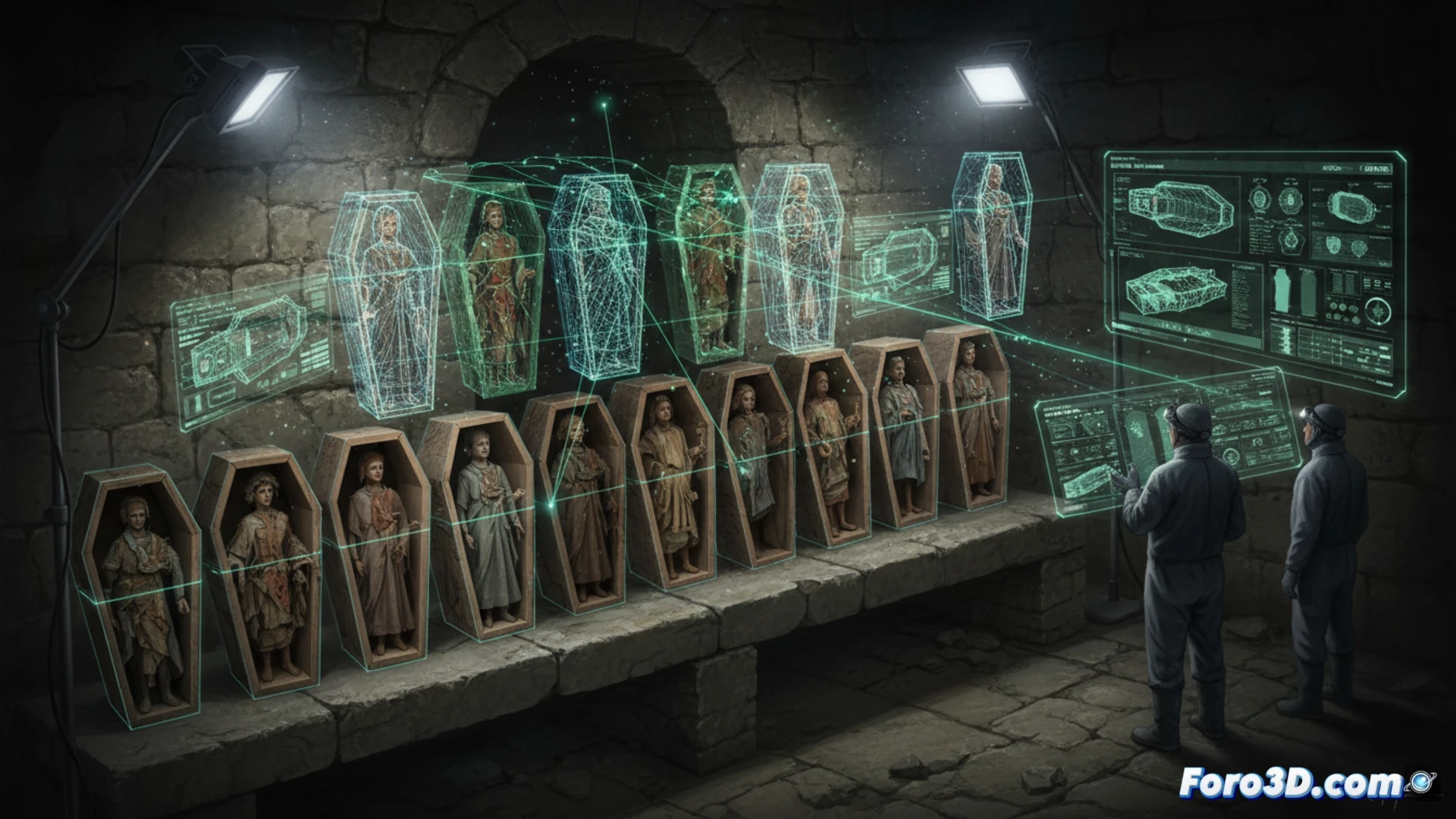
In 1836, some children discovered 17 tiny pine coffins hidden in a cave on Arthur's Seat, Edinburgh. Each contained a wooden figure dressed in cloth clothing. For nearly two centuries, their purpose has been a mystery: were they objects of witchcraft, mementos of murder victims, or symbolic funerary effigies? Now, digital archaeology allows these objects to be analyzed without touching them, applying 3D scanning techniques to preserve every detail and reconstruct their original context.
Photogrammetry and virtual preservation of the micro-coffins 🗿
The team at the National Museum of Scotland has used high-resolution photogrammetry to capture the exact geometry of the 17 pieces. This process generates point clouds that allow observation of the wood texture, fabric wear, and tool marks on the figurines, all without exposing the fragile materials to light or direct handling. The resulting 3D models have been integrated into an interactive viewer that allows measuring angles and volumes. This methodology is key to testing hypotheses: for example, by virtually aligning the figures, it is possible to simulate whether they were arranged in a specific ritual order within the cave, something impossible to verify with the current physical remains.
Resolving the past with pixels and polygons 🔍
The digitization of these coffins not only protects heritage but also opens new avenues for interpretation. By comparing the virtual reconstructions with other digitized Scottish funerary finds, such as those from the Oakbank crannog, archaeologists can look for patterns of manufacture and symbolism. 3D modeling acts as a forensic time machine, allowing researchers to run digital experiments on the arrangement of the pieces. Enigmas that once relied on speculation are now approached with precise metric data, demonstrating that current technology is the best ally for unraveling Scotland's oldest secrets.
What forensic and symbolic revelations have 3D scanning techniques provided about the small Arthur's Seat coffins that could not have been obtained through traditional study methods?
(PS: and remember: if you can't find a bone, you can always model it yourself)