In 1872, a worker discovered in New Hampshire, USA, a strange ovoid artifact known as the Winnipesaukee Stone. Carved from a material of extreme hardness, it features engravings of human faces, an ear of corn, and symbols that some interpret as constellations. The most unsettling aspect is that its carving technique and cultural origin remain a complete mystery to conventional archaeology.
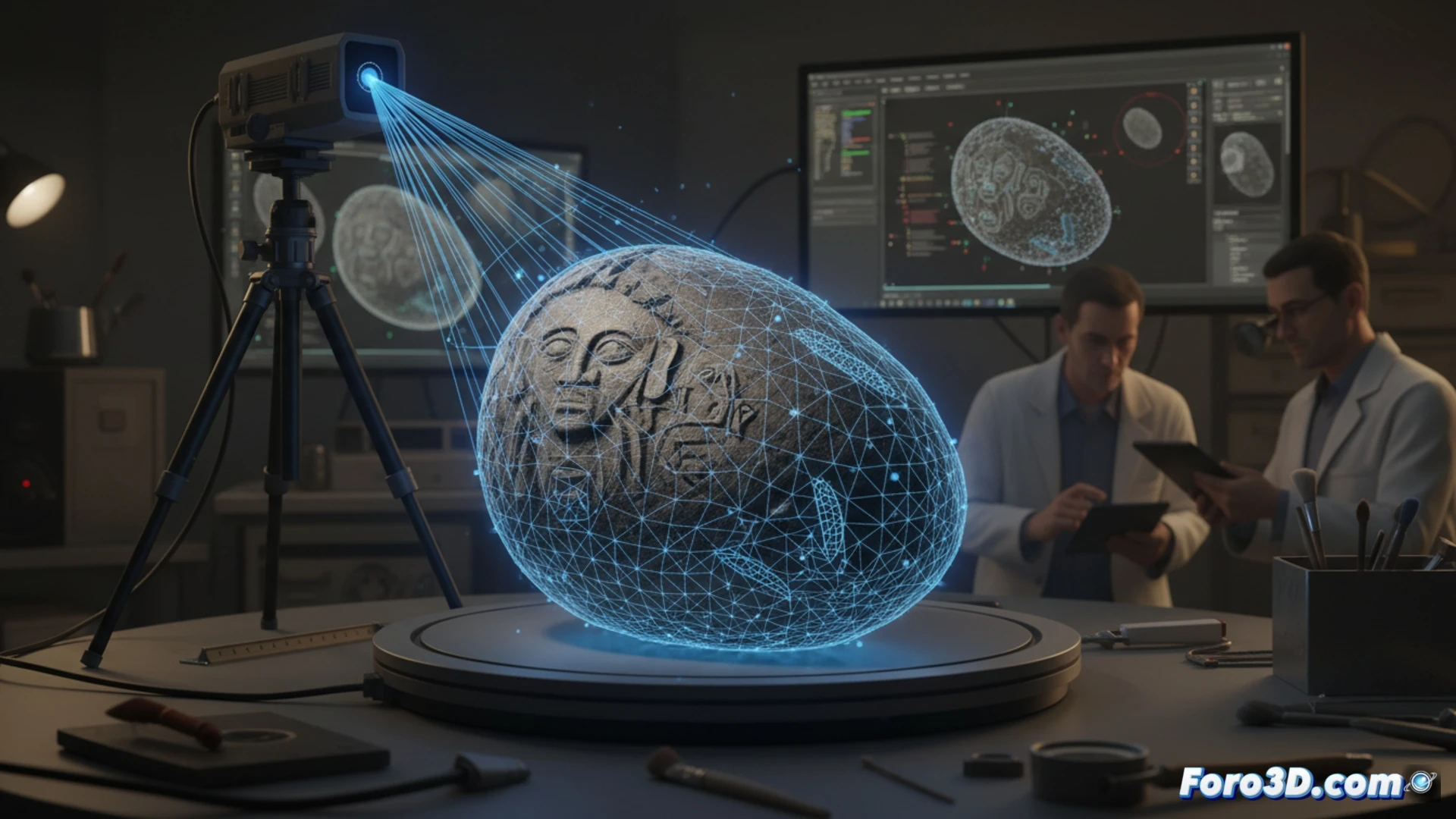
Photogrammetry and microscopic surface analysis 🔍
For digital archaeology, this object is an ideal case study. A 3D scan using high-resolution photogrammetry would capture every micron of the relief, generating a digital model that preserves the object without the need for physical handling. Subsequent analysis, using Reflectance Transformation Imaging (RTI) techniques, would reveal details of the carving striations that the human eye cannot perceive. This would allow experts to compare tool marks with those of other Native American cultures or even determine if they were made with modern technology, thus solving part of the enigma.
Reconstructing the lost context 🏛️
Beyond the analysis of the piece, 3D technology invites us to speculate about its original context. Through virtual reality, we could recreate the geological environment of the shores of Lake Winnipesaukee in 1872. A digital simulation would allow testing hypotheses about its use: was it a ceremonial stone, an astronomical marker, or a Victorian hoax? Digitization does not solve the mystery, but it offers us a virtual laboratory to experiment with the past without damaging the only physical vestige we possess.
Can high-resolution 3D scanning reveal tool marks or carving techniques that allow determining whether the Winnipesaukee Stone was created by a pre-colonial indigenous culture or is a modern forgery?
(PS: and remember: if you can't find a bone, you can always model it yourself)