Beneath the province of Zhejiang, in China, lies an archaeological mystery of colossal scale: the Longyou Caves. This complex of 24 artificial caverns, carved into soft sandstone over two millennia ago, challenges historians due to the absolute absence of written records. With no documents about their construction, purpose, or the methods employed, the site becomes a perfect canvas for digital archaeology, where 3D technology allows us to read the marks of history without disturbing the heritage. 🏛️
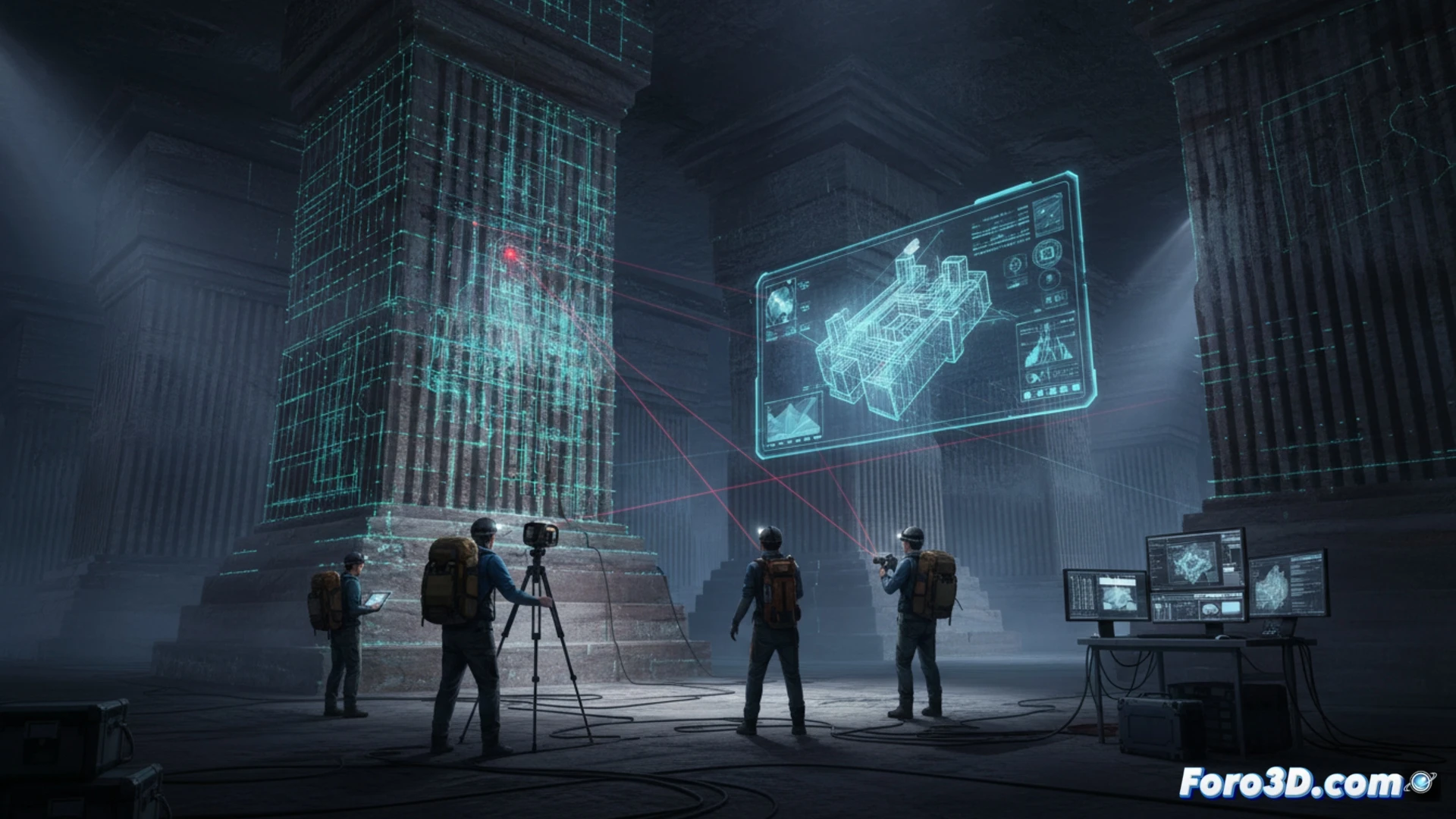
Photogrammetry and laser scanning to decipher the carving 🔍
The application of terrestrial laser scanning (TLS) and high-resolution photogrammetry techniques is key to addressing the mystery of Longyou. These methods generate point clouds and three-dimensional models that capture every millimeter of the walls, ceilings, and pillars. Digital analysis of these models allows for the identification of carving patterns impossible to see with the naked eye, such as the uniformity of cutting angles or the near-perfect symmetry of the columns. Furthermore, virtual reconstruction facilitates the study of acoustics and natural lighting, shedding light on possible ceremonial or storage uses. This non-invasive approach preserves the site's integrity while extracting critical data about the tools and labor of a civilization that left no written trace.
What does the silence of the stone hide from us? 🤔
The absence of historical records about Longyou is not a void, but a challenge to technical imagination. How did the builders of the Qin dynasty or earlier manage to extract over a million cubic meters of rock with millimeter precision, using only iron tools? The 3D model acts as a virtual time machine, allowing researchers to simulate excavation processes and test hypotheses. In the end, technology does not just document; it forces us to reformulate questions about lost knowledge and to accept that some of humanity's greatest achievements are carved in stone, waiting to be read by a scanner.
How does 3D scanning influence the reinterpretation of the construction techniques of the Longyou Caves, considering the absence of historical records about their origin?
(PS: If you dig at a site and find a USB drive, don't plug it in: it could be Roman malware.)