Last month, an incident on an autonomous platooning test track left two trucks collided after a perception failure. The onboard system detected a ghost obstacle, a non-existent entity generated by desynchronization between the front LIDAR data and the rear radar. This error caused the second truck to brake abruptly, resulting in a rear-end collision by the first truck. The case exposes a critical vulnerability in sensor fusion for autonomous convoys.
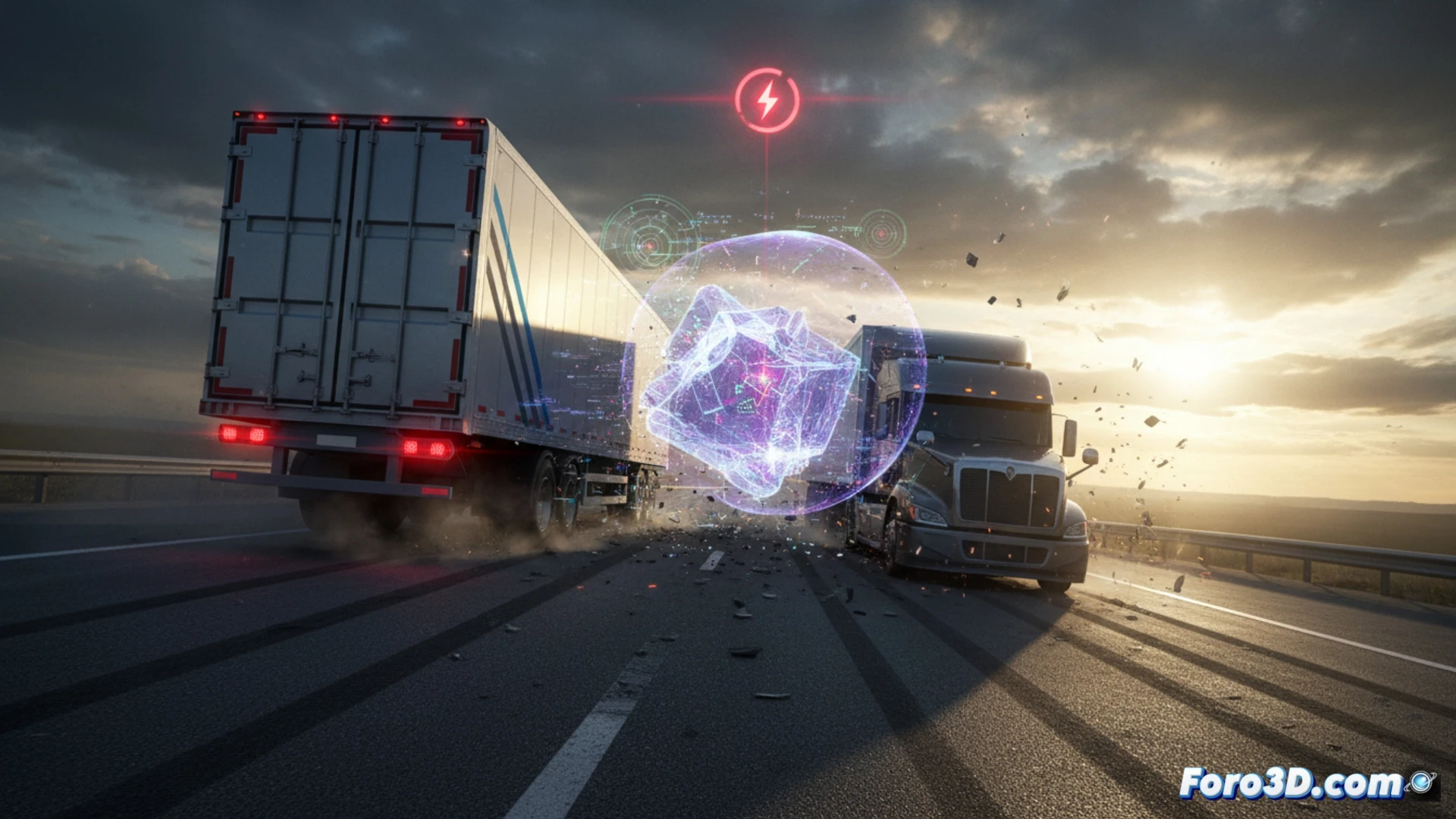
Technical analysis: temporal offset in LIDAR-Radar data fusion 🚛
In an ideal platooning system, the LIDAR scans the environment at 10 Hz while the radar operates at 20 Hz. When there is uncompensated latency in the control unit (ECU), a microwave bounce from a guardrail can be registered as a static object just before the LIDAR confirms free space. By merging both point clouds without a precise timestamp, the system interprets this residue as a real obstacle. Tools like Unreal Engine and Vissim allow reproducing this failure: the former renders the environment geometry and the ghost obstacle's trajectory, while Vissim models the reaction of surrounding traffic. CloudCompare, for its part, facilitates point cloud analysis to identify the temporal discrepancy.
Towards a more robust simulation of vehicular perception 🛠️
This incident demonstrates that ADAS system validation cannot be limited to road tests. Simulation with 3D engines and traffic software must include sensory desynchronization scenarios to train fault-tolerant fusion algorithms. Implementing a dynamic temporal buffer in the ECU, capable of aligning data by arrival order rather than fixed frequency, is a solution already being tested in virtual environments. The goal is that no ghost obstacle ever becomes a real accident again.
Is it possible that a synchronization error in V2V communication between trucks during autonomous platooning can be detected and corrected in real time using 3D sensor systems, such as multi-layer LIDAR, to avoid collisions like the one that occurred on the test track?
(PS: at Foro3D our cars have more polygons than horsepower)