A state-of-the-art tidal power plant experienced a drastic 40% drop in operational efficiency in just six months. The initial diagnosis pointed to premature blade wear. Through forensic analysis using 3D mapping and CFD simulation, the engineering team identified an erosion pattern caused by the impact of siliceous silt particles, a surface fatigue phenomenon that was destroying the turbine's aerodynamic profile.
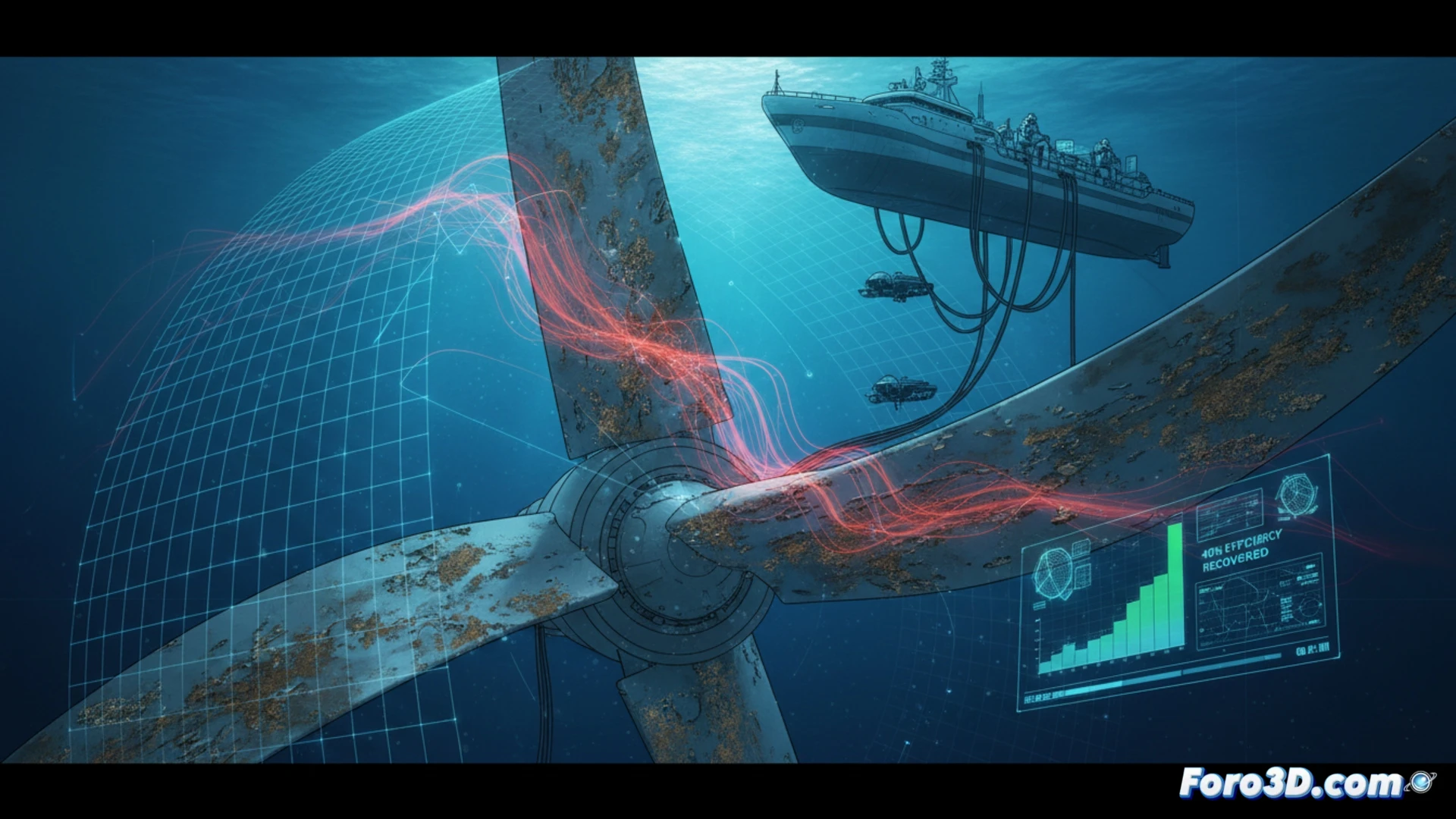
Particle fatigue analysis: from GOM scanner to Star-CCM+ 🔬
The research process began with the geometric inspection of the damaged blades using GOM Inspect. The software generated a high-density point cloud that revealed micro-craters and grooves oriented in the flow direction. This data was imported into Star-CCM+ to perform a Lagrangian multiphase simulation, modeling the silt as discrete particles. The results showed that the erosion rate was concentrated on the leading edge and pressure zone, generating roughness that altered the boundary layer and triggered friction losses. The correlation between the actual wear map from GOM and the virtual impact map from Star-CCM+ was 92%, confirming the solid impact fatigue mechanism.
Redesigning against abrasion: the lesson from Inventor ⚙️
With the validated fatigue model, the team used Autodesk Inventor to redesign the aerodynamic profile. The solution was not to harden the material, but to modify the blade curvature to deflect particles toward the center of the channel, reducing impact velocity by 35%. This approach, based on material fatigue simulation, demonstrates that a turbine's efficiency depends not only on initial hydrodynamics, but on how its geometry withstands constant sediment aggression. The new design promises to recover lost efficiency and extend the equipment's service life.
As a simulation engineer, what specific 3D mapping methodology did you apply to correlate erosion patterns with the efficiency drop and achieve a 40% recovery without replacing the entire blades?
(PS: Material fatigue is like yours after 10 hours of simulation.)