The discovery of the sea urchin Sicyocidaris sp., nicknamed the Cactus Urchin for its disproportionately long and thick spines, has shaken the marine biology community in 2024. This echinoderm, found in the depths of the Salas y Gómez Ridge, has a morphology radically different from its relatives. For scientific visualization specialists, this specimen offers a perfect canvas to explore 3D representation of extreme defensive structures and adaptations to low-light ecosystems.
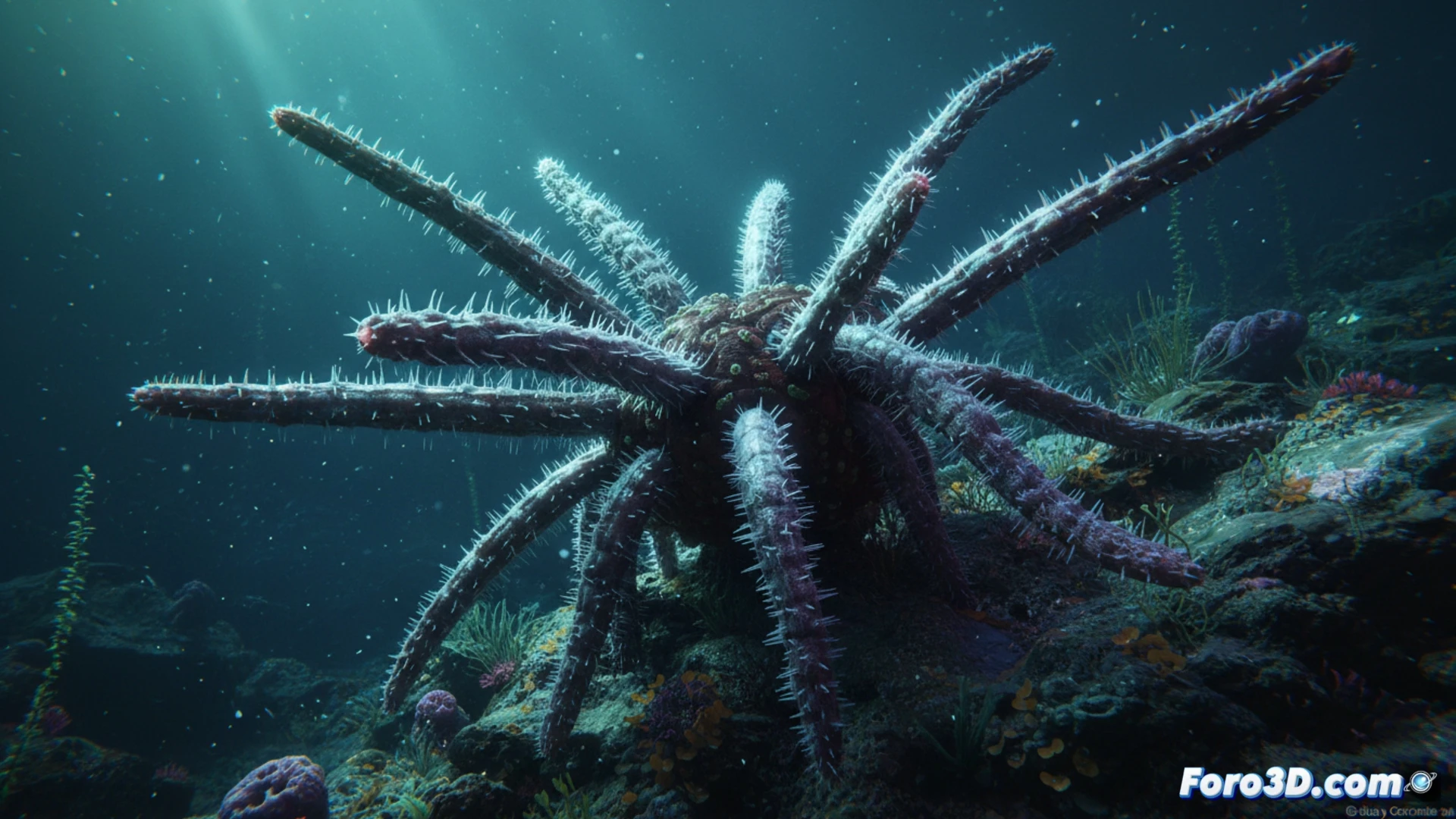
Polygonal reconstruction and morphometric analysis of Sicyocidaris sp. 🦔
The first major challenge for the 3D modeler is capturing the density and thickness of the primary spines, which resemble cactus prickles. Unlike urchins such as Diadema antillarum, whose spines are thin and hollow, those of this new species require a mesh with high-strength topology. The use of underwater photogrammetry scanning is recommended to capture the porous texture of the shell and the calcareous base of each spine. The visualization should include a cross-section of the exoskeleton to show the ambulacral system and the musculature that allows the movement of these imposing defenses. Volumetric lighting will be key to simulating the twilight of the rocky habitat at 500 meters depth.
Beyond the render: the species' value in outreach 🌊
Modeling the Cactus Urchin is not just a technical exercise; it is a tool for conservation. By creating a digital twin of Sicyocidaris sp., biologists can study its biomechanics without removing specimens from its fragile ecosystem. Animating its life cycle, from the planktonic larva to the adult with its massive spines, allows educators to explain how evolutionary pressure in an isolated submarine ridge generates such unique life forms. This 3D model thus becomes a living archive of the biodiversity of the southeastern Pacific.
How the unique spine structure of the Cactus Urchin was modeled in 3D to ensure biological accuracy and visualize its adaptive function in the Salas y Gómez ecosystem
(PS: fluid physics for simulating the ocean is like the sea: unpredictable and you always run out of RAM)