Professional illustration involves chronic exposure to biomechanical and sensory risk factors. Data from the National Institute for Occupational Safety and Health indicates that 78% of illustrators report severe visual fatigue after more than six hours in front of screens. Furthermore, the prevalence of musculoskeletal disorders in the neck and wrist reaches 62% in this population, exceeding the average for other graphic trades by 15%.
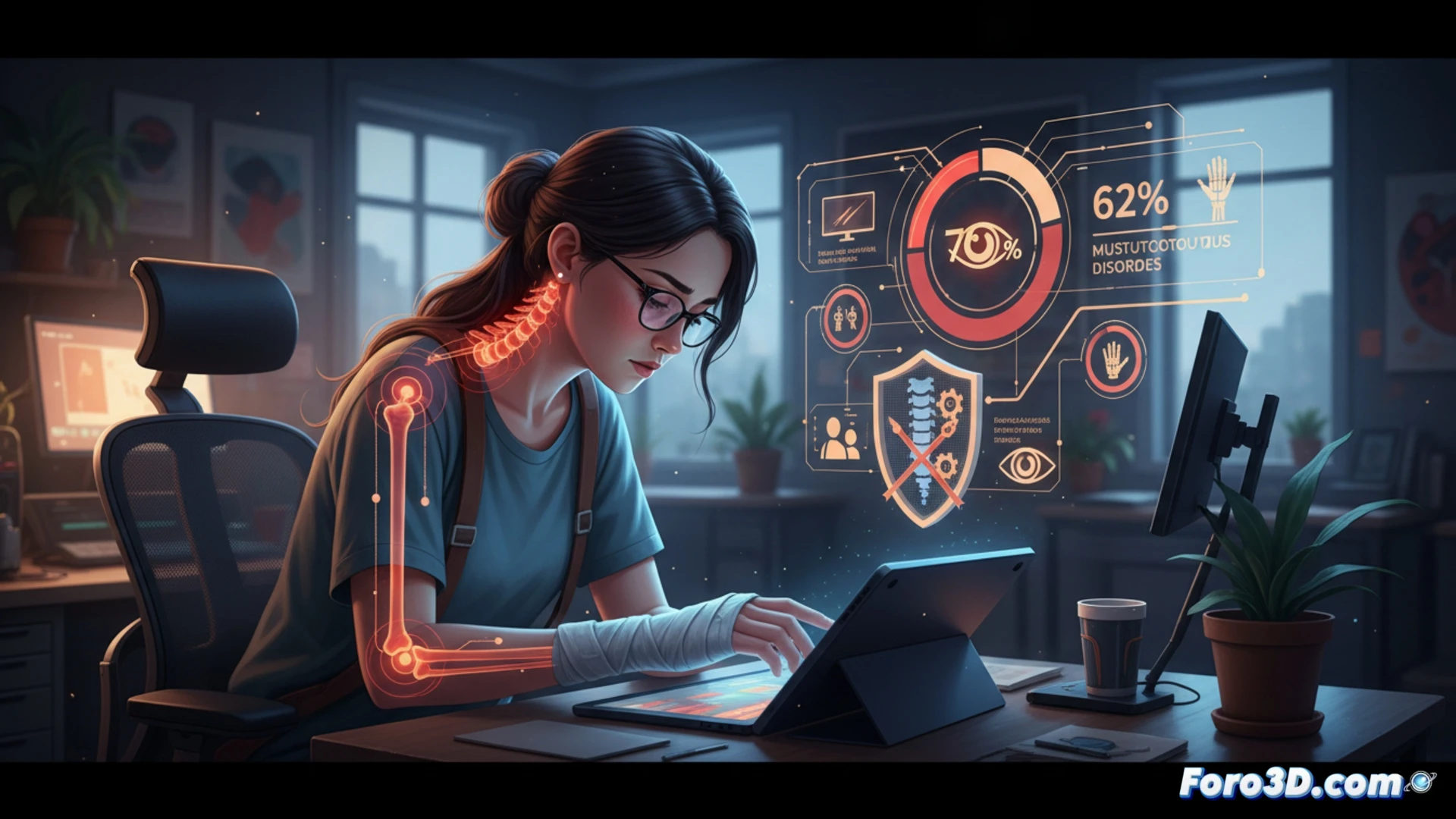
Prevalence and Anatomical Distribution of Injuries: 3D Thermal Mapping 🔥
Anatomical heat maps generated with interactive 3D models reveal a critical concentration of tension in the cervical area (C4-C7) and the carpal tunnel. Longitudinal data from the Spanish Society of Occupational Epidemiology show a 23% increase in cases of De Quervain's tenosynovitis among digital illustrators in the last five years. Postural simulations indicate that a neck tilt greater than 20 degrees for two continuous hours triples the probability of developing tension headaches and contractures. Exposure to organic solvents in traditional techniques increases the risk of peripheral neuropathy by an additional 11%.
Data-Driven Prevention: Beyond the Active Break 🛡️
Statistical evidence supports the implementation of real-time ergonomic feedback systems. The use of inertial sensors and postural analysis software reduces injury incidence by 34% at six months. Visual fatigue, the main complaint of the group, requires specific light intervention: screens with blue light filters and ambient lighting of 500 lux reduce ocular symptoms by 47%. Prevention is not just a break; it is a parametric adjustment of the work environment.
In your clinical experience or as an illustrator, which biomechanical risk factor associated with posture or repetitive movements do you consider most determinant in the development of visual musculoskeletal disorders in professional illustrators?
(PS: the 3D incidence maps look so good they almost make being sick enjoyable)