The work Enigma, by Peter Milligan and Duncan Fegredo, burst onto the scene in the 90s like a visual and narrative punch. Michael Smith, an unremarkable young man, sees the characters from his favorite childhood comic come to life to commit absurd crimes. This forced awakening leads him to question not only reality, but also his own sexuality and essence. The story is a broken mirror of the superhero genre, where Fegredo's stains and dirty lines act as catalysts for an existential crisis.
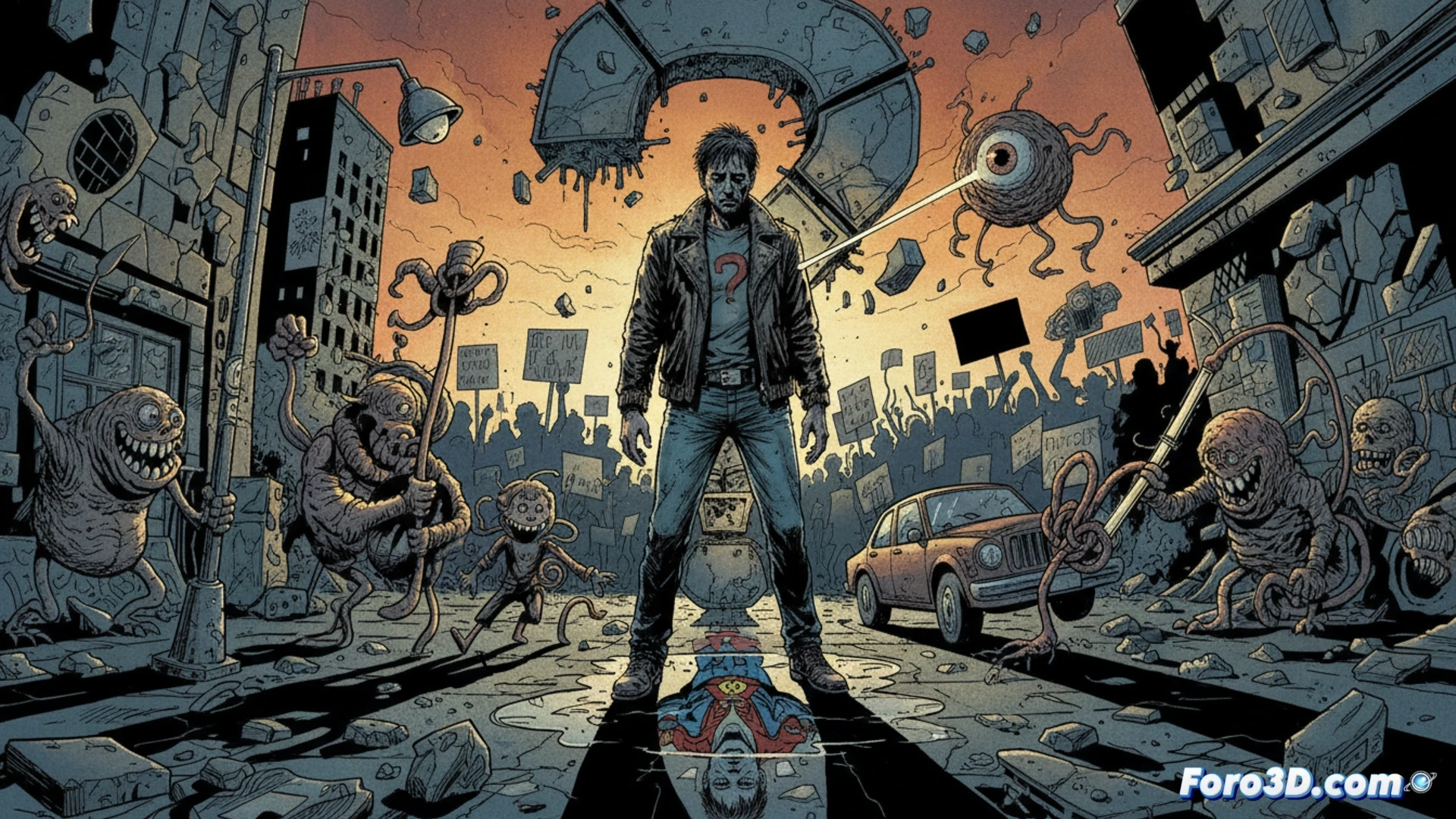
Expressionist technique and graphic chaos as a deconstructive language 🎨
Duncan Fegredo's art in Enigma is deliberately unstable. Far from clean, heroic drawing, it uses a chaotic expressionism where figures deform and backgrounds dissolve into ink stains. This dirty aesthetic is not an accident; it is a statement of intent. Visually, the comic rejects the rigidity of the superhero archetype to embrace the fluidity of identity. In the context of contemporary digital art, this approach resonates with 3D modeling techniques that seek fragmentation and imperfection, such as the use of extreme displacement maps or datamoshing to represent the dissolution of the self. The stain becomes a rebellious pixel that refuses to fit into the binary grid of the classic hero.
Queer activism and the reinvention of the hero in digital art 🏳️🌈
Enigma not only deconstructs the superhero, but openly embraces sexual ambiguity as part of its central plot. Michael discovers that his identity is as malleable as the panels surrounding him. This act of liberation directly connects with LGBTQ+ digital activism, where 3D artists use animation software and virtual reality to create non-normative bodies and dissident narratives. Just as Fegredo stains the paper, these creators deform polygonal meshes to break gender stereotypes, demonstrating that technology can be as powerful a weapon as ink for questioning who we are.
How can the fragmented narrative and deconstruction of the hero in Enigma be considered a form of digital activism in the pre-internet era, and how has this approach influenced current strategies of art and identity online?
(PS: if your virtual reality installation doesn't change the world, at least don't let it lag)