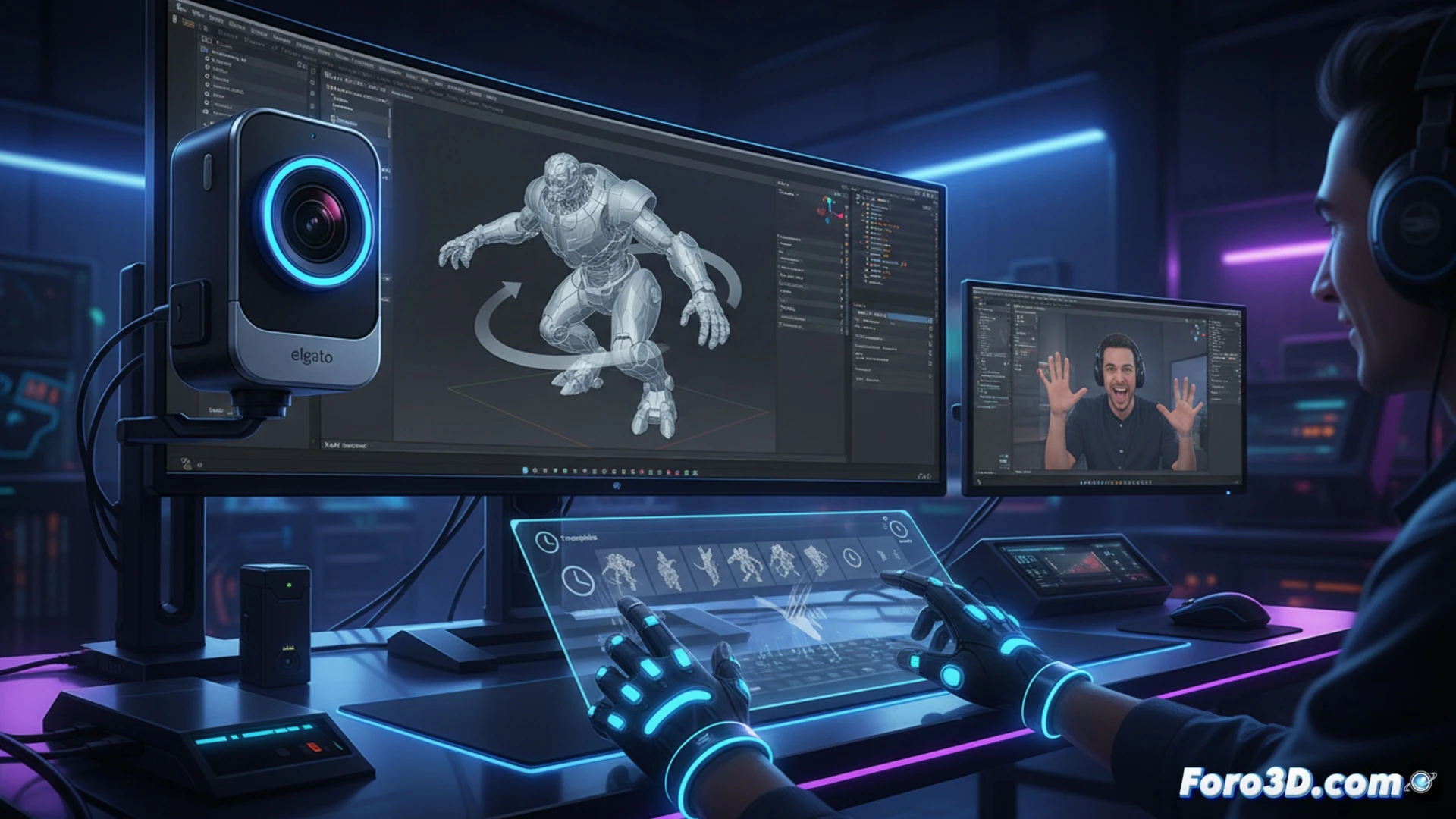
Elgato has launched the Facecam Pro, positioned as the first native webcam capable of recording video in 4K resolution at 60 frames per second. For the 3D content creator, this specification is not a luxury but a technical necessity. Capturing timelapses of complex modeling or streaming high-definition simulations requires visual fluidity that standard webcams (limited to 1080p or 30 FPS) cannot offer without compression artifacts. The Facecam Pro promises to eliminate that capture bottleneck.
Technical analysis: Latency and fidelity vs. Mirrorless 🎥
The big question for the 3D hardware user is whether this camera can replace a mirrorless like the Sony A7 or Canon EOS R in a desktop setup. The Facecam Pro uses a 1/1.8-inch STARVIS CMOS sensor with a fixed-focus lens and f/2.0 aperture. In terms of latency, the webcam wins hands down: it offers plug-and-play USB output without the need for external capture cards or HDMI converters, reducing signal latency to imperceptible levels for client video conferences. However, in color fidelity and dynamic range, a mirrorless with interchangeable lenses remains superior, especially in mixed lighting conditions. The Facecam Pro offers a neutral color profile and manual exposure control (ISO, shutter speed, white balance), allowing precise calibration to match the reference monitor, critical for real-time render demonstrations.
Integration into the 3D creator ecosystem 🖥️
For the professional working with software like Blender, Maya, or ZBrush, the Facecam Pro simplifies the setup. By not requiring complex drivers or third-party capture software, it integrates directly into OBS Studio or Discord with a single click. Its 90-degree field of view captures the entire desktop without excessive distortion, ideal for showcasing the digital sculpting process. Although it does not replace a mirrorless camera for cinematic final product shots, its consistent performance at 4K60 makes it the definitive tool for daily work streaming, eliminating the frame drops that ruin demonstrations of real-time particle or physics simulations.
Is it possible to fully leverage the 4K60 recording of the Elgato Facecam Pro in a professional 3D workflow without relying on streaming software, using only its hardware settings?
(PS: Your CPU heats up more than the Blender vs. Maya debate)