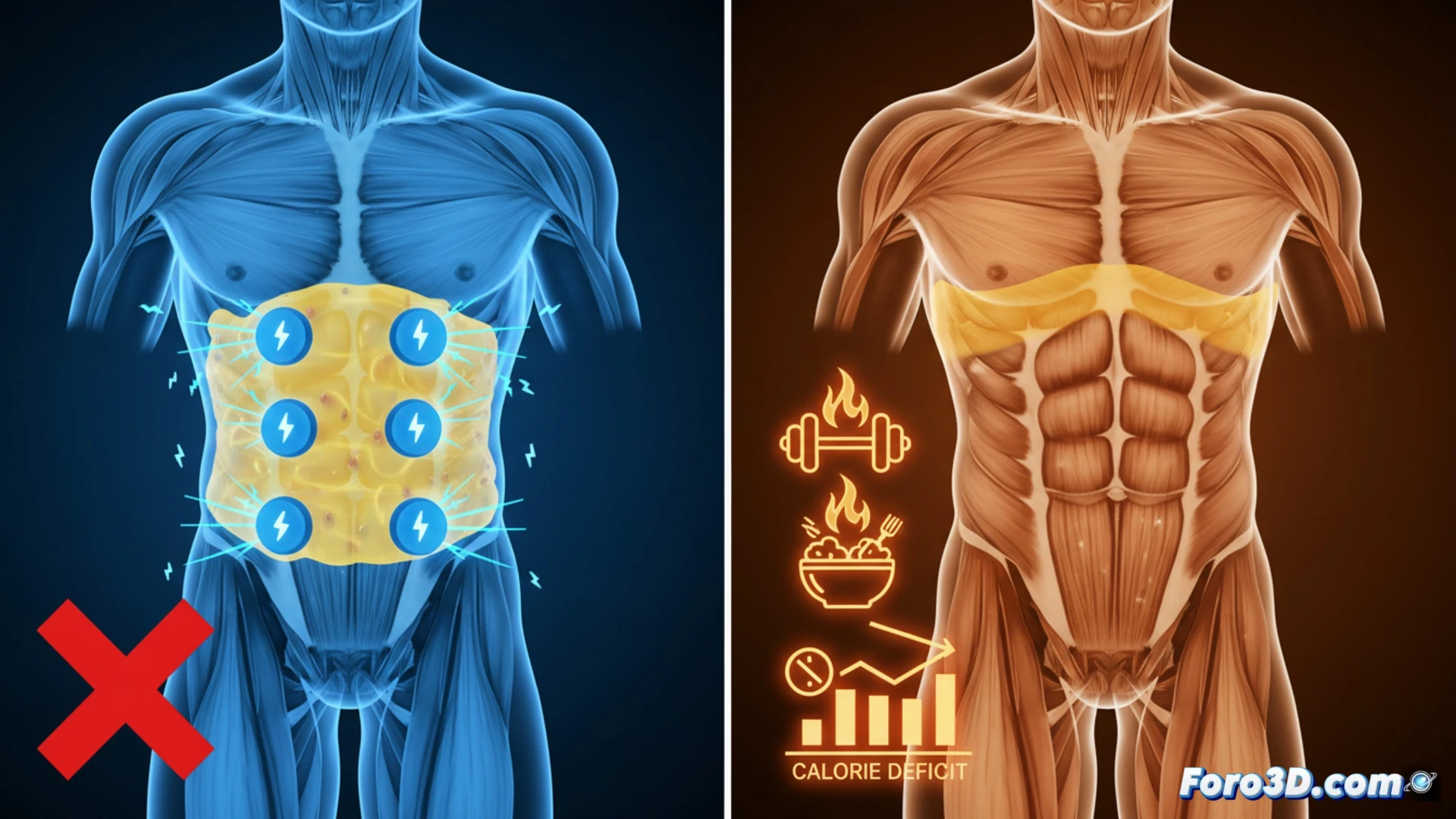
Ab-Gins device ads promise a chiseled abdomen while you rest, but metabolic reality is stubborn. Without voluntary exercise that creates a caloric deficit, the layer of subcutaneous fat covering the rectus abdominis does not mobilize. Electrical stimulation only contracts the muscle beneath the fat, it does not eliminate it. To visually educate this process, we propose an interactive 3D infographic that dissects the abdominal wall and shows the lipid barrier preventing the six-pack from being seen.
3D modeling of fat metabolism and body composition 🧬
The 3D infographic should simulate two comparative scenarios: an abdomen with a thick subcutaneous fat layer (more than 15 mm) and another after a sustained caloric deficit (less than 8 mm). The animation will show how lipolysis is only activated when the body detects a negative energy balance, a process that passive electrical stimulation does not trigger. Include a cross-section of adipose tissue where adipocytes releasing fatty acids into the bloodstream are visualized, contrasting with the metabolic inertia of rest. The model should allow the user to rotate the muscle layer and fat to understand that electrical stimulation does not burn local calories.
Visual education as an antidote to fitness marketing 🎯
This 3D representation not only debunks the deception but teaches real physiology: muscle is toned through voluntary contraction and fat is reduced through caloric deficit. By showing visceral and subcutaneous fat as a translucent layer over the muscle, the user understands that no passive device can eliminate that barrier. The infographic becomes an educational tool for nutritionists and trainers, explaining that rest does not burn calories and that the promise of zero effort is simply an optical illusion with no metabolic basis.
It is possible that abdominal electrical stimulation artificially activates muscle contraction, but if there is no caloric deficit induced by exercise and diet, how can science explain the metabolic impossibility of reducing localized fat without generating significant energy expenditure?
(PS: at Foro3D our diet is based on pixels and coffee, but at least we render vegetables)