Last October, a high-performance data center suffered an electrical fire in one of its immersion cooling racks. The losses were in the millions, but the origin of the failure was a mystery. Technicians found no evidence of overload or manufacturing defects. The solution came from the virtual world: a digital twin built with SolidWorks, Ansys Icepak, and ParaView revealed the existence of a lethal air vortex that left a processor without cooling.
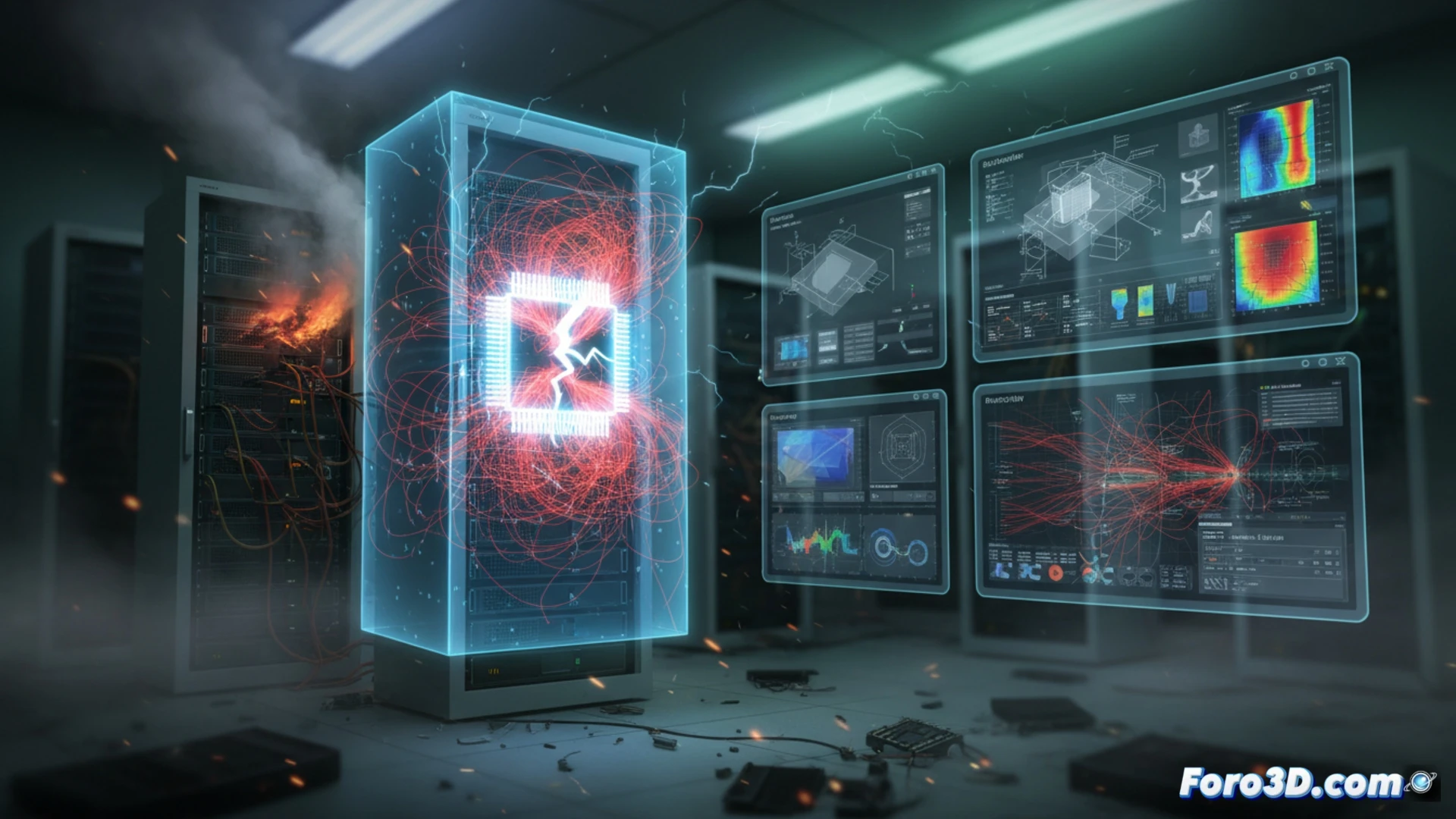
Modeling, simulation, and visualization of the thermal failure 🔥
The digital forensic engineering team replicated each submerged rack in SolidWorks, capturing the exact geometry of the heatsinks, dielectric fluid conduits, and ventilation grilles. This geometry was exported to Ansys Icepak to run a multiphysics CFD simulation. The mesh was refined in critical areas around the processors. The results showed an unexpected phenomenon: an upward hot air current, generated by a minimal pressure difference, created a stable vortex that diverted the coolant flow away from a specific chip. The temperature at that point exceeded 200 degrees Celsius in seconds, causing the substrate to ignite. ParaView allowed visualization of the streamlines and isotherms, confirming that the vortex was the root cause of the failure.
Lessons for catastrophe prevention in critical infrastructure 🛡️
This case demonstrates that digital twins are not just design tools, but essential instruments for diagnosing complex failures. The vortex was invisible to the naked eye and left no physical trace. Only the virtual replica, fed with real pressure and temperature data, could reveal the hidden fluid dynamics. For those responsible for critical infrastructure, the lesson is clear: simulating before a disaster occurs can save millions of euros and, most importantly, lives. Immersion cooling is not infallible; fluid dynamics always finds a weak point.
Considering that the digital twin was able to predict the heat vortex and smoke trajectory before the fire spread, what sensors and real-time simulation algorithms were key to detecting the critical point in the rack before traditional suppression systems failed?
(PS: don't forget to update the digital twin, or your real twin will complain)