An approach called double copy is revolutionizing the study of Hawking radiation, that faint glow that prevents black holes from being completely dark. Although the radiation is impossible to observe directly, this method connects Einstein's gravity with the standard model of particles, allowing complex calculations to be translated from one field to another to gain new perspectives.
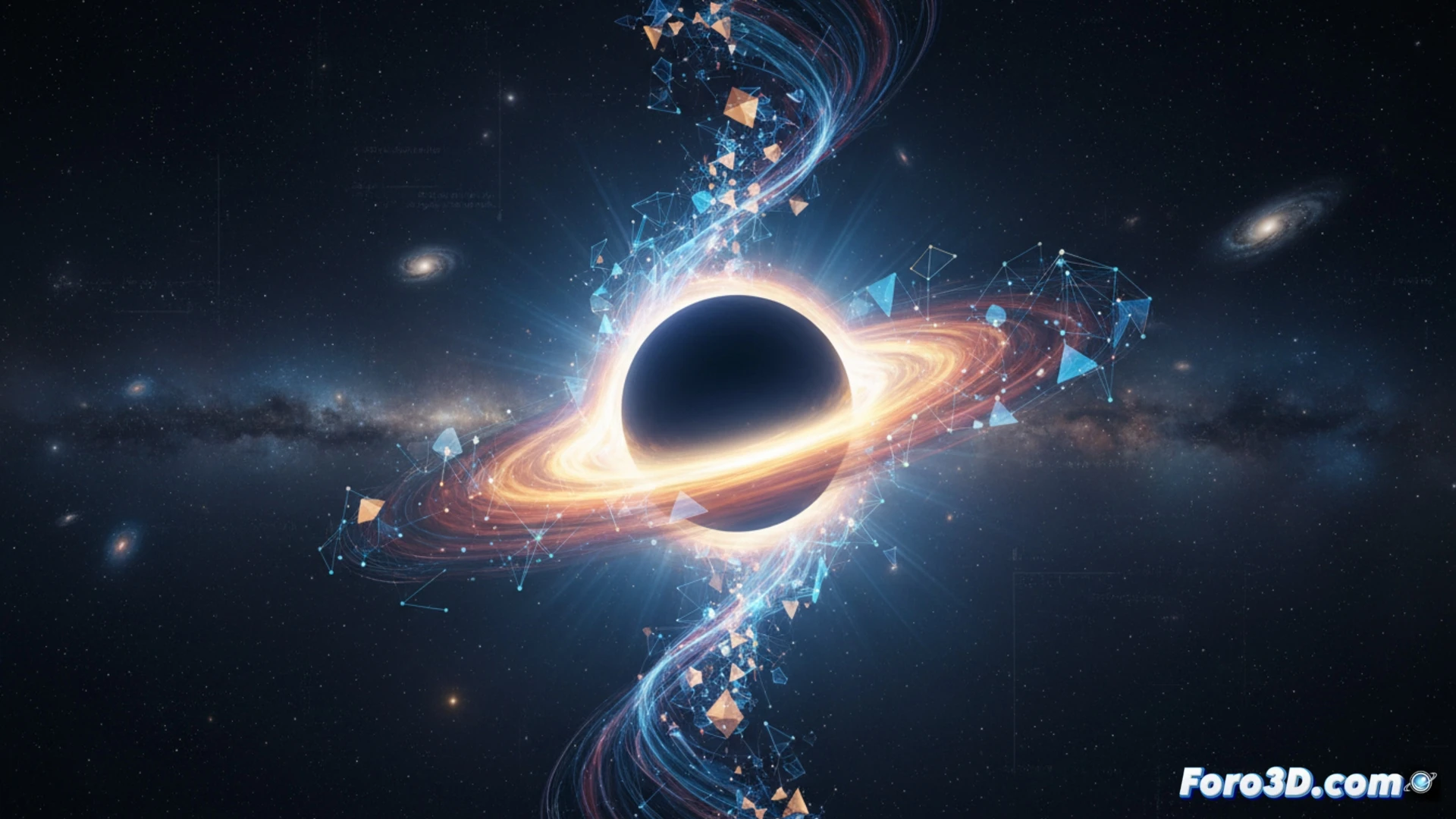
Translating gravity into the language of particles 🧬
Recently, several teams have found an analog of Hawking radiation within the standard model. The discovery occurs when studying a charged particle scattering off a spherical shell of collapsing matter. The double copy allows transforming the equations of general relativity into quantum field theory calculations, simplifying problems that were previously intractable and offering a practical tool to explore black hole physics from a theoretical laboratory.
Black holes: not so black, but just as hungry 🕳️
So it turns out that black holes are not as dark as we thought. They emit a faint glow, but don't worry, they won't light up the cosmos like a desk lamp. The mathematical trick of the double copy is like having a universal translator between gravity and particles, although for now it only serves to help physicists sleep better knowing that, in the end, the universe remains a strange place full of calculations to be done.