The disappearance of the Knights Templar treasure in 1307 is one of the great historical enigmas. Following the arrest order issued by King Philip IV of France, the immense fortune accumulated by the military order vanished, giving rise to legends that place its whereabouts in Scotland or even America. Today, digital archaeology allows us to approach this mystery from a technical perspective.
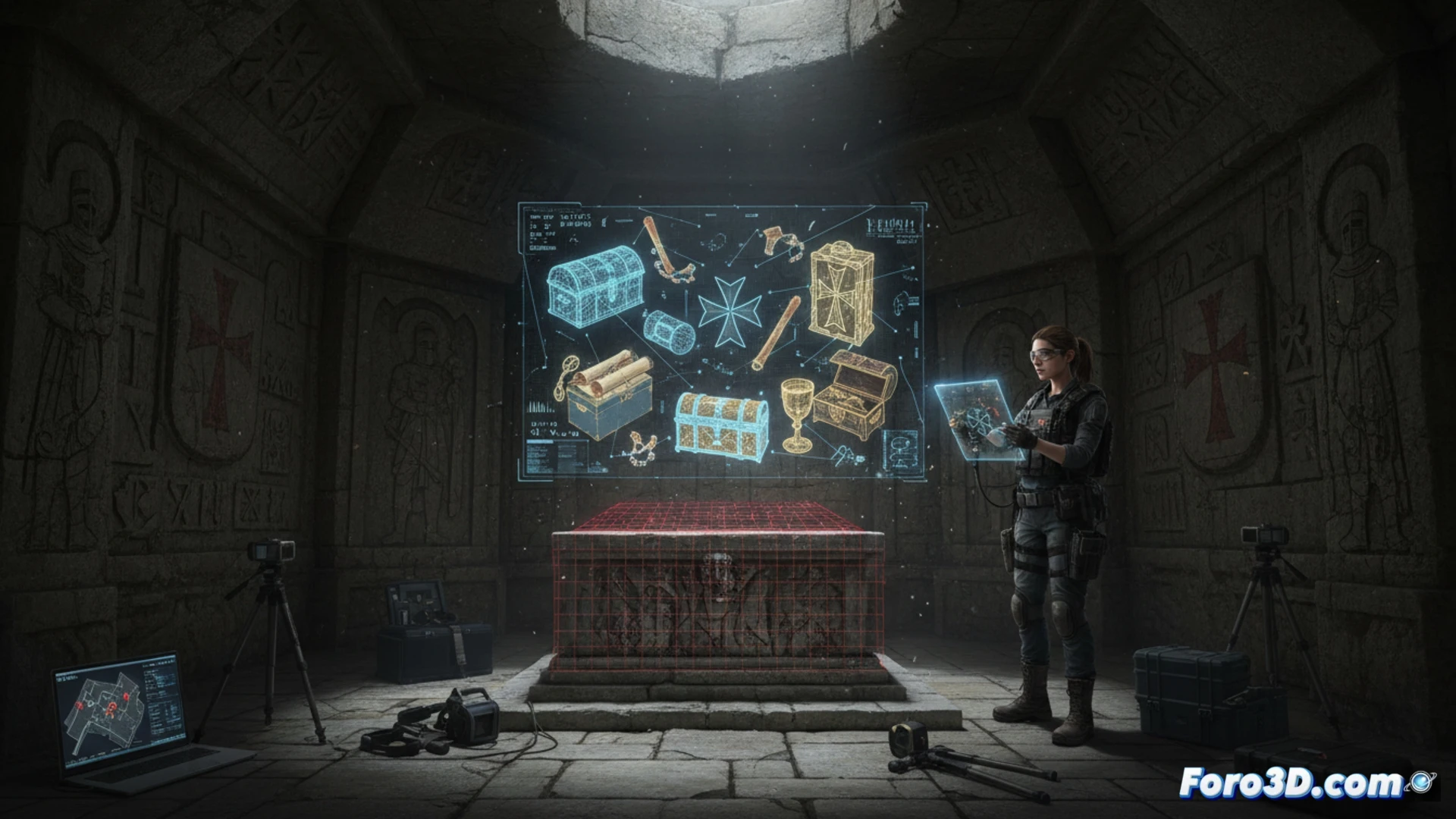
Photogrammetry and laser scanning in Templar fortresses 🏰
The application of photogrammetry and laser scanning techniques in castles such as Chinon or Tomar allows for the generation of high-resolution three-dimensional models. These digital twins facilitate the structural analysis of walls, crypts, and hidden passageways where the treasure might have been concealed. Additionally, the virtual reconstruction of escape routes, from La Rochelle to the Scottish coasts, is simulated using geographic information systems (GIS). The 3D modeling of historical documents and Templar seals also helps decipher codes and maps that could indicate the location of the ingots and relics.
Virtual reality to explore the legend 🥽
The creation of immersive virtual reality environments allows the public to tour the cellars of the Temple or Rosslyn Chapel (Scotland) as they were in 1307. These recreations, based on archaeological data, not only disseminate history but also allow for the comparison of theories regarding the transatlantic transfer. Digital archaeology does not solve the mystery, but it offers a visual laboratory where science and myth meet to preserve the memory of the order.
What 3D modeling and photogrammetry techniques are being used to digitally recreate the possible hiding places of the Templar treasure, and how do they help validate or rule out historical theories about its whereabouts.
(PS: If you dig at a site and find a USB drive, don't plug it in: it could be Roman malware.)