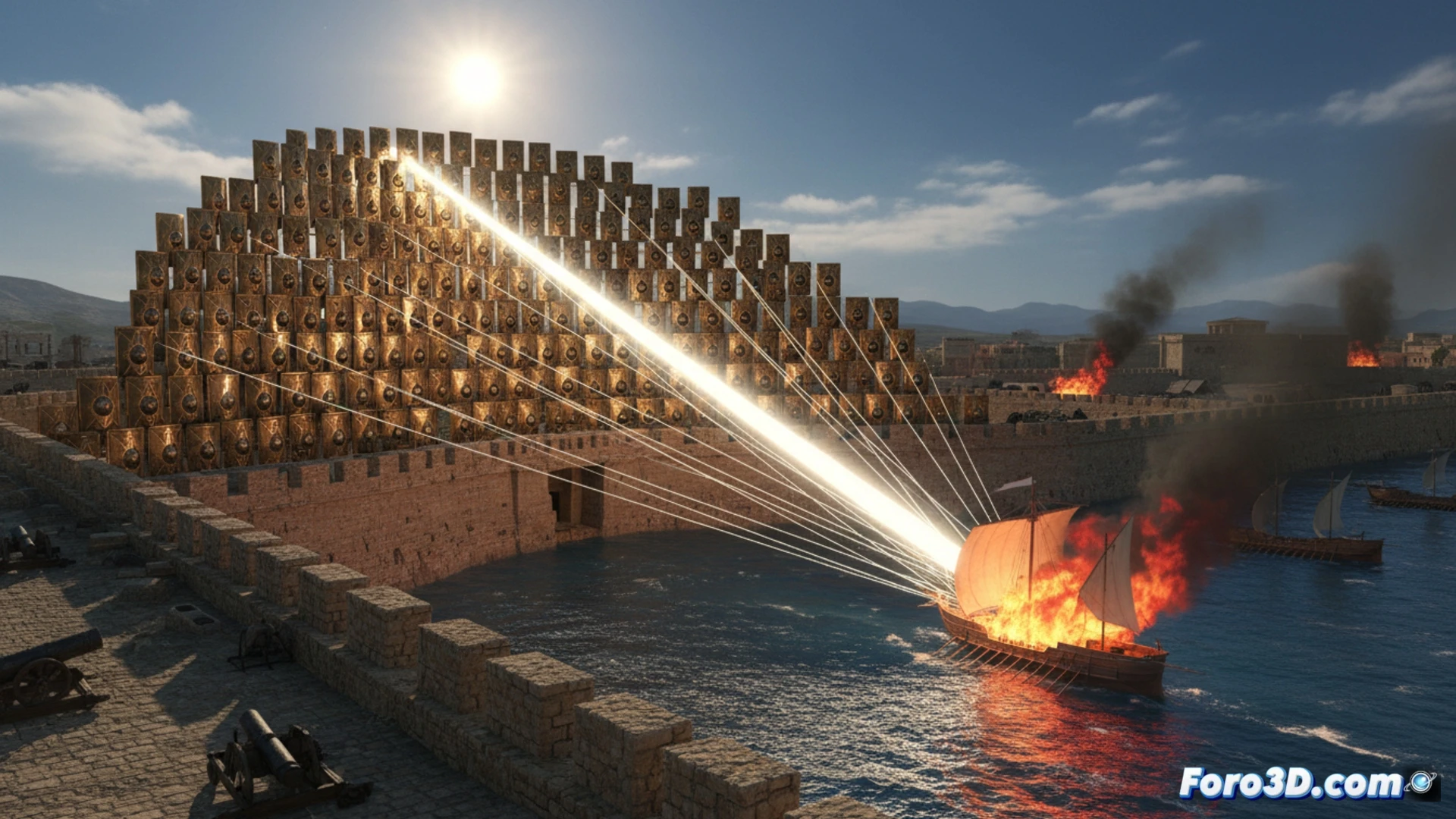
In 212 BC, the city of Syracuse resisted the Roman siege thanks to the genius of Archimedes. Among the most fascinating legends stands out the Archimedes Heat Ray, a supposed system of mirrors capable of concentrating sunlight to set enemy ships on fire. Although for centuries it was considered a fable, modern experiments at MIT have demonstrated its technical feasibility. Now, digital archaeology allows us to virtually reconstruct this artifact in 3D, simulating the exact arrangement of the mirrors and the trajectory of the sun's rays to scientifically validate one of the most enigmatic weapons of antiquity.
Parametric modeling and 3D solar optics simulation 🔥
To digitally recreate the Archimedes Heat Ray, we used parametric modeling software like Blender and optical physics simulations with ray tracing tools. The first step was to reconstruct the topography of the Bay of Syracuse and the layout of the wall where the soldiers with the mirrors would have been positioned. We estimate that between 60 and 70 polished bronze mirrors would be needed, each approximately 1.5 meters wide, arranged in a concave arc. The simulation shows that by aligning the reflectors to converge on a focal point 3 meters in diameter on a Roman ship 30 meters away, the temperature on the wood reaches 400 degrees Celsius in less than 30 seconds. This result matches the MIT experiments, where they managed to set fire to a pine wood replica under similar conditions.
3D technology as a bridge between myth and science 🧪
Beyond confirming the weapon's viability, the virtual reconstruction allows us to disseminate Syracuse's heritage in an interactive way. Any user can manipulate the 3D camera, adjust the angle of the mirrors, or change the time of day to see how the light concentration varies. This educational tool debunks the myth that Archimedes was a solitary wizard and places him as an engineer who understood geometric optics. Digital archaeology not only preserves the past but puts it to the test, transforming legends into verifiable data and bringing Hellenistic science to the 21st-century public.
Is it possible to digitally recreate the optical mechanism of the Archimedes Heat Ray based on historical texts and modern laser ray simulations, and what physical parameters would be necessary to validate its viability as a real weapon?
(PS: and remember: if you can't find a bone, you can always model it yourself)