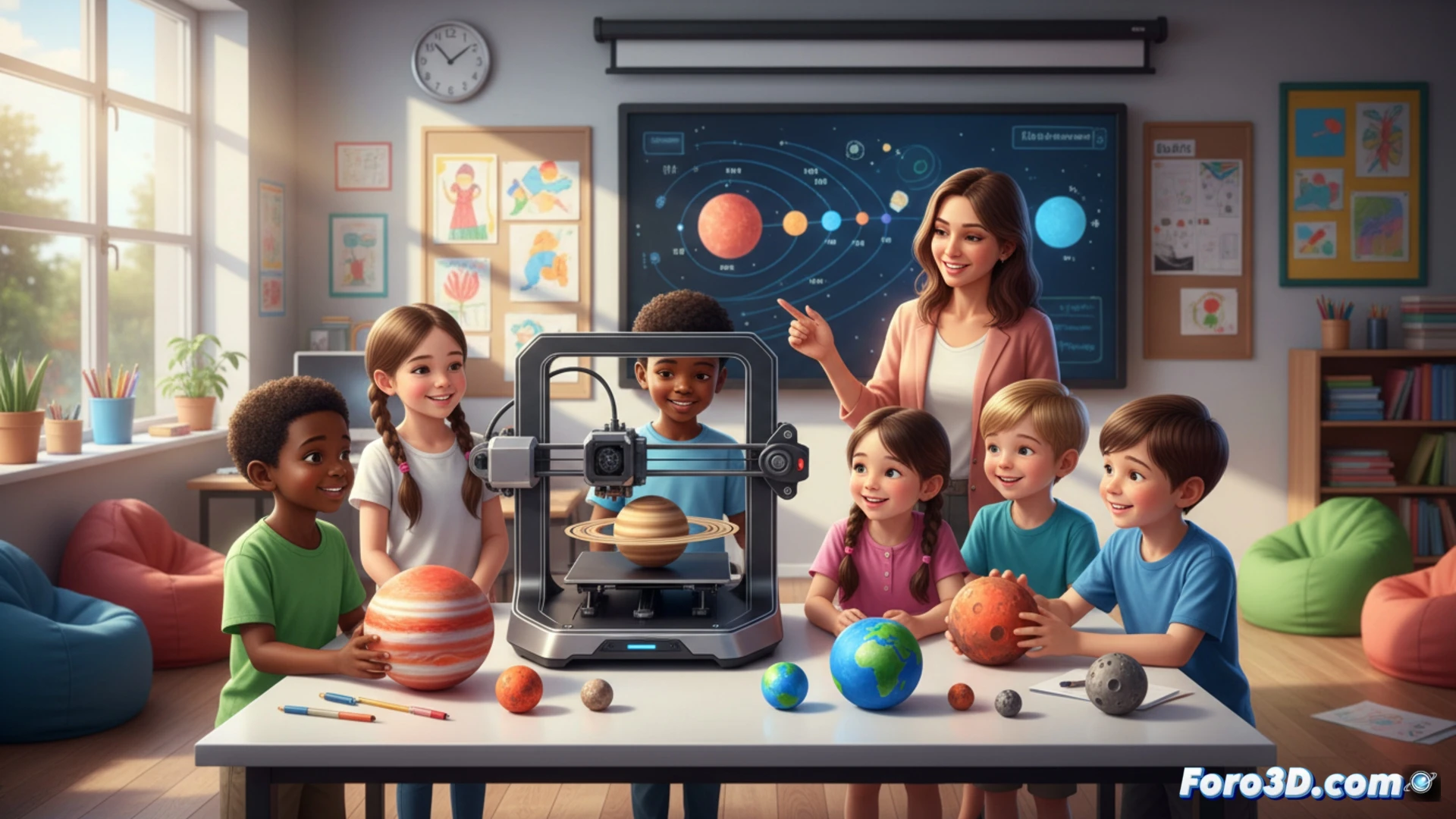
3D technology offers elementary school teachers a tangible way to explain abstract concepts. A clear example is teaching the solar system. Instead of showing flat images, the teacher can print scale planets so students can touch, compare sizes, and understand orbits. This transforms the lesson into a sensory experience that holds attention and facilitates understanding.
Basic programs to get started in the classroom 🖥️
To put this into practice, the teacher needs simple modeling software like Tinkercad, ideal for children due to its block interface. To prepare files and print them, Cura is used, a free and stable slicer. With a low-end FDM printer (like the Creality Ender 3) and PLA filament, the cost per piece is minimal. The key is to dedicate a session to designing the planets with the students, fostering collaboration and problem-solving.
When the printer decides to be a patience teacher 😅
Of course, everything is wonderful until the printer decides it doesn't want to work today. The filament gets tangled, the base detaches after five minutes, or the piece comes out looking like an alien potato. And there is the teacher, explaining to twenty eight-year-olds that technology sometimes needs a break. The good thing is that while they wait, they learn something more valuable: that perseverance is also printed layer by layer.