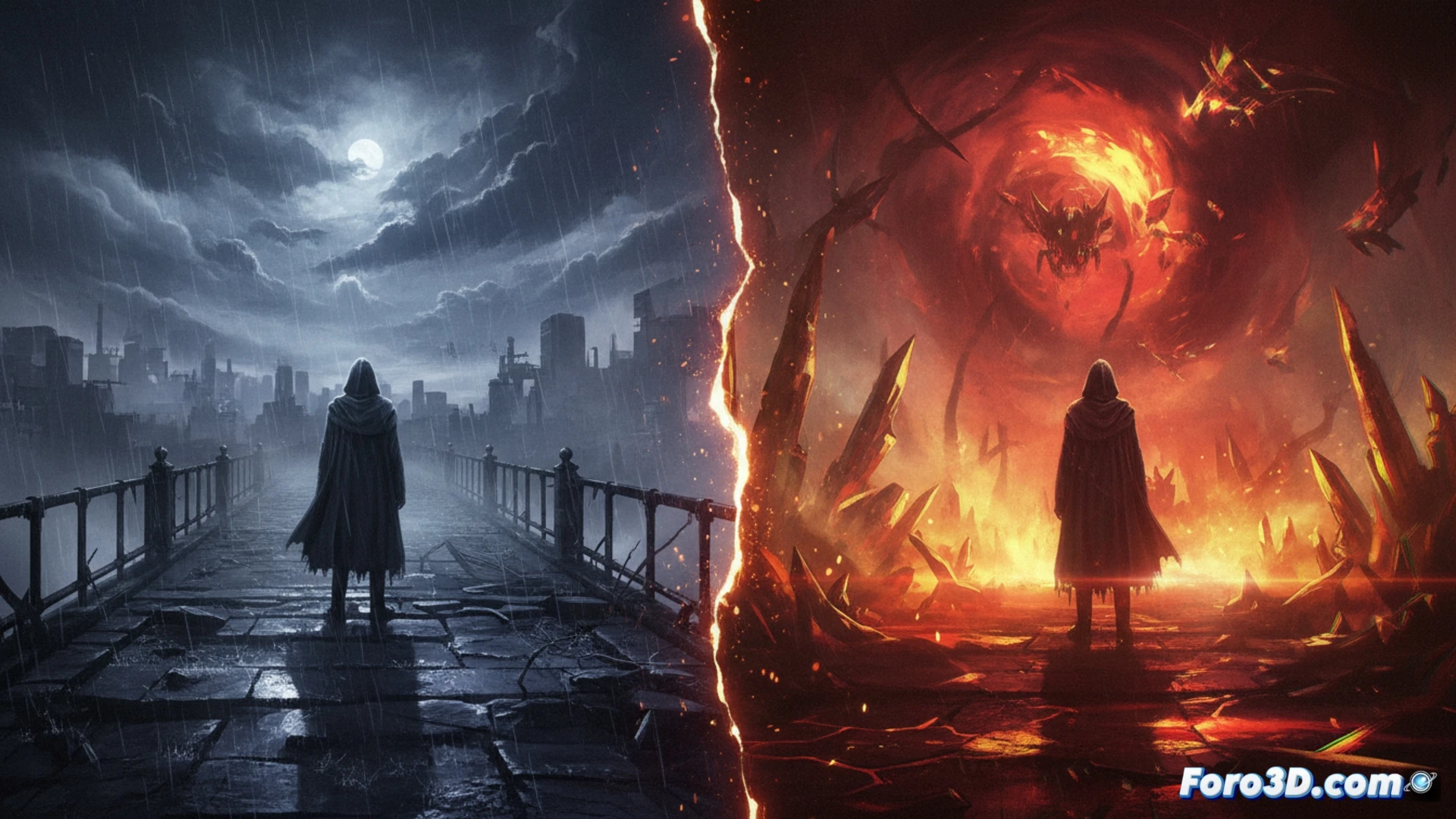
The video game Monark, developed in Unity, stands out for its ability to convey two opposing realities through the use of visual effects. The game engine allows precise control over lighting and camera, creating a strong chromatic contrast between the real world, with cold and saturated tones, and the world of madness, where reds, oranges, and a hazy distortion dominate. This approach not only defines the game's identity but also demonstrates how post-processing tools can elevate a dark anime aesthetic to a higher technical level. 🎮
Shaders, Volumetric Fog, and Chromatic Aberration in Unity 🎨
To replicate the style of Monark, developers must master Unity's Volume Profile. The key lies in the combination of three effects: Volumetric Fog, which envelops the scenarios of the world of madness, reducing visibility and creating an oppressive atmosphere; Chromatic Aberration, which distorts the edges of objects to simulate mental instability; and Color Grading, which forces the palette towards reddish and magenta tones. Additionally, using custom shaders for characters, which eliminate realistic lighting in favor of flat shadows (cel shading), is essential to maintain visual anime coherence. The transition between worlds is achieved by interpolating these values in real-time, a technique that requires optimization to avoid performance drops on consoles.
Tips for Indies Seeking a High-Contrast Visual Style 💡
If you are an indie developer aiming for a similar style, prioritize the optimization of effects. Do not apply chromatic aberration or volumetric fog to the entire scene all the time; use them as narrative tools, activating them only at key moments or in specific areas. Create two post-processing profiles (one for the real world and one for the altered world) and use a simple Lerp script to transition between them when entering certain colliders. Finally, limit your color palette to a maximum of 5 or 6 tones per world; the contrast in Monark comes not from the number of colors, but from the extreme saturation and brightness of the few that are used.
How the post-processing effects in Unity were configured to achieve the visual transition between the two opposing realities of Monark without losing real-time performance
(PS: a game developer is someone who spends 1000 hours making a game that people complete in 2)