Team Ninja has demonstrated with Stranger of Paradise: Final Fantasy Origin that dark fantasy and frenetic action can coexist in an optimized proprietary engine. This title, far from being a simple spin-off, represents a major technical challenge: achieving real-time crystallization effects on enemies and environments while maintaining a stable frame rate on last-generation consoles. We analyze how the studio combined its internal engine, Maya, and Substance Painter to achieve this.
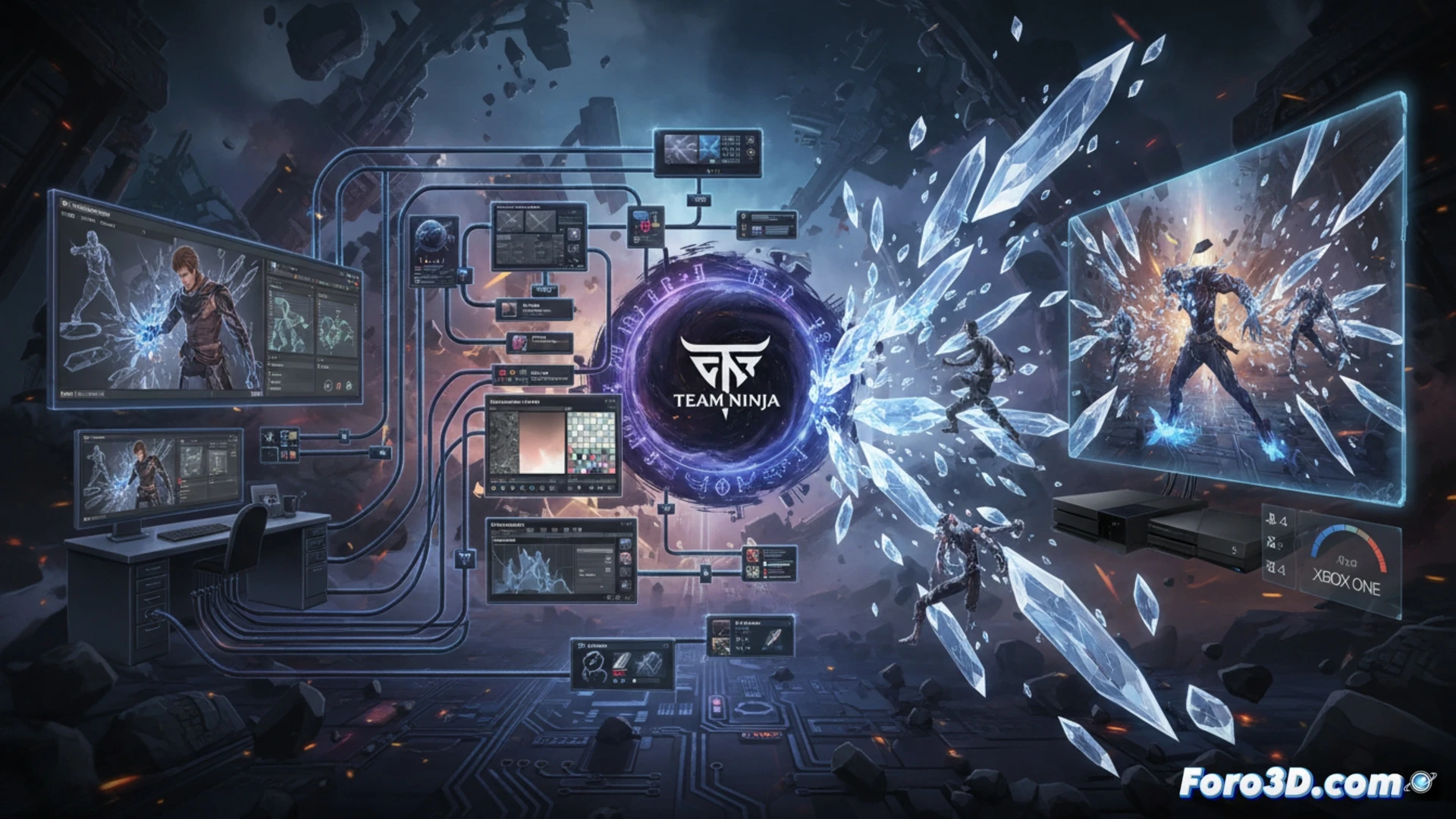
Proprietary Engine and Crystallization Shaders 🎮
The Team Ninja Engine, known for its performance in titles like Nioh, had to be adapted to support a new material system based on refraction and dispersion. Crystallized enemies are not simple textures; each fragment is a 3D asset modeled in Maya with specific polygonal geometry to dynamically reflect light. The texturing pipeline in Substance Painter was crucial for simulating glassy and broken surfaces, using height masks and roughness channels that the engine interprets in real time. Optimization was achieved by limiting the number of visible fragments per scene and using aggressive LODs for crystals in the background.
The Art of Visual Degradation 🎨
Beyond technology, the art team made key decisions for aesthetic coherence. The decision for the crystals to be a dark purple color, instead of the classic Final Fantasy blue, responds to an art direction design that seeks to reinforce the feeling of corruption and chaos. This approach demonstrates that a well-tuned proprietary engine, combined with standard industry tools like Maya and Substance Painter, can produce unique visual results without relying on generic middleware solutions, as long as there is a clear vision of the dark fantasy to be conveyed.
How does Team Ninja manage to maintain a stable framerate during transitions between pre-rendered cinematics and real-time gameplay in Stranger of Paradise without sacrificing the visual quality of particle effects and dynamic lighting?
(PS: optimizing for mobile is like trying to fit an elephant into a Mini Cooper)