The recent announcement of Tales of the Shire: A The Lord of the Rings Game has captured the attention of indie developers for its promising illustrated book aesthetic. With a Unity engine as its foundation and a workflow supported by Blender and Adobe Photoshop, the title presents a fascinating case study on how to achieve visual warmth and organic detail in real-time. We analyze the technical keys behind this adaptation of the hobbit universe. 📖
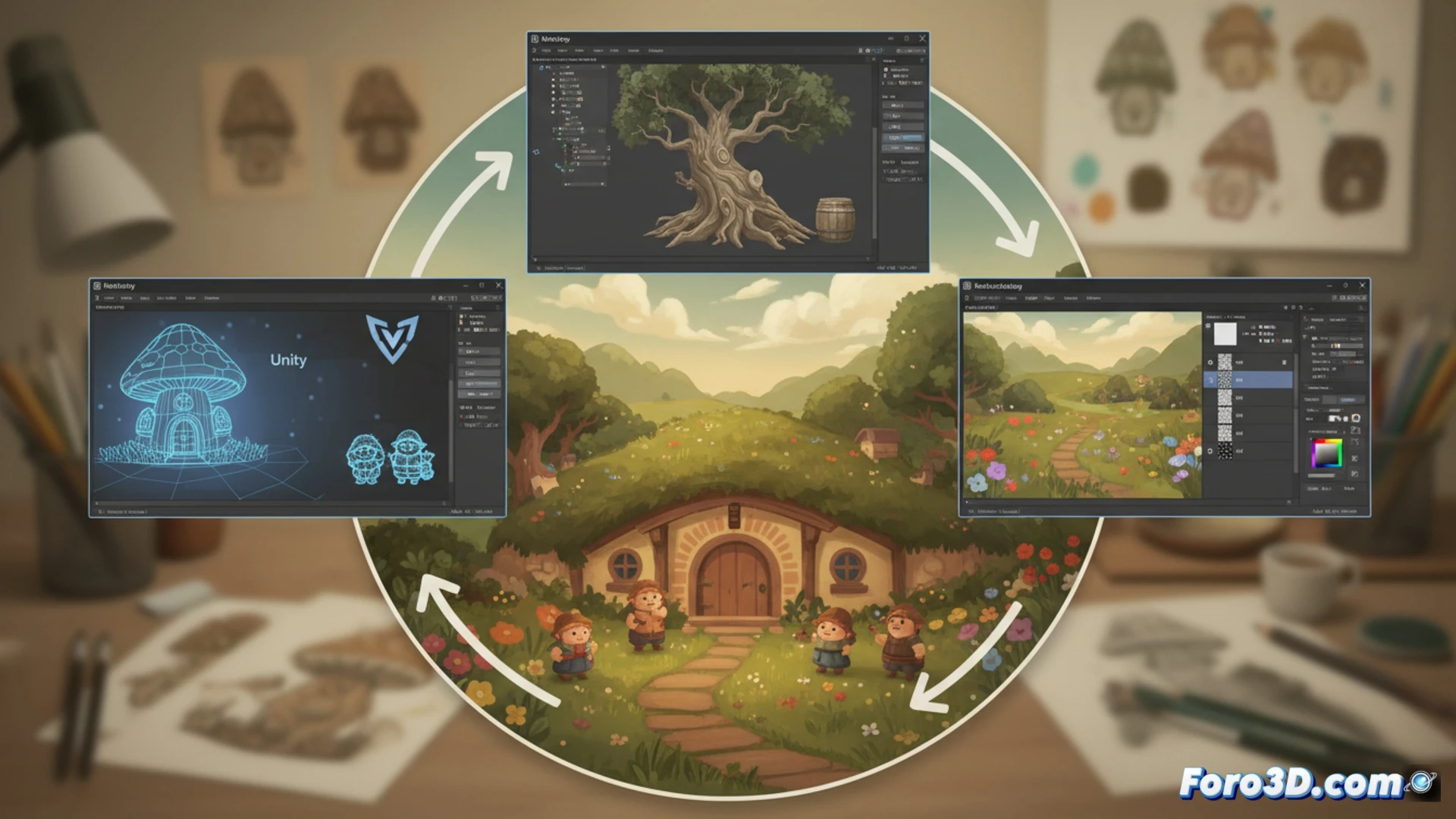
Asset optimization and vegetation modeling in Blender 🌿
To achieve the saturation and warmth of the Shire, the team has likely used Blender for high-resolution modeling of vegetation and hobbit architecture. The key lies in the retopology of these assets for Unity, reducing the polygon count without losing the pictorial character. The interiors, with their warm lighting, require hand-painted textures in Photoshop, applying normal maps generated from Blender to simulate the relief of wood and stone. Detailed vegetation, such as hedges and apple trees, benefits from using leaves with double-sided shaders and a system of LODs (levels of detail) to maintain stable performance on consoles and PC.
Lighting and post-processing for the book aesthetic 🪔
The biggest technical challenge lies in replicating the lighting of an illustrated story within Unity. To achieve this, a combination of soft directional lights with high-quality shadows and intensive use of light probes to illuminate the cozy corners of hobbit houses is employed. Post-processing is essential: a warm color profile, soft bloom, and vignetting help emulate the matte finish of a book. This technique, accessible to small studios, demonstrates that an AAA engine is not needed to generate worlds with great artistic personality if the Blender and Photoshop pipeline is mastered.
As an indie developer, what specific technical recommendations would you give to those seeking to replicate with Blender and Photoshop the artistic style of Tales of the Shire to optimize the pipeline towards Unity without losing the essence of Middle-earth?
(PS: 90% of development time is polishing, the other 90% is fixing bugs)