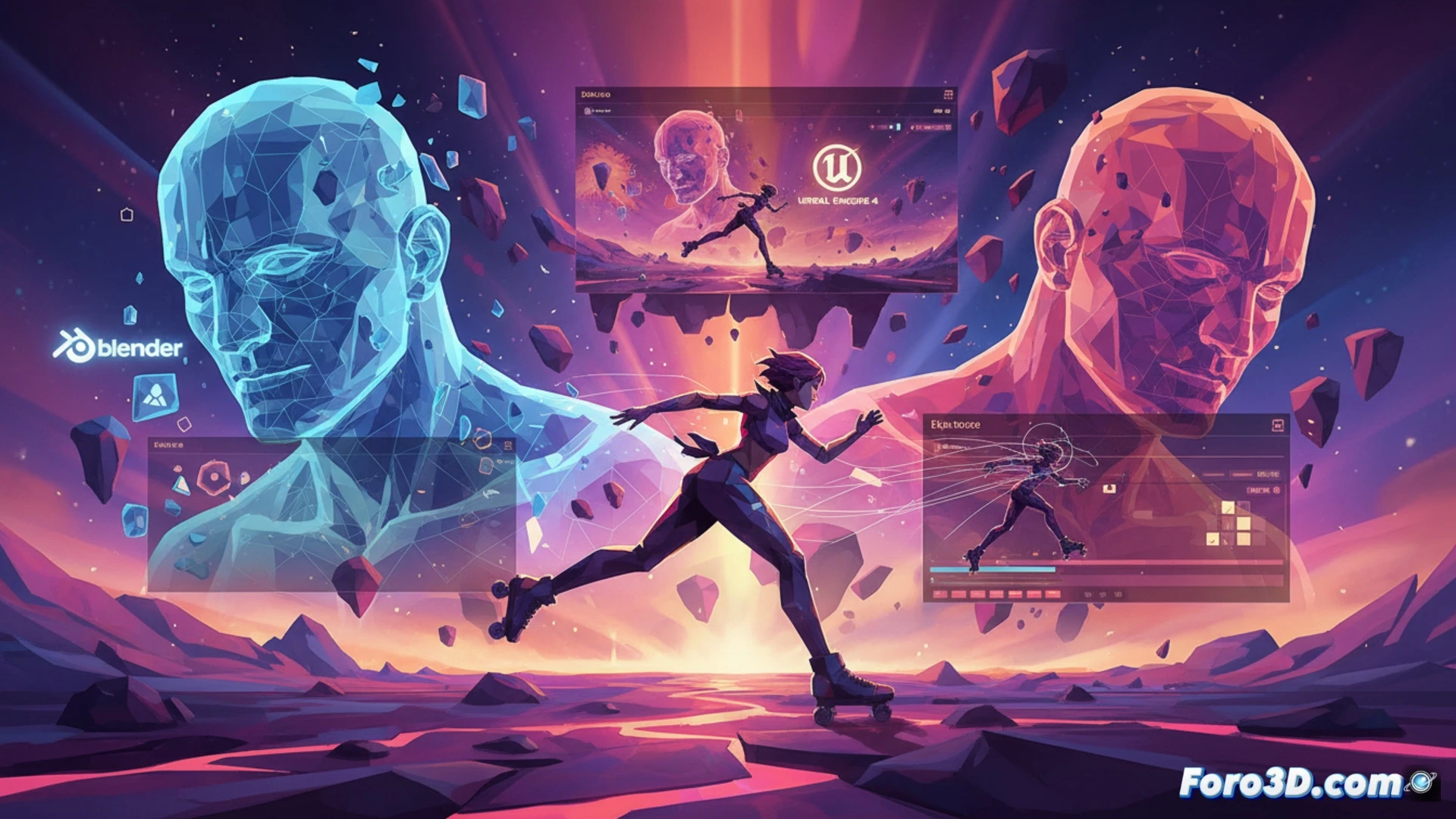
Solar Ash, developed by Heart Machine, is not only a visual feast but also a case study on how to integrate disparate tools to achieve a unique identity. The game uses Unreal Engine 4 as its foundation, but its magic lies in the workflow between Blender, used to sculpt the low-poly colossi, and Maya, responsible for the skating animations that define the protagonist's fluidity. This article breaks down the technical and artistic process behind its dreamlike aesthetic.
Optimizing low-poly assets for real-time in Unreal Engine 4 🎮
The stylized low-poly aesthetic of Solar Ash is not a technical limitation but a calculated artistic decision. To make the colossi, modeled in Blender, work in real-time without sacrificing epic scale, the team applied aggressive retopology techniques and efficient UV mapping. The key was maintaining a readable silhouette even with few polygons, using baked normals from a high-resolution model to simulate details. In Unreal Engine 4, this translated to reduced use of complex shaders, allowing dynamic lighting and high-contrast palettes to stand out without saturating the graphics pipeline. For the skating, Maya enabled the creation of animation cycles that prioritize inertia and movement continuity, synchronized with the engine's physics system so that every slide felt organic.
The high-contrast palette as a navigation and narrative tool 🎨
Beyond modeling, Solar Ash's vibrant color palette serves a technical and level design function. The high contrast not only defines the dreamlike atmosphere but also guides the player through large-scale landscapes. Working in Unreal Engine 4, the team configured post-processing effects that exaggerate saturation and dynamic range, preventing the low-poly models from looking flat. This approach demonstrates that a solid technical pipeline does not rely on raw power but on coherent decisions between the modeling software and the game engine.
How did Heart Machine achieve the seamless transition from models sculpted in Blender to integration into the Maya and Unreal Engine 4 pipeline, maintaining Solar Ash's unique visual identity without sacrificing real-time performance?
(PS: 90% of development time is polishing, the other 90% is fixing bugs)