Risk of Rain 2 is not only a triumph of gameplay design but also a case study in asset optimization for Unity. Its stylized 3D aesthetic, based on sharp silhouettes and neon color palettes, did not emerge by chance. Behind every massive enemy and particle explosion lies a carefully orchestrated pipeline that combines modeling in Maya, texturing in Substance Painter, and brutal scale management within the game engine.
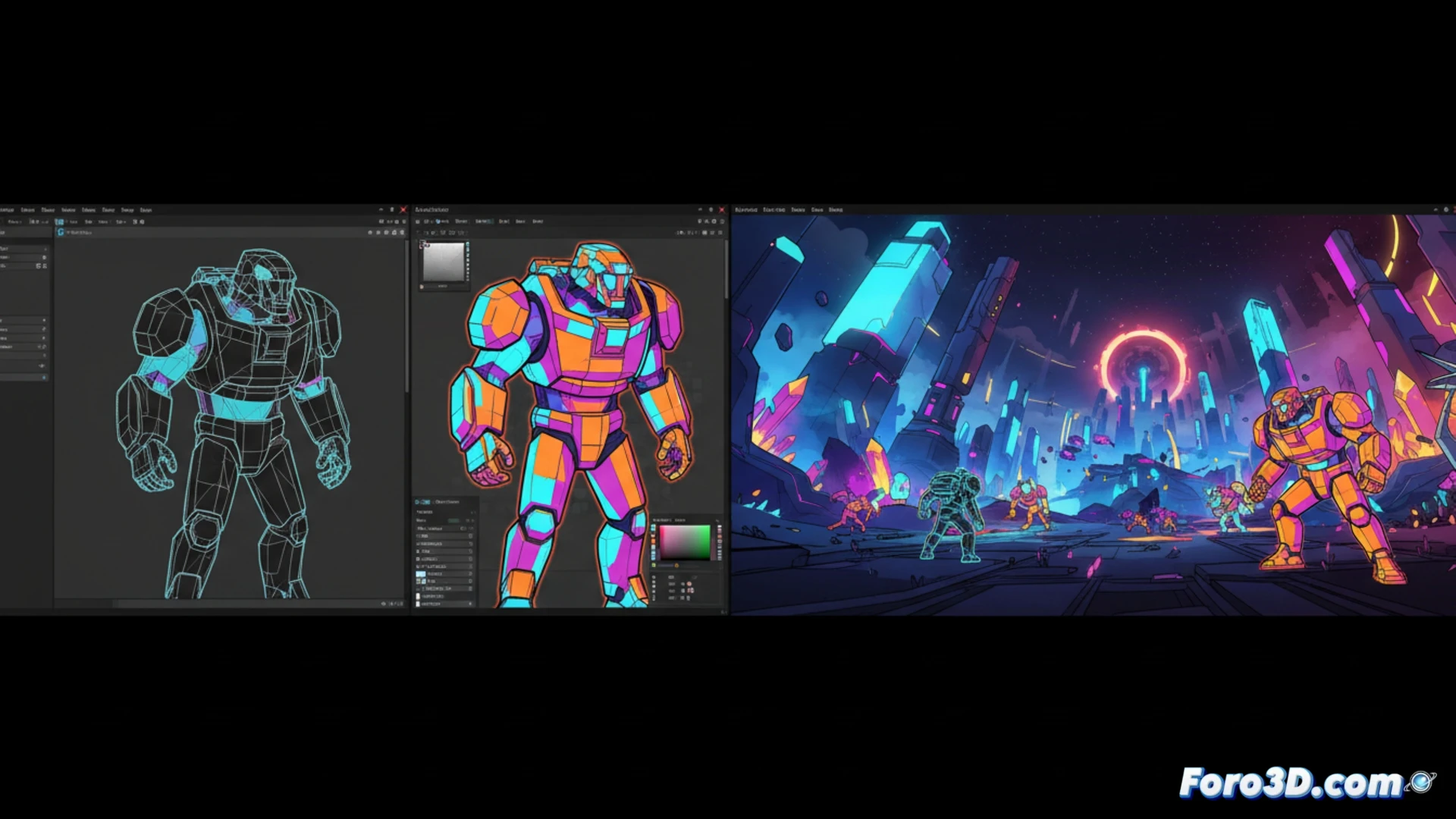
From Maya to Unity: Modeling, Silhouettes, and the Cel-Shading Trick 🎨
The process begins in Maya, where survivors and aliens are modeled with clean, low-polygon topology. The key lies not in microscopic details but in the silhouette: each character must be readable even when hundreds of enemies fill the screen. Once the base model is exported, the work moves to Substance Painter. Here, instead of realistic textures, a cel-shading style is applied using flat shadow generators and ink borders. The technical trick lies in the color ID maps and emission channels: neon tones are assigned to materials that will glow in Unity without requiring complex lights, saving rendering resources. The result is an asset that retains volume without losing the cartoon aesthetic.
Massive Scale and Particles: The Indie Optimization Challenge ⚙️
The biggest technical challenge of Risk of Rain 2 is the scale. With dozens of enemies and simultaneous particle effects, poor LOD (Level of Detail) management destroys performance. The solution was to create modular particle systems in Unity that reuse low-resolution textures, combined with the GPU Instancing system to duplicate enemies without duplicating memory. To replicate this aesthetic in indie projects, the advice is clear: prioritize silhouettes over details, use Substance Painter to generate flat textures with light borders, and never underestimate the power of a good neon color palette to hide low polygon density.
How did the Risk of Rain 2 team manage to balance the high performance required for its chaotic multiplayer with the use of procedural textures in Substance and cel-shading in Unity without sacrificing the game's neon visual identity?
(PS: 90% of development time is polishing, the other 90% is fixing bugs)