The Nazca Ridge has witnessed a milestone in marine biology: the first high-resolution footage of the whip anglerfish (Gigantactis sp.). This specimen, known for its disproportionately long and bioluminescent illicium, has been captured with unprecedented clarity. For scientific visualization, this footage is not just an image, but the raw material for a revolution in the volumetric reconstruction of abyssal species.
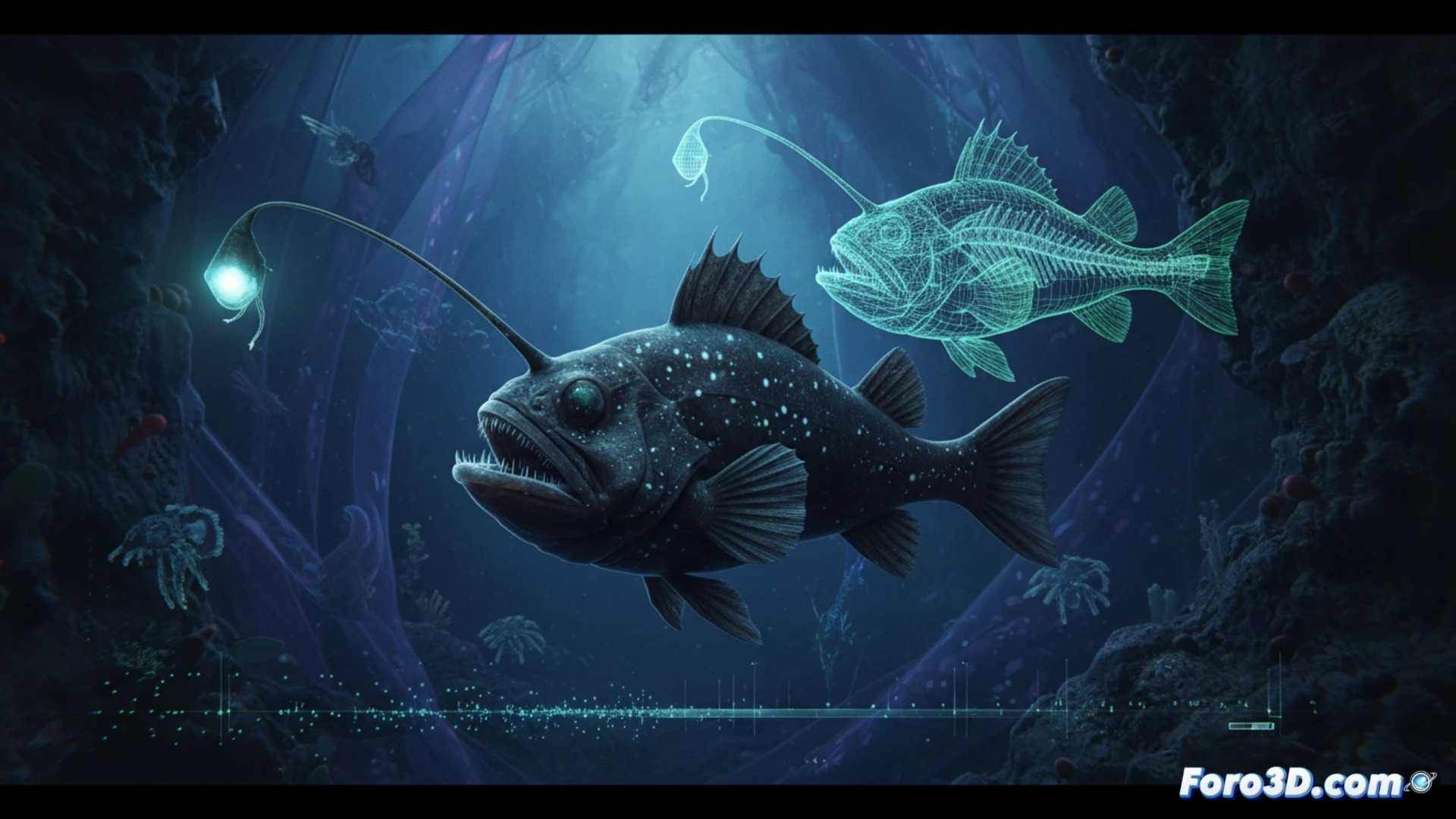
From Camera to Mesh: Volumetric Reconstruction 🎥
The technical process begins with photogrammetry from the 4K video. Structure from Motion (SfM) algorithms analyze each frame to extract dense point clouds. Since the Gigantactis lacks scale references, researchers calibrate the coordinates using the known length of its luminous illicium. Subsequently, Poisson meshing is applied to generate a continuous surface. The greatest challenge is texturing the bioluminescent lure, which requires HDR mapping to capture the blue-green light pixels emitted by symbiotic bacteria. This photorealistic model allows biologists to measure the relationship between the lure length and the fish's attack angle, something impossible to do in situ.
The Lure as an Educational Tool 🎓
Beyond modeling, this footage enables reflection on science communication. The illicium of the Gigantactis is not just an ornament; it is an evolutionary weapon in total darkness. By converting this footage into an interactive 3D asset, educators can simulate the bathypelagic zone in a laboratory. Students can rotate the model, activate the lure's light emission, and understand how pressure and temperature affect the fish's morphology. This visualization breaks the barrier of the inaccessible, transforming a chance encounter in the trench into a tangible lesson on extreme adaptation.
How the technical challenges of lighting and capture in the abyssal depths were solved to obtain a faithful 3D reconstruction of the whip anglerfish in its natural habitat
(PS: modeling manta rays is easy; the hard part is making them not look like floating plastic bags)