In the granite quarries of Aswan lies a stone colossus that defies the logic of ancient engineering. At 42 meters in length and an estimated weight of 1,200 tons, the Unfinished Obelisk is not only the heaviest piece of stone ever worked by man, but also a technical enigma regarding how the Egyptians planned its transport and erection. Its abandonment, due to a crack in the bedrock, has bequeathed us a frozen snapshot of a construction process that remains a subject of debate.
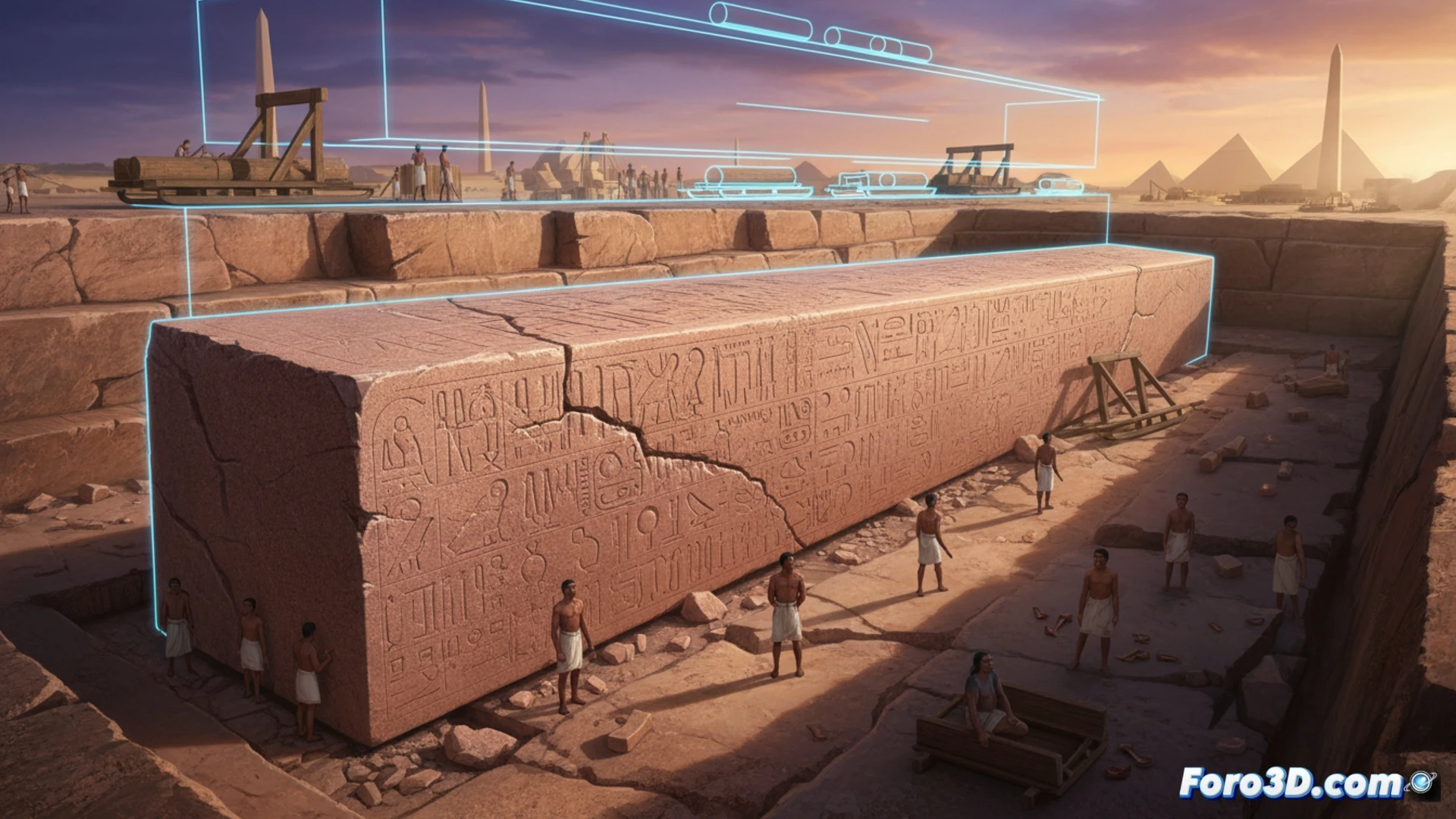
Photogrammetry and 3D Modeling to Unravel the Colossus 🏛️
Digital archaeology today offers tools that 19th-century Egyptologists could not have imagined. Through high-resolution photogrammetry, a digital twin of the monolith has been generated, allowing analysis of extraction marks with millimeter precision. Finite element simulations on these 3D models help calculate weight distribution and the stress the hauling rope would endure. Furthermore, virtual reconstructions of the extraction process, based on traces of wooden wedges and dolerite hammers, allow hypotheses about the necessary workforce and the logistics of its transport to the Nile to be tested.
The Legacy of a Construction Failure 🧱
The crack that doomed the obelisk is, paradoxically, its greatest treasure for research. By remaining incomplete, it reveals the quarrying techniques that are hidden under the final polish in finished obelisks. Analyzing this monolith with 3D technology not only resolves technical questions but also humanizes the process: it reminds us that even the most ambitious projects of Egyptian royalty were subject to the fragility of raw materials and the judgment of physics, turning a failed monument into a lesson on past engineering.
What 3D scanning and digital modeling techniques could be used to analyze tool marks on the Unfinished Obelisk and determine whether its abandonment was due to geological causes or human error in the extraction process?
(PS: and remember: if you can't find a bone, you can always model it yourself)