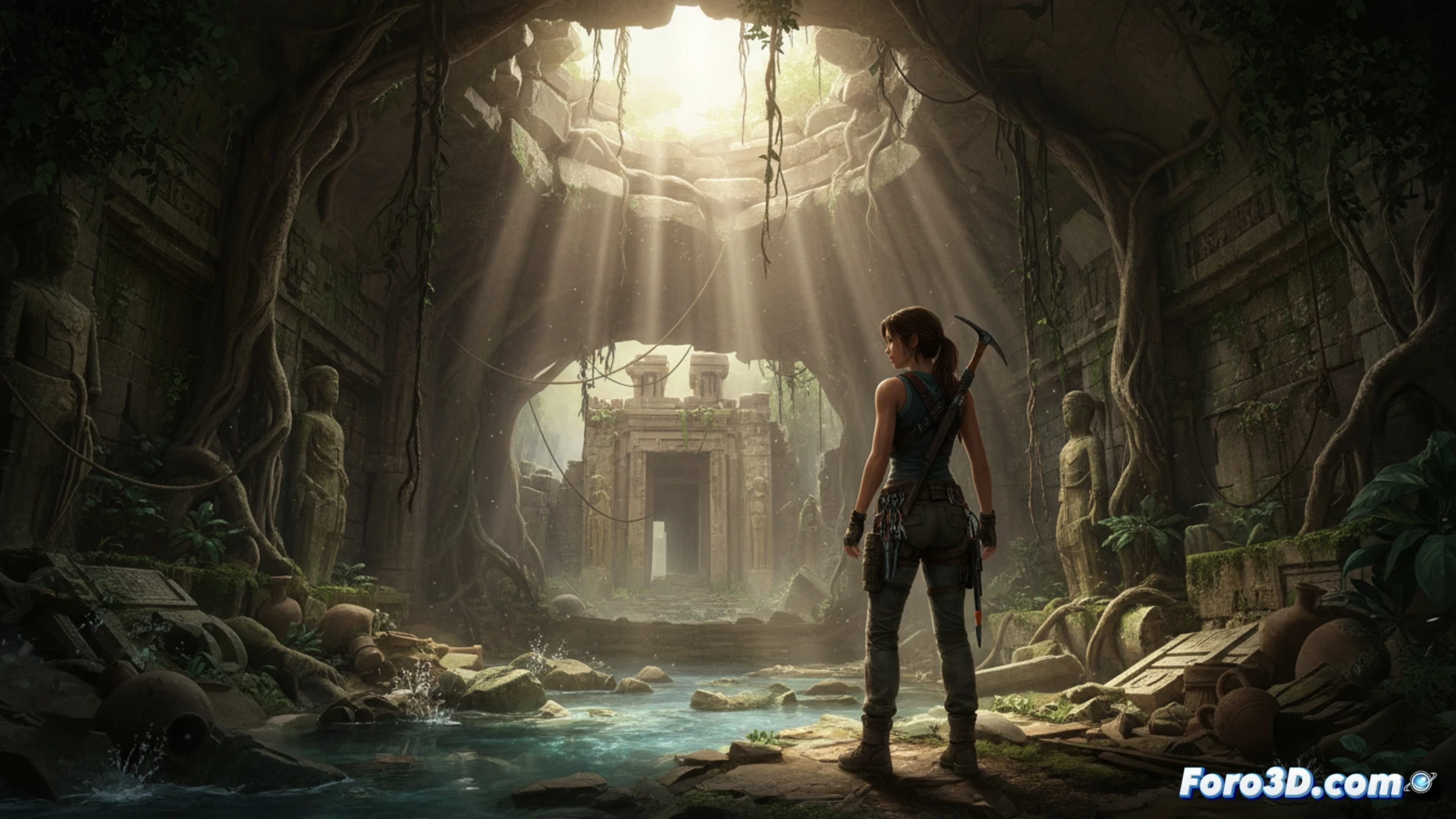
The next chapter of Tomb Raider promises to redefine realism in action-adventure video games. Crystal Dynamics has confirmed the use of Unreal Engine 5 as the main engine, fully leveraging technologies like Nanite and Lumen to bring archaeological environments to life with a cinematic level of detail. The project is in the development phase, but technical leaks point to a significant generational leap in the representation of ruins, temples, and caves, supported by a production pipeline that combines classic modeling tools with real-world environment scanning.
Technical Pipeline: From Maya to Megascans in Real Time 🎮
The studio's workflow integrates Maya and ZBrush for creating high-polygon assets, with a special emphasis on Lara Croft's organic geometry and the stone elements of the environments. Texturing is done in Substance Painter and Designer, allowing the generation of PBR materials that respond to Lumen's dynamic lighting. The use of Quixel Megascans is key to populating levels with realistic surfaces like eroded rocks, mud, and vegetation, all scanned from real locations. The implementation of Nanite allows these models, which traditionally would require normal baking, to be rendered with their original geometry of millions of triangles without performance loss, eliminating LODs and favoring total player immersion.
Real Scanning: The New Standard of Immersion 🏛️
Beyond technology, the narrative approach of Tomb Raider has always depended on the credibility of its settings. The team has conducted photogrammetry expeditions at real archaeological sites to capture textures and shapes that are then integrated directly into the engine. This technique, combined with Unreal Engine 5's ability to handle diffuse global illumination and precise reflections, creates a sense of presence that no other game in the saga has achieved. The result is not just a visually stunning video game, but a virtual exploration tool where every crack in a tombstone or every reflection in a puddle of water tells a story.
In an engine that allows recreating the millimeter-scale degradation of materials, how does Crystal Dynamics plan to balance the archaeological authenticity of the ruins with the agile gameplay and puzzles that define the saga?
(PS: optimizing for mobile is like trying to fit an elephant into a Mini Cooper)