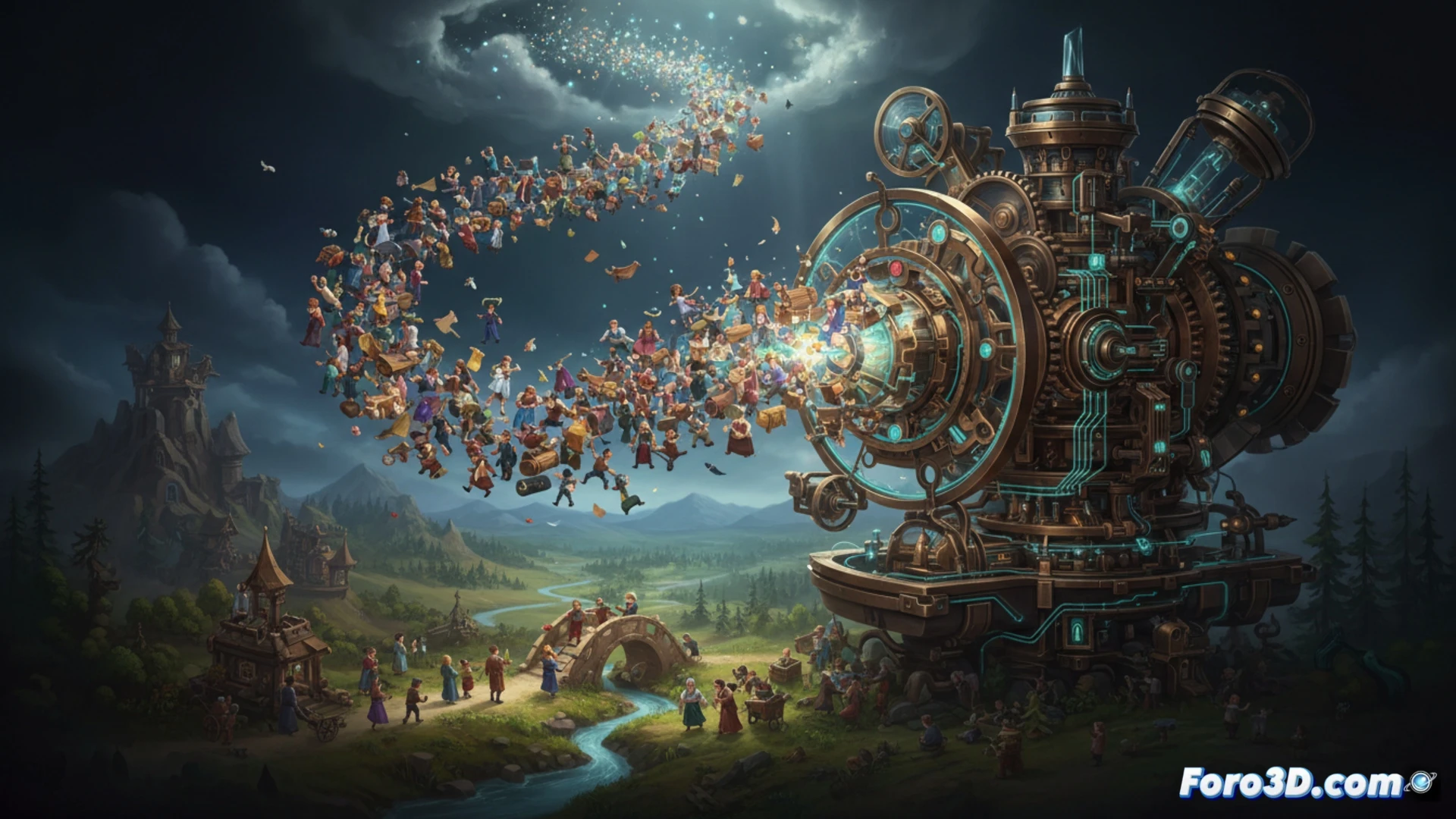
Envision Entertainment has developed a proprietary engine for Pioneers of Pagonia with the goal of recreating the so-called Wuselfaktor effect, a German term describing a vibrant and bustling environment. This system allows for managing and rendering thousands of citizens independently, each with unique animations, without collapsing real-time performance. The technical challenge lies in maintaining visual fluidity while processing hundreds of simultaneous interactions in an organic world.
Production Pipeline: Blender and Photoshop as Key Tools 🛠️
To achieve this density of characters, the team uses Blender as the primary modeling and animation tool. Each asset is optimized through polygon reduction techniques and texture baking, ensuring the custom engine can load multiple variants without saturating memory. Photoshop, in turn, is used to create diffuse textures and normal maps that add visual detail without increasing geometric load. The pipeline includes the generation of animation atlases, where each citizen shares a base skeleton but varies in colors, accessories, and movement cycles, achieving the illusion of individuality at scale.
Performance and Vitality: The Technical Balance ⚖️
The custom engine from Envision Entertainment focuses not only on the crowd but also on the interaction between agents and the environment. To avoid bottlenecks, dynamic LOD systems and occlusion culling are implemented, prioritizing characters close to the camera. Each citizen's decision trees are lightweight, using finite state machines instead of complex neural networks, allowing hundreds of routines to execute per second. The result is a world that breathes and moves, where every pixel tells a story without sacrificing frame rate stability.
How does the custom engine of Pioneers of Pagonia generate the organic chaos of the Wuselfaktor effect without compromising real-time performance during video game development?
(PS: a game developer is someone who spends 1000 hours making a game that people complete in 2)