The recent Castlevania Dominus Collection has surprised the technical community with its focus on preservation over simple emulation. Konami has used its internal Cradle engine, a proprietary tool designed for remastering legacy titles. This software not only runs the original ROMs but dynamically upscales the 2D graphics from the Nintendo DS, offering native resolution on modern screens without resorting to linear stretching that degrades the image.
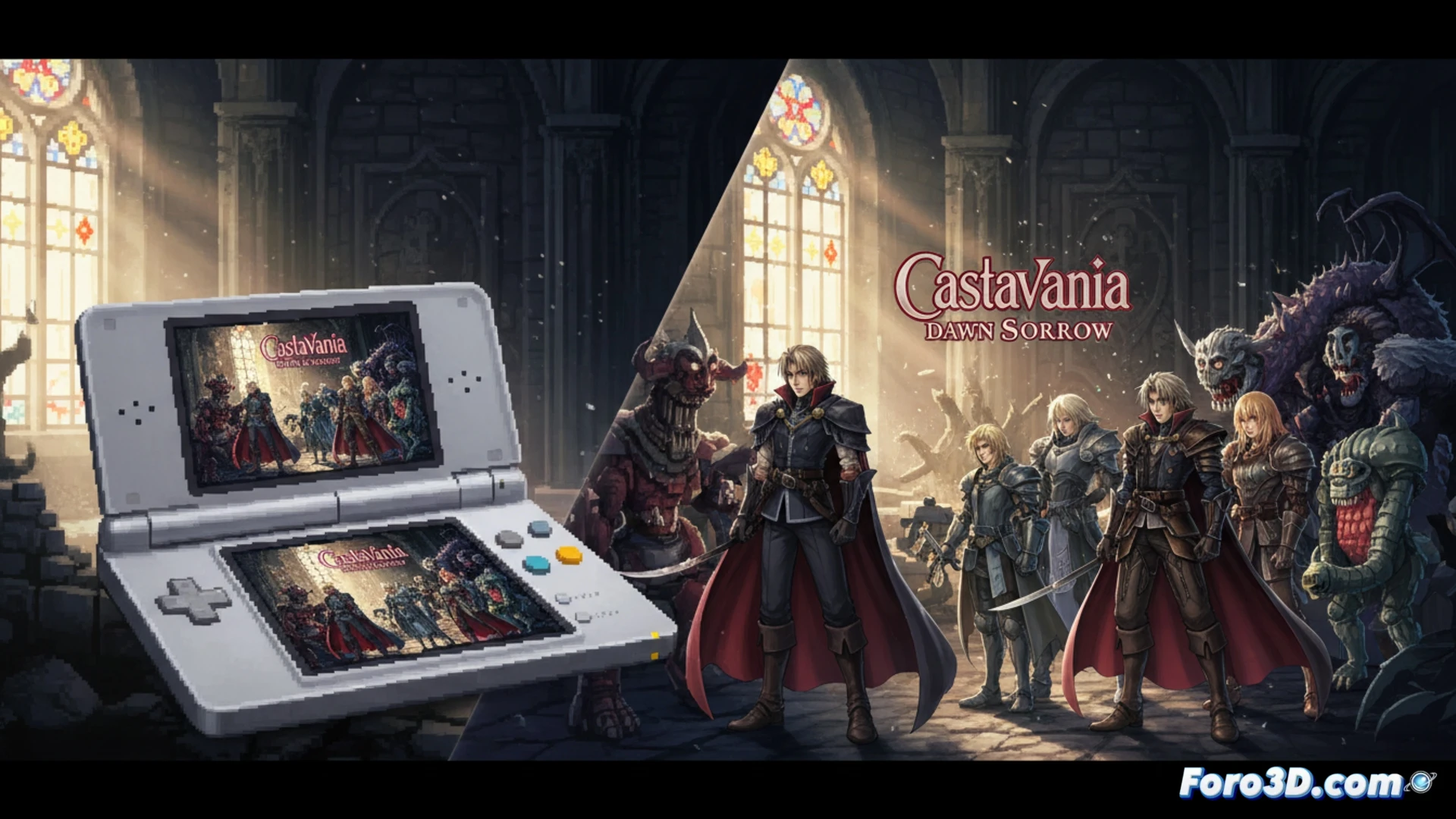
Sprite smoothing and hardware upscaling 🎮
The biggest technical challenge for Cradle is adapting the DS assets (256x192 pixels) to 1080p resolutions or higher. Instead of applying a generic bilinear filter, the engine implements a sprite smoothing algorithm that respects the hard edges of the original pixel art. The system analyzes the color palette of each tile and applies selective antialiasing only on high-contrast transitions, avoiding the dreaded blur effect. Additionally, Cradle maintains the original input latency by not introducing additional buffering into the rendering pipeline, a crucial detail for the gameplay of titles like Order of Ecclesia.
The value of the art gallery as technical documentation 🖼️
Beyond emulation, the inclusion of high-resolution art galleries offers a window into Konami's original production pipeline. These images, scanned from concept sketches and sprite sheets, allow developers to study the limited color palette and frame-by-frame animation techniques of the DS era. For any aspiring retro game developer, analyzing these assets reveals how visual expressiveness was maximized with 4 MB memory constraints, an optimization lesson that remains relevant in modern indie game development.
How does Konami's Cradle engine accurately emulate the interaction of the two touch screens and the microphone of the Nintendo DS in Castlevania Dominus Collection, and what specific technical challenges did its modernization for current platforms entail?
(PS: shaders are like mayonnaise: if they break, you start all over again)