Since 2018, fourteen fleeting blue flashes have puzzled astronomers. These events, known as LFBOTs, appear and fade within days, showing a persistent blue color that indicates extreme temperatures. Now, a team from the Harvard Center for Astrophysics proposes an explanation: the violent collision between a black hole or neutron star and a Wolf-Rayet star.
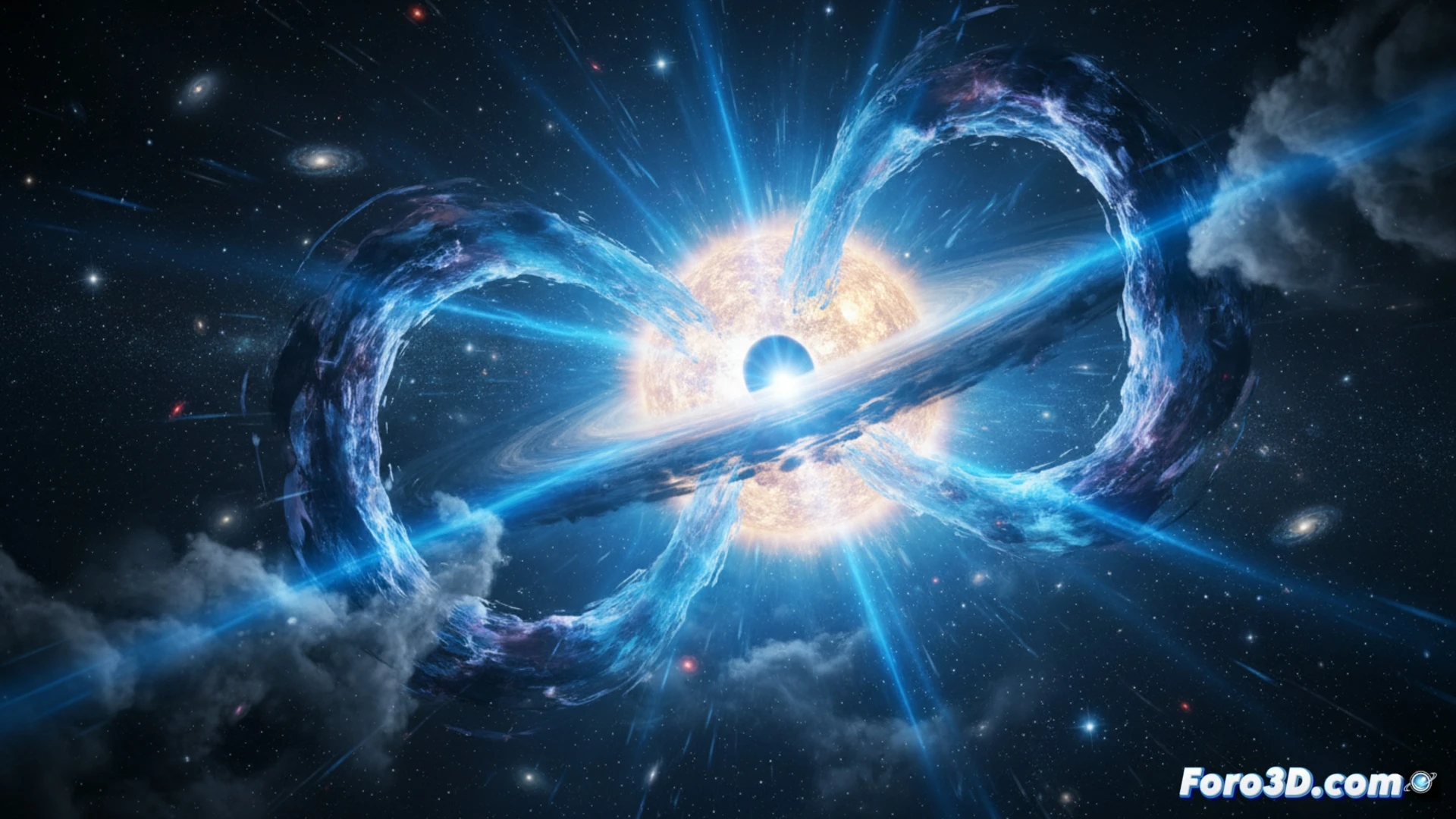
The mechanics of the cosmic impact 💥
The Harvard hypothesis details the process. Wolf-Rayet stars are superheated helium cores, remnants of massive stars that have lost their hydrogen layer. When a compact object, such as a black hole or neutron star, collides with this core, the released energy generates a short-lived blue flash. This model explains the rapid evolution of LFBOTs and their color, as the impact temperature is high enough to emit blue light for days.
The universe has parking problems 🚀
It seems that even in space, collisions are unavoidable. It turns out that a black hole can be so clueless that it crashes into the core of a dying star. It would be like a space garbage truck crashing into the core of an orange. Good thing these explosions are fast, because if they were slow, astronomers would have to make an appointment to see them.