Monolith Soft has achieved what seemed impossible on Nintendo Switch: a massive open world with panoramic views stretching to the horizon without sacrificing fluidity. The secret lies in an aggressive and dynamic LOD (Level of Detail) system that drastically reduces the geometry of distant environments, while high-fidelity anime-style shading maintains the visual coherence of characters in the foreground. This technical duality allows the studio's proprietary engine to manage millions of polygons without the console suffering from stuttering.
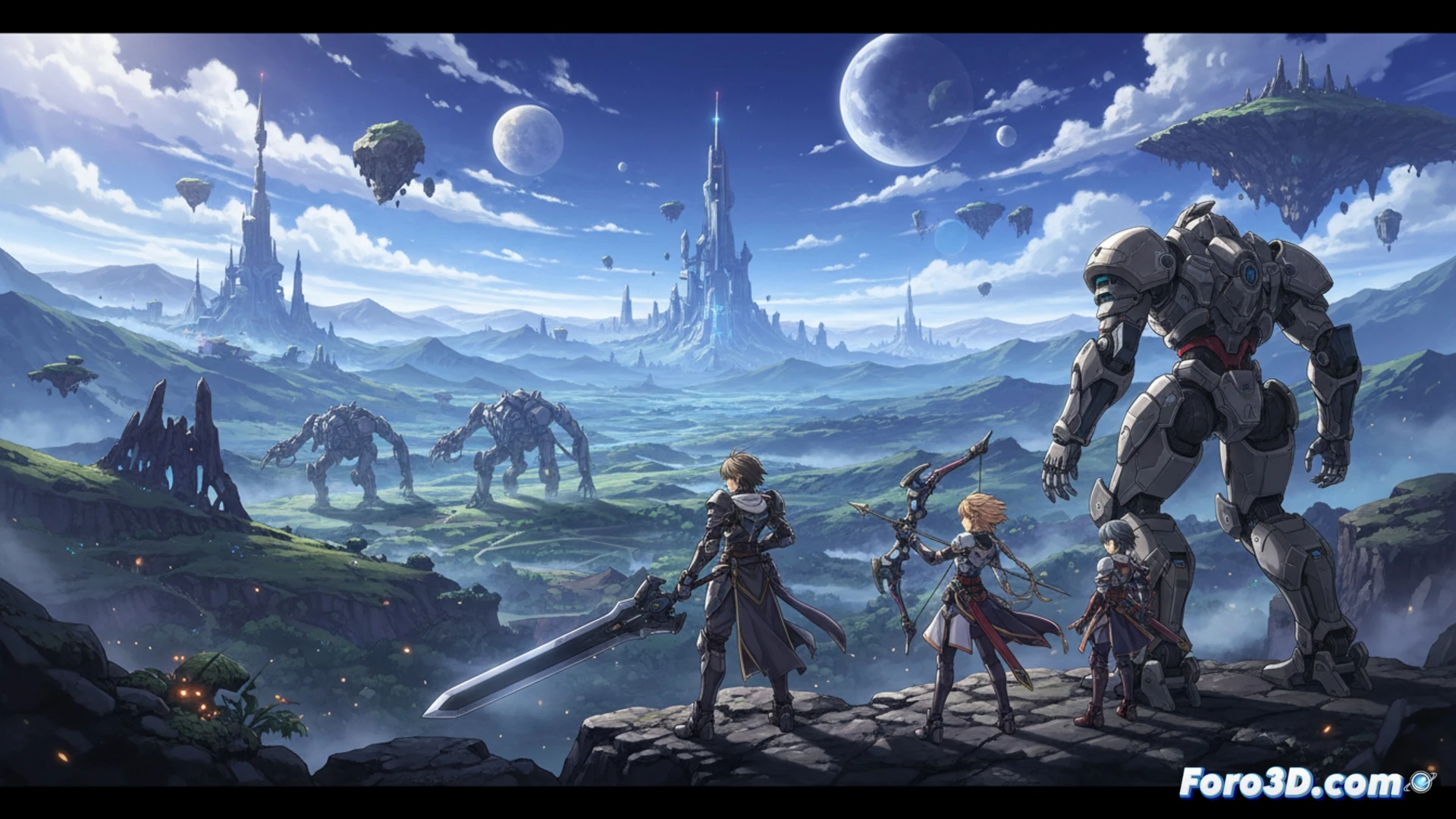
Creation Pipeline: Maya and Photoshop in the Battle Against Performance 🎨
For the colossal Ouroboros, the rigging team turned to Autodesk Maya, where they implemented a hierarchical bone system capable of deforming the enormous joints without breaking the stylized silhouette. Each character fusion required hybrid rigging that combined FK and IK controls for combat transitions. In parallel, the vast horizons were digitally painted in Photoshop, generating 8K textures that the engine dynamically compresses based on camera distance. This matte painting technique applied to distant backgrounds allows the Switch to load only nearby geometry, while distant skies and mountains are mere textured planes.
Lessons for Indie Developers: Scale Without Sacrifice 🎮
Monolith Soft's approach demonstrates that a well-optimized proprietary engine can outperform generic solutions when hardware limitations are understood. For any studio seeking to create open worlds without an AAA engine, the key lies in prioritizing layered LOD: simple geometry in the distance, details only where the player steps. Additionally, using Photoshop for static backgrounds drastically reduces GPU load, freeing up resources for character shading. The final lesson is that stylized art is not a whim, but a technical decision to maintain visual identity without demanding cutting-edge hardware.
As a developer, what LOD technique would you implement in your own engine to emulate the colossal performance of Xenoblade 3 without sacrificing the visual quality of characters at long distances?
(PS: 90% of development time is polishing, the other 90% is fixing bugs)