The tomb of China's first emperor, Qin Shi Huang, has remained intact and sealed since 210 BC. Ancient chronicles describe an underground palace with a map of the empire whose rivers and seas are made of liquid mercury, along with mechanical traps designed to eliminate any intruder. Given the impossibility of excavating without damaging the heritage, digital archaeology presents itself as the only viable way to explore this unprecedented mystery.
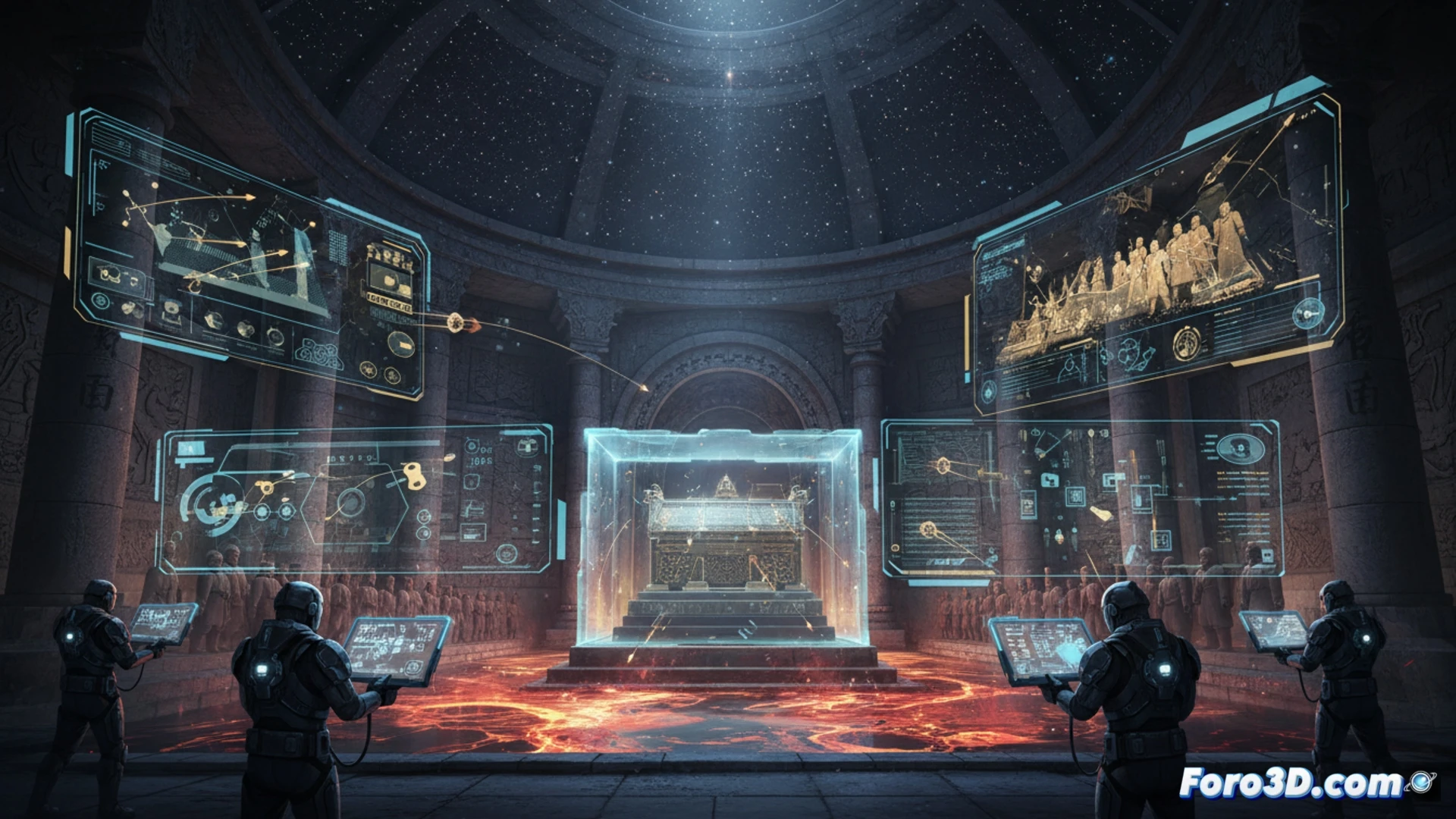
Non-Invasive Documentation: LiDAR and Muon Tomography 🏛️
To analyze the internal structure of the burial mound, research teams could employ airborne LiDAR scanners, capable of penetrating dense vegetation and detecting topographic anomalies in the ground. At the underground level, the muon tomography technique, similar to that used in the pyramids of Egypt, would allow mapping cavities and possible corridors without excavation. Once the data is collected, parametric 3D modeling would facilitate the simulation of the trap mechanisms described in historical texts, integrating physical variables such as the hydraulic pressure of mercury to recreate its behavior in a virtual environment.
Visual Hypothesis and Virtual Conservation ⚖️
Digital reconstruction not only satisfies scientific curiosity but also raises an ethical dilemma: is it correct to generate detailed visual hypotheses of a space that Chinese culture considers sacred and that must remain inviolate? Digital archaeology must balance the dissemination of heritage with respect for funerary traditions, creating models that clearly specify the margins of uncertainty. Thus, the mausoleum of Qin Shi Huang becomes a perfect case study to demonstrate how 3D technology can preserve historical memory without disturbing the emperor's eternal silence.
Could muon tomography technology and 3D modeling solve the mystery of the mercury rivers described in the chronicles of Qin Shi Huang's mausoleum without drilling through its original seal?
(PS: If you dig at a site and find a USB drive, don't plug it in: it could be Roman malware.)