For decades, smell was an enigma for neuroscience. With over a thousand types of receptors and twenty million neurons, its complexity seemed unfathomable. Now, a team from Harvard has managed to map this system, discovering that neurons are not randomly distributed. Instead, they form a spatial code of overlapping stripes, organized by receptor type from the top to the bottom of the nose. This pattern, identical in all animals studied, is directly reflected in the brain's olfactory bulb, creating a fundamental topographical continuity.
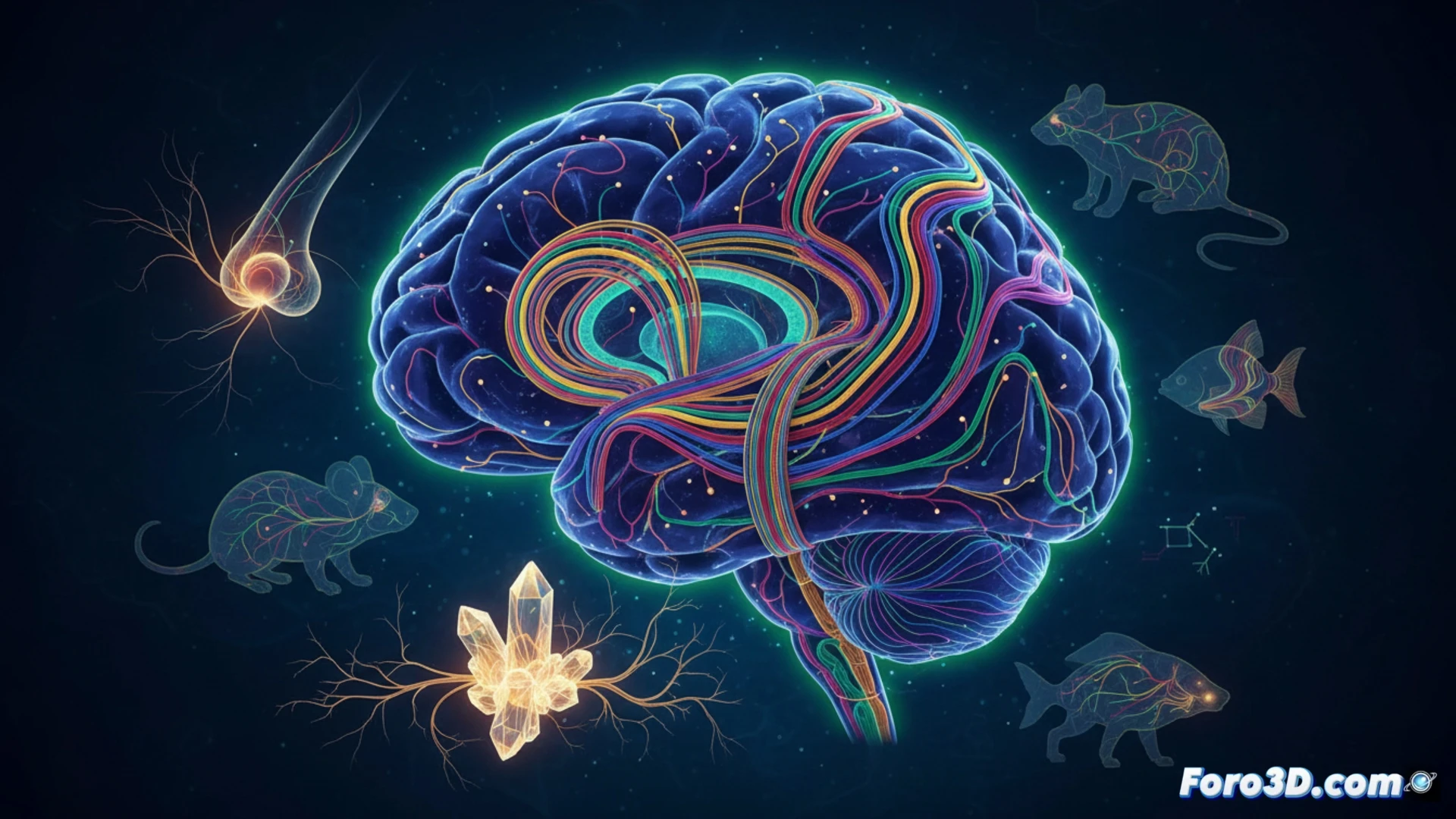
3D Modeling of the Spatial Code and Neuronal Topography 🧠
For scientific visualization, this finding represents a unique challenge and opportunity. We can create an interactive 3D infographic that represents the nasal cavity as a cylinder segmented into colored stripes, each corresponding to a receptor type. By rotating the model, the user would see how neurons in the upper stripe of the nose send signals to the upper area of the olfactory bulb, maintaining an exact topographical correspondence. The key animation would be post-COVID regeneration: showing how damaged neurons attempt to reconnect, but without the stripe map, connections fail and go astray. The comparison between species, such as mouse and human, would reveal the evolutionary conservation of this pattern, allowing both models to be superimposed to highlight structural similarities.
The Lost Architecture That Explained the Failure of Treatments 🔬
Without this map, any attempt to develop therapies for smell loss was doomed to failure. It is like trying to repair electrical wiring without knowing the installation plan. Now we know that the neuroplasticity of smell depends on new neurons finding their correct stripe. For visualizers, this opens the door to simulations of guided regeneration, where we could show how an ideal therapy would redirect connections toward their original destination, restoring the lost sense.
How could the scientific visualization technique used to map the Harvard olfactory spatial code be applied to other complex sensory systems, such as proprioception or interoception, in future research?
(PS: at Foro3D we know that even manta rays have better social bonds than our polygons)