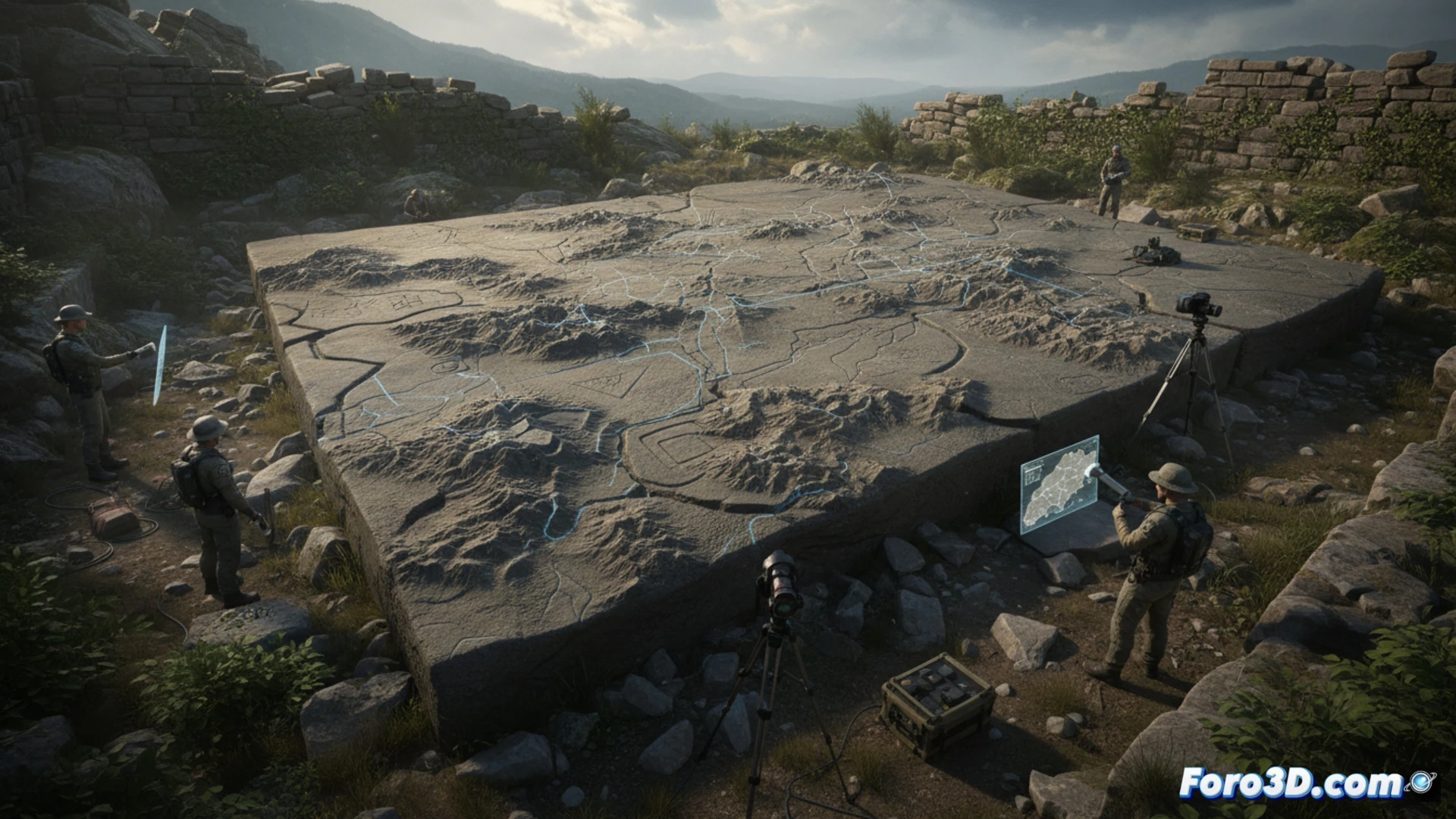
In 1999, an expedition in the Ural region, near the town of Chandar, unearthed a stone slab that challenges conventional chronologies. Dubbed the Map of the Creator or Dashka Stone, this dolomite piece features a three-dimensional relief that, according to some geologists, represents the topography of the Bashkortostan region with astonishing cartographic precision. The discovery not only raises questions about lost civilizations but has also become a perfect case study for digital archaeology.
Photogrammetry and Lithographic Dating 🗺️
The technical analysis of the Dashka Stone required a multidisciplinary approach. High-resolution laser scans were performed to capture the relief without physical contact, generating a point cloud that allowed the digital 3D model to be reconstructed. The photogrammetry technique, applied with full-spectrum cameras, revealed details of channels and elevations that mimic the course of the Ufa River. Relative dating was based on the study of carbonate layers and fossils embedded in the rock matrix, suggesting a minimum age of 120 million years, although this data is fiercely debated. LiDAR technology helped contrast the stone relief with modern satellite maps, finding a geometric correlation exceeding 70%.
Authenticity and the Role of Digital Heritage 🏛️
Controversy is at the core of this artifact. Skeptics argue it is a natural geological formation with fracture patterns that mimic maps. However, the digital 3D model allows researchers to isolate relief layers and analyze the intentionality of the strokes without manipulating the original piece. This case demonstrates the power of digital preservation: even if the authenticity of the Map of the Creator remains unconfirmed, its digitization ensures that the scientific debate continues on a reproducible data basis, avoiding wear and tear on the lithographic heritage from constant physical handling.
Considering the photogrammetry and 3D scanning techniques, what geometric anomalies or hidden patterns in the topography of the Dashka Stone could reveal non-natural intervention or a carving technology incompatible with Stone Age tools?
(PS: and remember: if you can't find a bone, you can always model it yourself)