In the 16th century, while Europe debated theology, a military engineer named Conrad Haas wrote a treatise describing three-stage liquid-fuel rockets. The Sibiu Manuscript, rediscovered in 1961, anticipated the space age by more than 400 years. Today, digital archaeology allows these designs to be recovered through photogrammetry and 3D modeling, revealing the astonishing technical precision of a visionary ahead of his time.
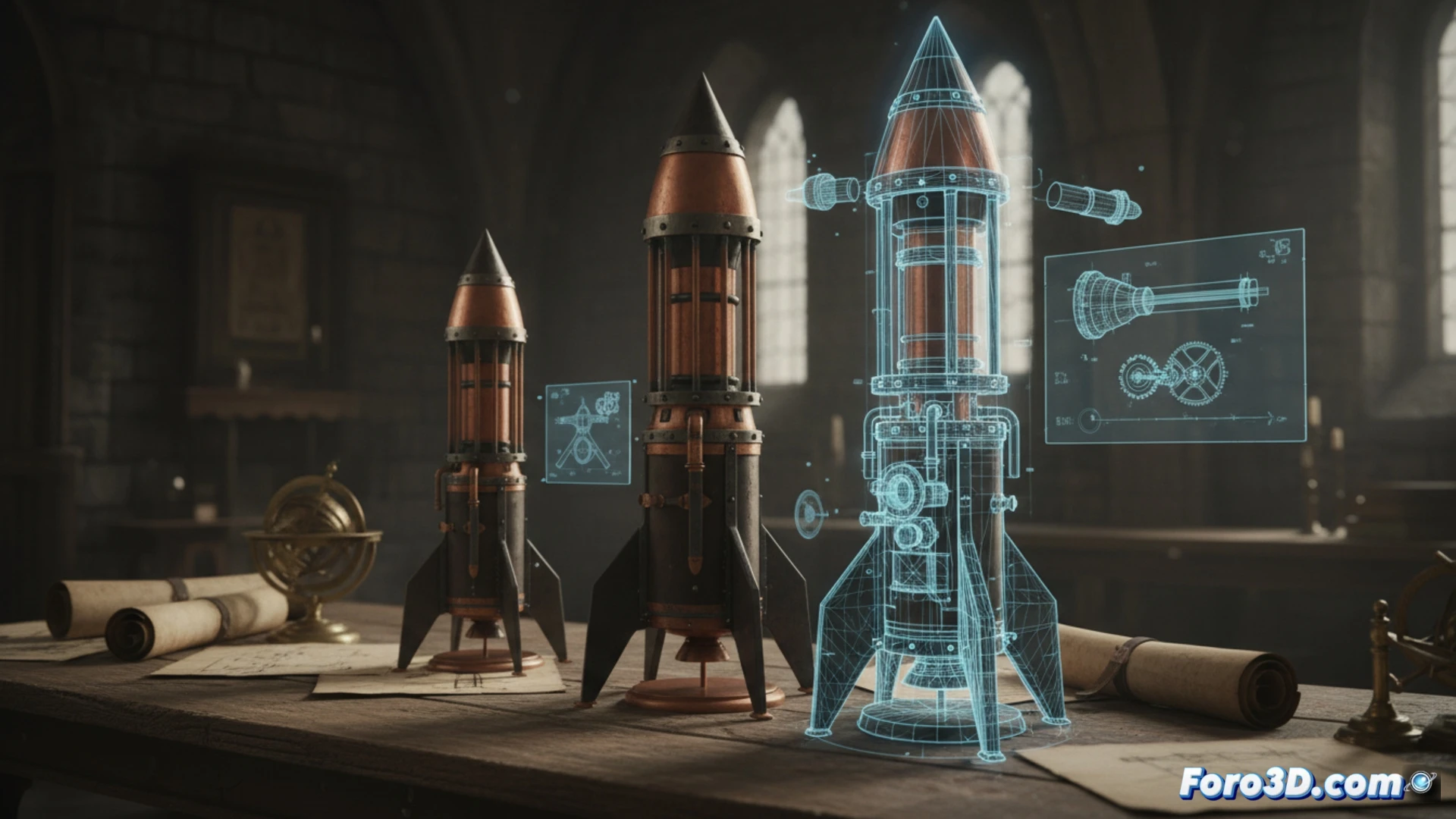
Photogrammetry applied to 16th-century folios 🚀
The digitization process of the Sibiu Manuscript requires a meticulous workflow. First, high-resolution images of each folio are captured with controlled lighting to avoid reflections on the aged parchment. Then, photogrammetry software processes the images to generate three-dimensional meshes that preserve the texture of the paper, the iron-gall ink marks, and the creases of time. From that data, expert modelers reconstruct Haas's sketches in 3D environments, assigning virtual materials that simulate wood, metal, and the chemical compounds described in the text. The result allows each stage of the rocket to be rotated, scaled, and disassembled, facilitating structural analysis and validation of its aerodynamic feasibility.
The legacy of a pioneer without rockets 🔭
Conrad Haas did not build his machines, but his manuscript survives as a bridge between alchemy and modern engineering. Recreating his designs in 3D not only preserves a fragile document but also allows researchers to simulate virtual combustions and flight trajectories. Each render is a tribute to human imagination, demonstrating that technology does not always advance in a straight line: sometimes, it waits for centuries hidden in a dusty book.
How were the challenges of interpreting the technical annotations of the Sibiu manuscript resolved for 3D modeling Conrad Haas's rockets, considering the material and physical limitations of the 16th century?
(PS: and remember: if you can't find a bone, you can always model it yourself)