The Rohonc Manuscript, discovered in Hungary in the 19th century, is one of the greatest mysteries in paleography. Its 448 pages contain a completely unknown writing system and over 80 illustrations blending Christian, Islamic, and Hindu symbols. With no translation possible to date, this book has become a perfect candidate for the most advanced digital archaeology techniques. 📜
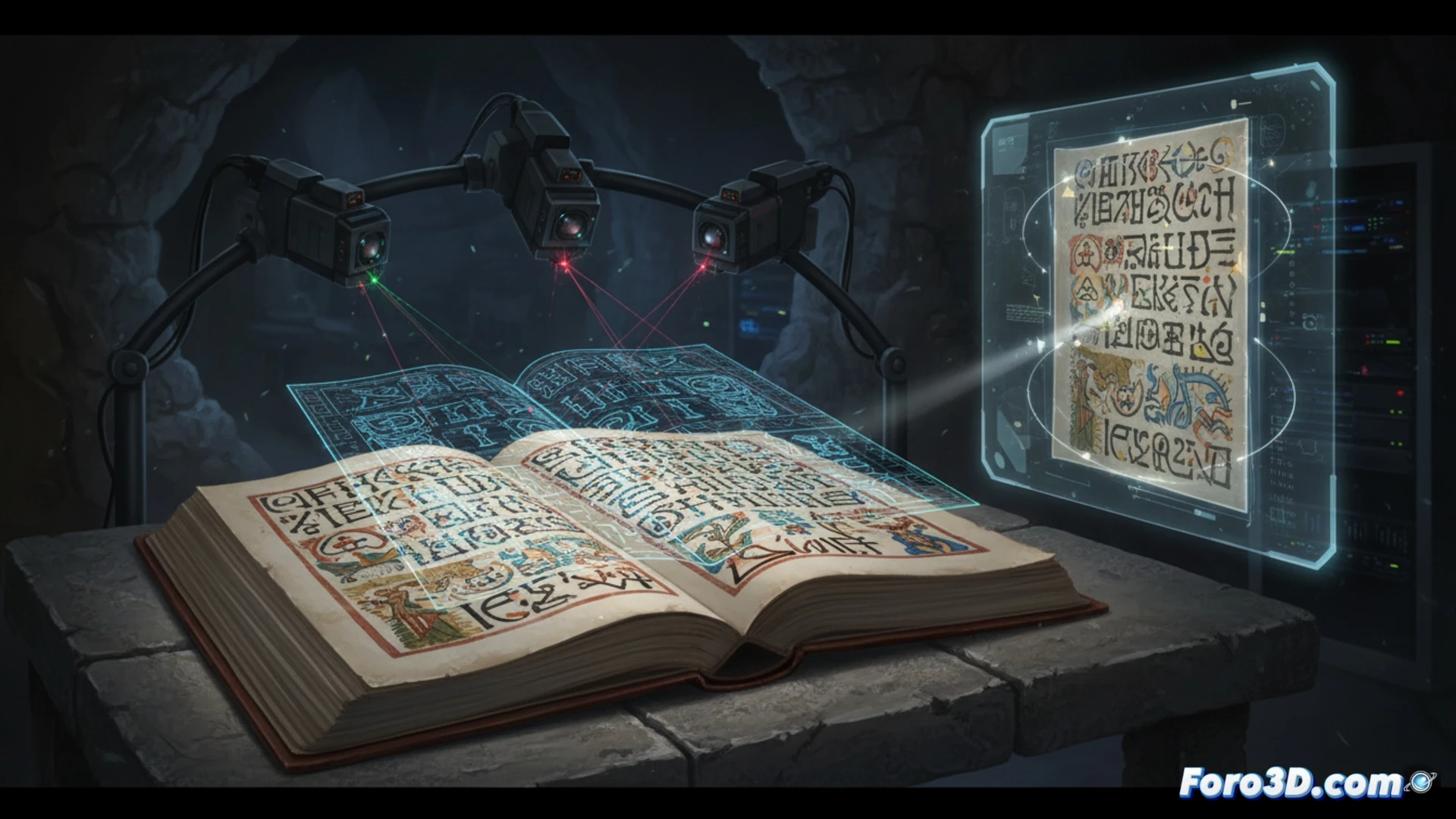
Photogrammetry and spectral analysis to decipher the undecipherable 🔍
The application of high-resolution photogrammetry would allow the creation of a digital twin of each page, capturing the relief of the paper and ink to detect hidden strokes or corrections. The use of multispectral imaging, from ultraviolet to infrared, could reveal faded inks or underlying layers of writing, key to understanding the language's structure. Additionally, a 3D scan of the syncretic illustrations would make it possible to isolate specific iconographies, comparing them with databases of manuscripts from around the world to search for common patterns. This non-invasive process avoids direct handling of extremely fragile material, ensuring its physical preservation while extracting the maximum possible information.
Preserving the mystery without destroying the evidence 🛡️
The great paradox of the Rohonc Manuscript is that, to decipher it, we must avoid damaging it. Digital archaeology offers the solution: an interactive 3D model where researchers can rotate, zoom in on, and analyze each symbol without touching the original. This approach not only protects the manuscript but also democratizes the study, allowing linguists, art historians, and symbology experts to collaborate globally. Perhaps the key to understanding this blend of religions lies not in the paper, but in the data we can safely extract from it.
Is it possible to reconstruct the writing system of the Rohonc Manuscript through three-dimensional analysis of its strokes to differentiate between a coded language and an artificial glossary?
(PS: If you dig at a site and find a USB stick, don't plug it in: it could be Roman malware.)