Herodotus described it as a wonder superior to the pyramids of Giza, a complex of 3,000 underground chambers beneath the mud of El Fayum. Today, the Hawara Labyrinth is a buried legend that Digital Archaeology seeks to rescue. Without the need for pick or shovel, technologies such as LiDAR scanning and photogrammetry allow researchers to virtually model this lost structure, contrasting classical accounts with the harsh reality of the Egyptian subsoil.
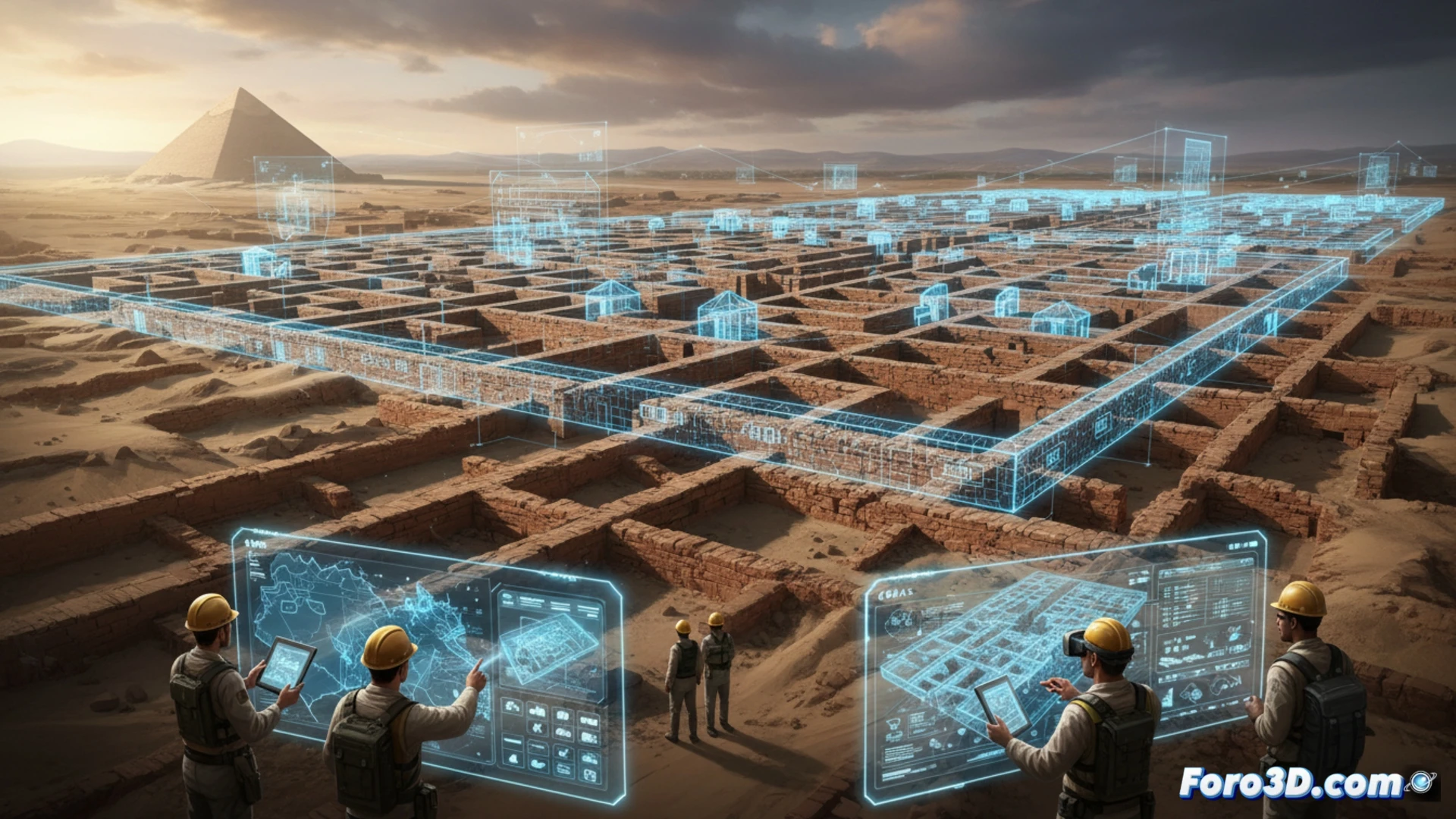
Photogrammetry and LiDAR: The virtual model against the mud 🏛️
The main challenge of the Hawara Labyrinth is not its depth, but the saturation of water and sediments that have buried it for millennia. To overcome this, survey teams use airborne LiDAR, capable of penetrating the dense vegetation of the oasis and detecting topographic anomalies. Combined with high-resolution photogrammetry, point clouds are generated that allow the hypothetical floor plan of the enclosure to be reconstructed. These 3D simulations are fed by the texts of Herodotus and Strabo, and by architectural fragments found in previous excavations. The result is a digital twin that allows archaeologists to virtually walk through its corridors, adjusting scales and proportions to validate or refute historical descriptions, all without moving a single layer of mud.
What does it mean to unearth with pixels? 🧩
The virtual reconstruction of the Hawara Labyrinth is not just a technical exercise; it is a paradigm shift in heritage preservation. By modeling the complex in 3D, researchers can simulate its original state, study its natural lighting, and propose hypotheses about its ritual or administrative function. This approach allows democratizing access to an inaccessible place, but also raises ethical questions: to what extent can a digital recreation replace archaeological truth? Technology does not unearth stones, but data, and in that process, the Hawara Labyrinth ceases to be a myth and becomes a visual hypothesis waiting to be confirmed by the shovel.
How can ground-penetrating radar and 3D photogrammetry technology solve the enigma of the Hawara Labyrinth and confirm whether the 3,000 chambers described by Herodotus really existed
(PS: and remember: if you can't find a bone, you can always model it yourself)