The White House has just announced the construction of a large ballroom with capacity for one thousand people. Officially, it is a solution to the lack of protocol space. However, behind this social facade lies a strategic security project that triples the underground surface area of the site, continuing a tradition of concealment that began in 1942 with Franklin D. Roosevelt's secret shelter.
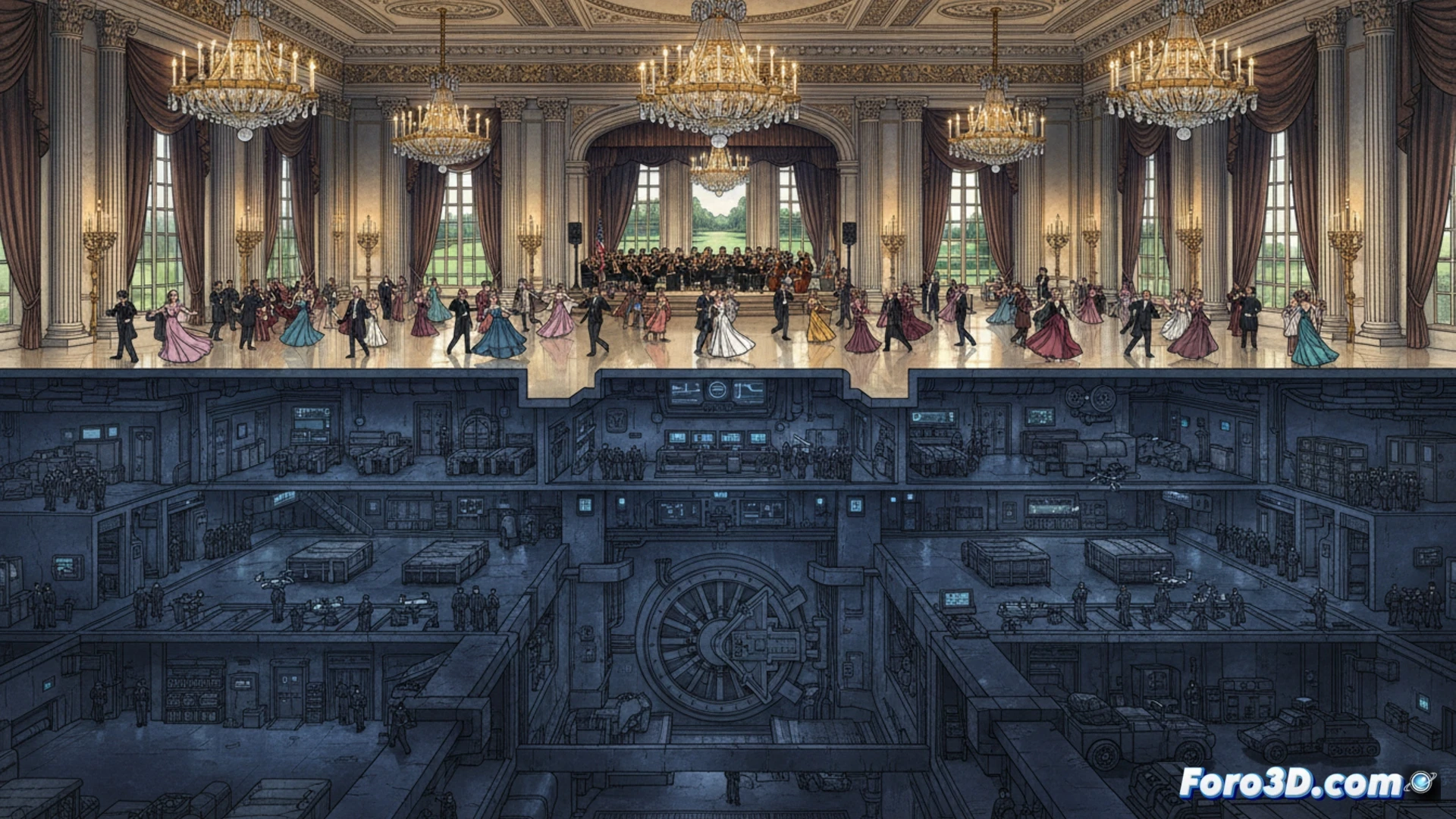
Double-layer architecture: 3D modeling of the hidden infrastructure 🏛️
A technical analysis using 3D modeling reveals that the ballroom, seemingly an open-plan public space, acts as a structural cover for an underground complex of 90,000 square meters. The visualized layers show blast-resistant reinforced concrete walls, anti-drone systems integrated into the false ceiling, and a secure communications network isolated from the outside. The visible renovation, with its marble and glass finishes, is nothing more than the aesthetic cover for a bunker designed for continuity of government in the event of an apocalypse. The discrepancy between the official plan and the actual infrastructure is so evident that only a sectional rendering allows one to understand the true magnitude of the project.
The facade as a strategy for political survival 🎭
The decision to label this project as a ballroom responds to a logic of political communication where the public appearance conceals the real vulnerability of power. By presenting a social renovation, debate on the militarization of the presidential site is avoided. This case demonstrates that, in the visual analysis of government architecture, what is not seen is more relevant than what is shown. The White House does not need more space for parties; it needs a shelter that guarantees that, even after a collapse, there is someone from whom to give orders.
How the architecture of the White House is transformed into an instrument of political communication when the construction of a large ballroom can be visually interpreted as a strategy to divert media attention from hidden infrastructures such as a 90,000 square meter bunker
(PS: analyzing political micro-expressions is like looking for inverted normals: everyone sees them, no one fixes them)