A 2000-horsepower hypercar lost control at 350 km/h when its active rear wing suddenly collapsed. The expert investigation used a combination of 3D scanning, SolidWorks modeling, and CFD simulations in Star-CCM+ to determine that the failure was not a manufacturing defect, but an asymmetric load induced by the turbulence of a preceding vehicle. This case demonstrates how active aerodynamics can become a critical point when the control software does not anticipate extreme external disturbances.
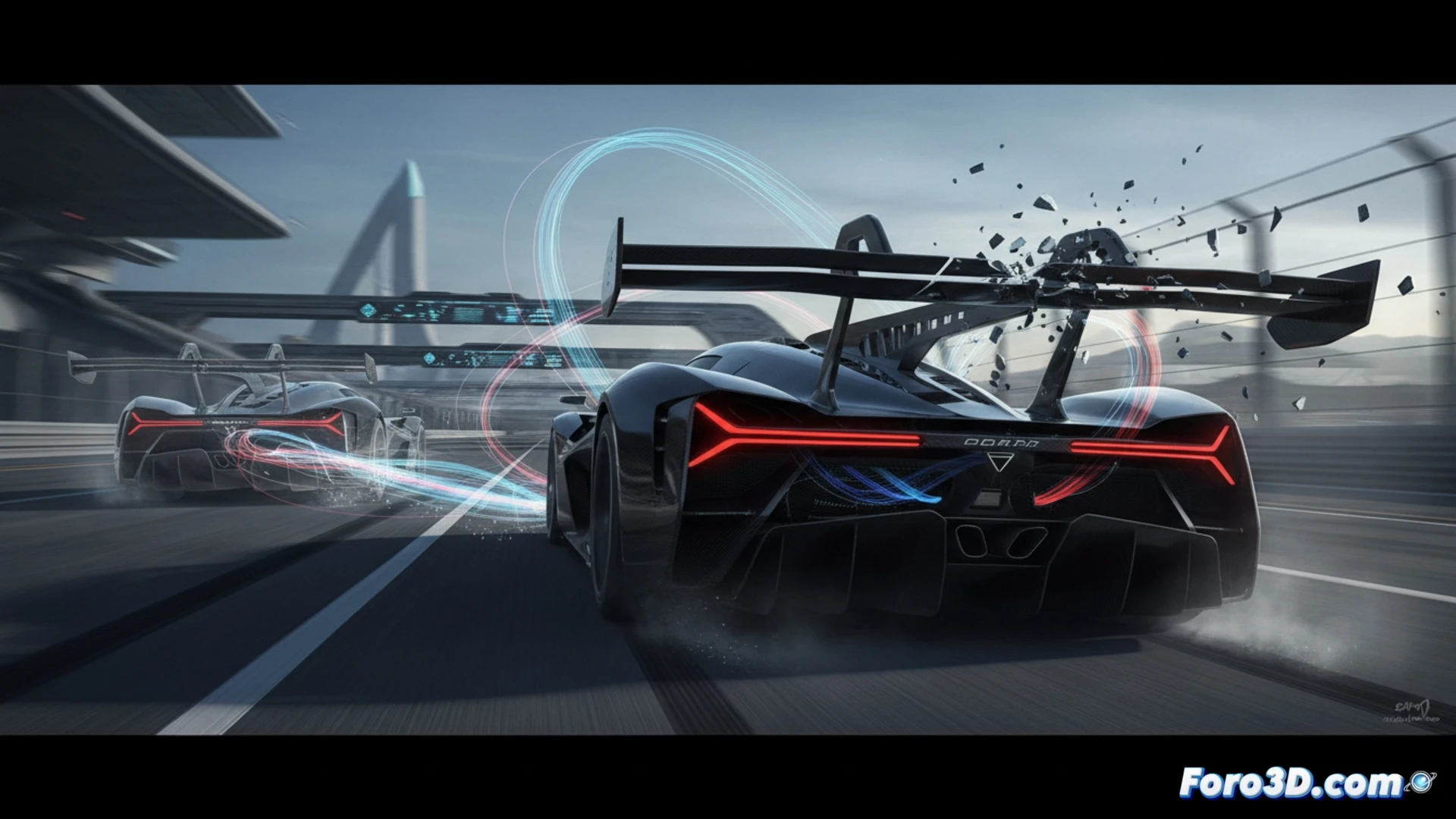
CFD Reconstruction and Hydraulic Actuator Analysis in Star-CCM+ 🛠️
The forensic team digitized the remains of the hydraulic actuator using GOM Inspect to obtain a precise point cloud, which was then integrated into SolidWorks to model the complete mechanism. The CFD analysis in Star-CCM+ revealed that the turbulent wake of a preceding car generated a lateral pressure gradient on the wing, creating an asymmetric force that exceeded the maximum torque sustainable by the left actuator by 40%. The transient simulation showed that the stress peak lasted less than 0.2 seconds, insufficient time for the hydraulic system to compensate for the difference, causing the rod to break and the instantaneous loss of aerodynamic load on the rear axle.
Design Lessons for Active Aerodynamic Systems ⚠️
This case underscores the need to incorporate dynamic safety margins in actuators, based on asymmetric load scenarios and not only on laminar flow conditions. The 3D reconstruction has served as conclusive expert evidence, but also as a warning for engineers: a 2000 HP hypercar must not only be fast, but also capable of managing the turbulence of other vehicles on the track. The integration of real-time pressure sensors and predictive algorithms could have prevented the disaster.
What design errors in the active rear wing actuation system or its integration with the stability control could have caused the aerodynamic collapse at 350 km/h in a 2000 HP hypercar?
(PS: simulating an ECU is like programming a toaster: it seems easy until you order a croissant)