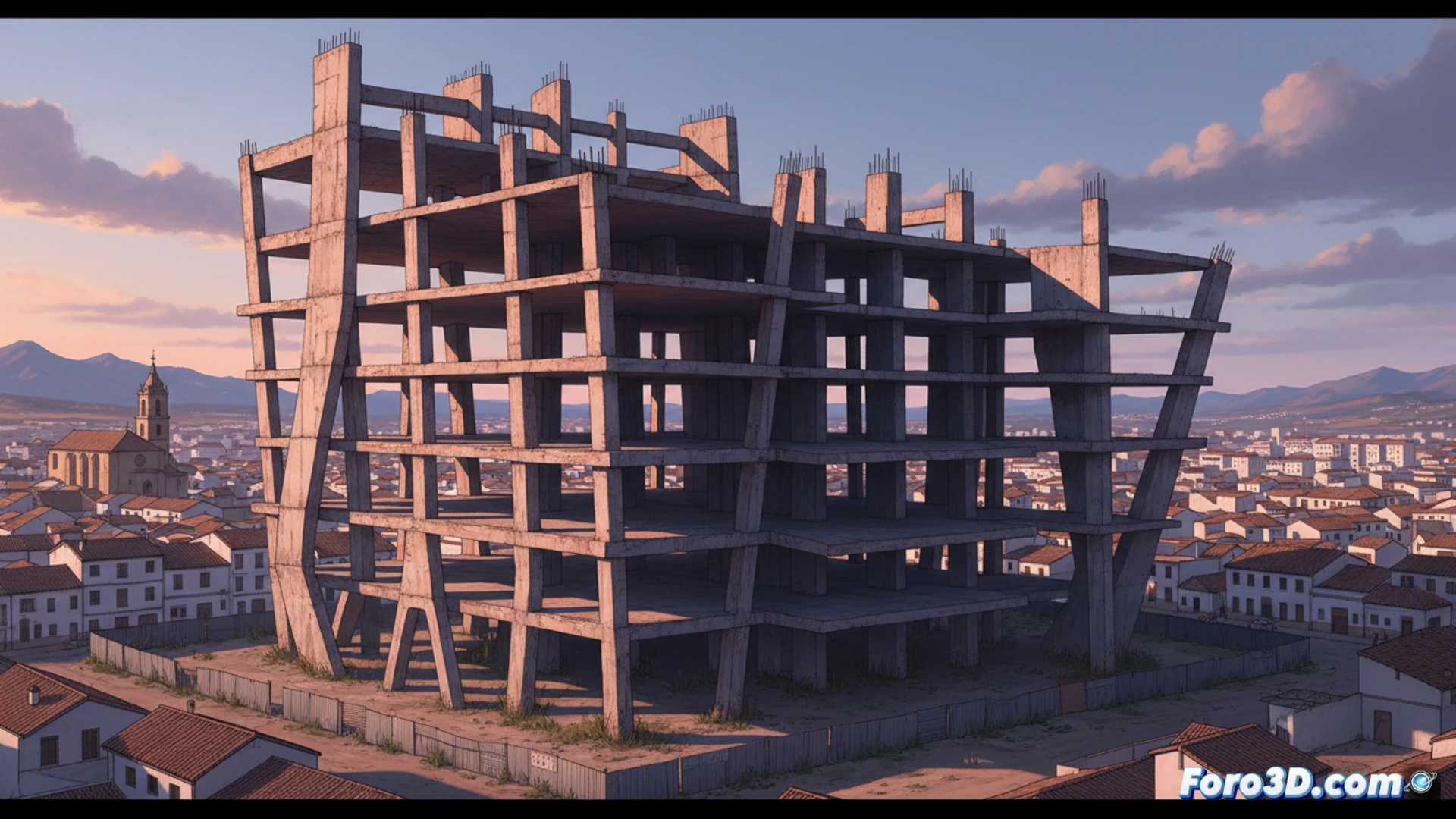
On the outskirts of Lucena, Córdoba, stands a concrete mass that popular imagination has dubbed the Skeleton of Music. This avant-garde auditorium, conceived as the cultural epicenter of the region, has been frozen in time since 2006, when funding evaporated. Today, its incomplete beams and walls stand as a testament to a failed project. For virtual reconstructors, this concrete skeleton is not just a ruin, but a technical challenge: to give it the digital life that reality denied it.
From Blueprint to Ruin: 3D Workflow 🏗️
The virtual reconstruction process of the Lucena Auditorium requires a dual approach. First, the ideal structure is modeled based on the original plans from the architecture firm, recreating the fluidity of its reinforced concrete curves, the layout of the orchestra pit, and the acoustics planned for 1,200 seats. Second, the current state is captured through photogrammetry of the real structure, generating a point cloud model that documents every crack, rusted steel bar, and unfinished slab. Overlaying both models in a rendering engine like Unreal Engine allows for millimeter-precise contrast, revealing the dialogue between architectural intention and the rawness of abandonment.
Preserving the Memory of Failure 📸
Beyond the technical exercise, this 3D reconstruction serves a social function. By visualizing the auditorium in its virtual splendor against its current state of ruin, a documentary record is generated that transcends photography. It is not about glossing over abandonment, but about accurately showing what was lost due to the crisis. 3D technology thus becomes a critical archive of failed heritage, allowing future generations and public administrators to understand the urban impact of a project halted halfway.
As a specialist in ruin reconstruction, what photogrammetry or laser scanning techniques do you consider most effective for capturing the geometry of a concrete structure in a state of abandonment like the Skeleton of Lucena, considering its exposure to the elements and the potential loss of surface detail?
(PS: Reconstructing ruins is like doing a puzzle without knowing how many pieces are missing. But at least you can make up the missing ones.)