Every year, in the village of Jatinga (India), hundreds of birds crash into artificial lights during foggy and windy nights. Far from the myth, science points to disorientation caused by atmospheric conditions and magnetic fields. Thanks to scientific visualization tools such as Volume Graphics VGSTUDIO MAX, COMSOL Multiphysics, and Materialise Mimics, we can recreate this phenomenon in 3D to understand its true nature.
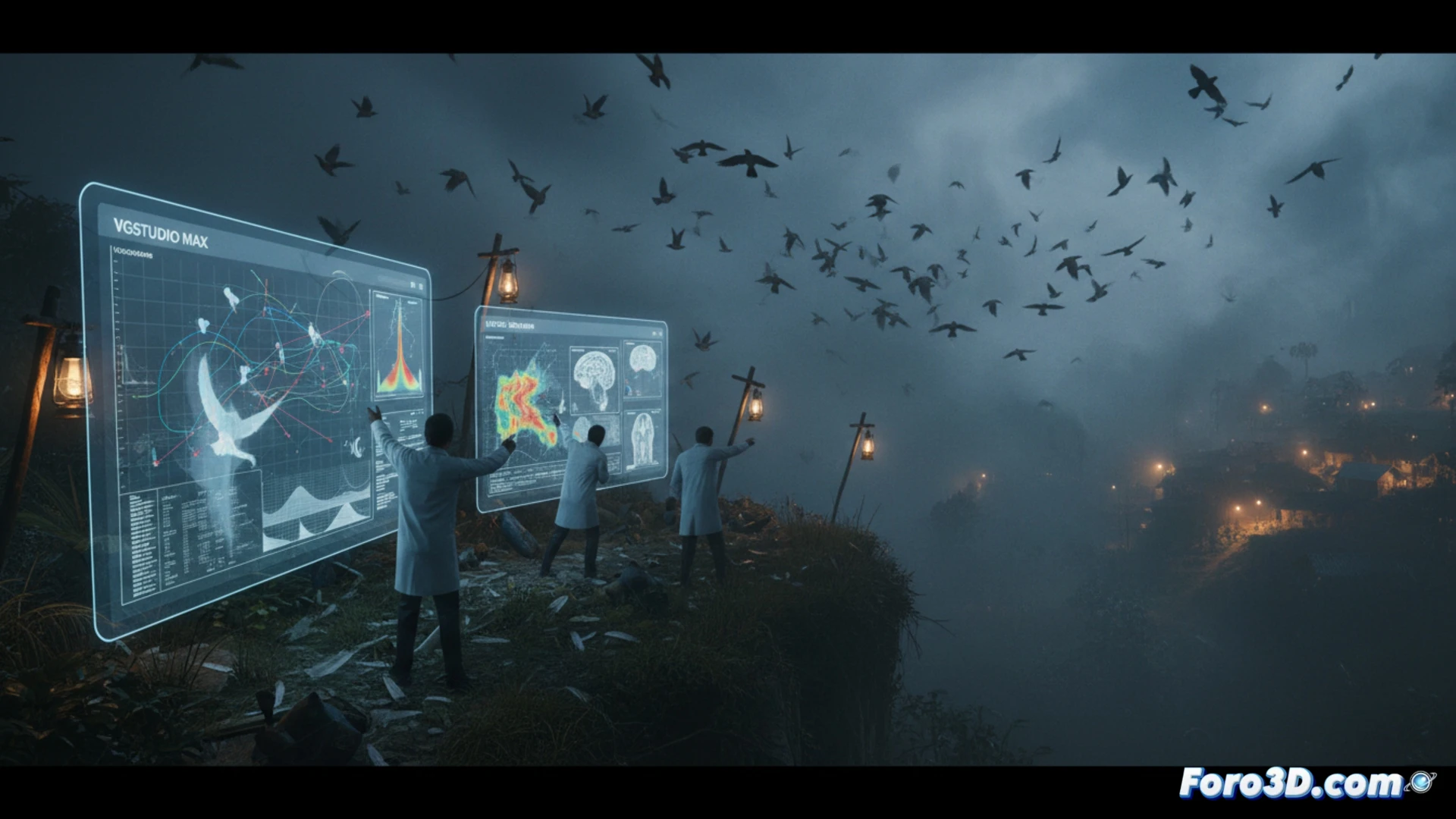
Digital reconstruction of flight and magnetic field in Jatinga 🧲
To analyze bird behavior, we first used Materialise Mimics to segment CT scans of specimens and generate detailed 3D models of their anatomy, including the structure of the inner ear and the orientation system. Subsequently, in COMSOL Multiphysics, we simulated the bio-electromagnetism of the environment: we superimposed a local magnetic flux map with atmospheric variations in pressure and humidity. Finally, in VGSTUDIO MAX, we rendered flight trajectories in 3D animations, visualizing how birds, upon crossing a zone of magnetic anomaly induced by fog, lose their way and spiral towards the village's light sources.
When fog blurs the bird's internal map 🐦
The final reflection is that we are not facing animal suicide, but rather a failure in biological navigation systems. 3D modeling allows us to see the invisible: how wind and humidity alter the perception of gravity and magnetism in the bird's brain. Tools like VGSTUDIO MAX and COMSOL not only explain the mystery but also demonstrate that scientific visualization is the key to demystifying natural phenomena, transforming folklore into comprehensible and animated data.
Is it possible to simulate with 3D models the behavior of artificial light in foggy conditions to determine if certain refraction patterns disorient the navigation system of birds in Jatinga?
(PS: if your manta ray animation isn't exciting, you can always add documentary music from channel 2)