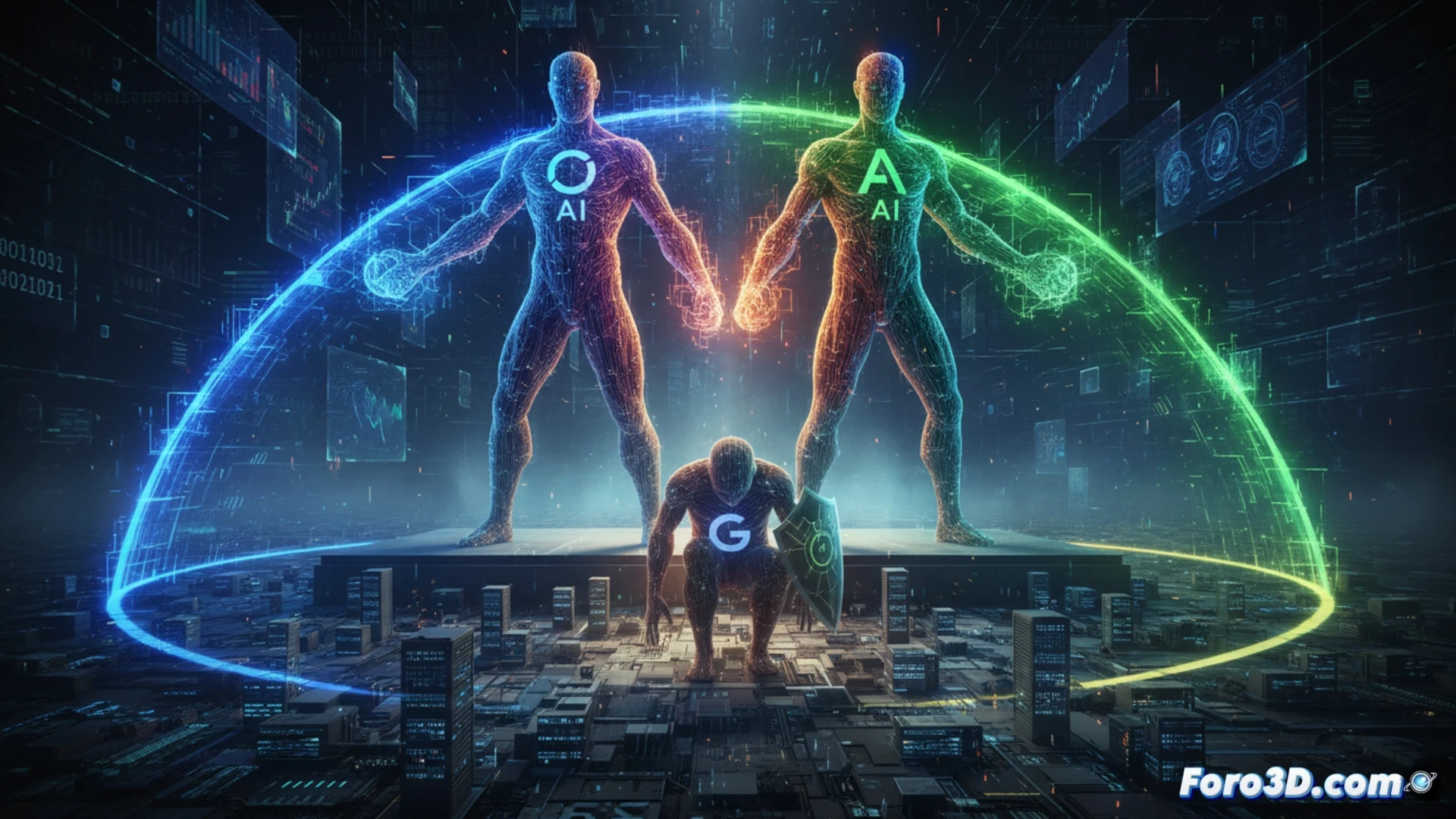
The paid artificial intelligence market in the United States has become a two-horse race. According to Ramp data analyzed by Visual Capitalist and reported by Eva R. de Luis in Xataka, OpenAI and Anthropic concentrate nearly 66% of corporate AI spending. OpenAI leads with a 35.2% share, closely followed by Anthropic at 30.6%. Google, despite its financial muscle, has stagnated at a marginal 4.3%, showing that innovation in specific tools is redefining corporate productivity.
Exponential growth: from chatbot to productivity platform 🚀
The most revealing data point in the report is Anthropic's trajectory, which multiplied its market share sevenfold in just three months, going from 4.1% in January 2025 to 30.6% in March 2026. This leap is no coincidence: it responds to the launch of two key tools. Claude Code, a programming assistant launched in February 2025, has revolutionized the workflow of technical teams. On the other hand, Cowork, an automation tool designed for non-technical users, has democratized access to AI in business departments. Meanwhile, OpenAI doubled its share, but Anthropic has captured market growth, especially among medium-sized companies seeking comprehensive solutions without relying on closed ecosystems.
Google's mirage and the lesson of specialization 🔍
Google's stagnation, which barely grew from 4.2% to 4.3% in the same period, demonstrates that investment in generalist models does not guarantee enterprise adoption. The key to Anthropic's success lies in its ability to offer specific tools that solve concrete problems: programming for engineers and automation for managers. This platform approach, rather than a simple chatbot, is transforming business productivity and displacing giants like Google, which bet on a vertical integration model that hasn't quite taken hold in the average corporate landscape. The enterprise AI war is not won by the largest model, but by the one that best adapts to daily workflow.
What implications does it have for diversity and the future of innovation in the digital society that two private companies, OpenAI and Anthropic, concentrate control of the paid artificial intelligence market in the United States?
(PS: at Foro3D we know that the only AI that doesn't generate controversy is the one that is turned off)