The Sabu Disk, carved from schist over 5,000 years ago, features a tri-lobed geometry that challenges the technological timeline. Its shape, similar to a modern propeller, lacks functional context in predynastic Egypt. Digital archaeology, through photogrammetry and three-dimensional modeling, now offers the necessary tools to dissect this enigma without touching the fragile original, enabling mechanical simulations that were previously impossible.
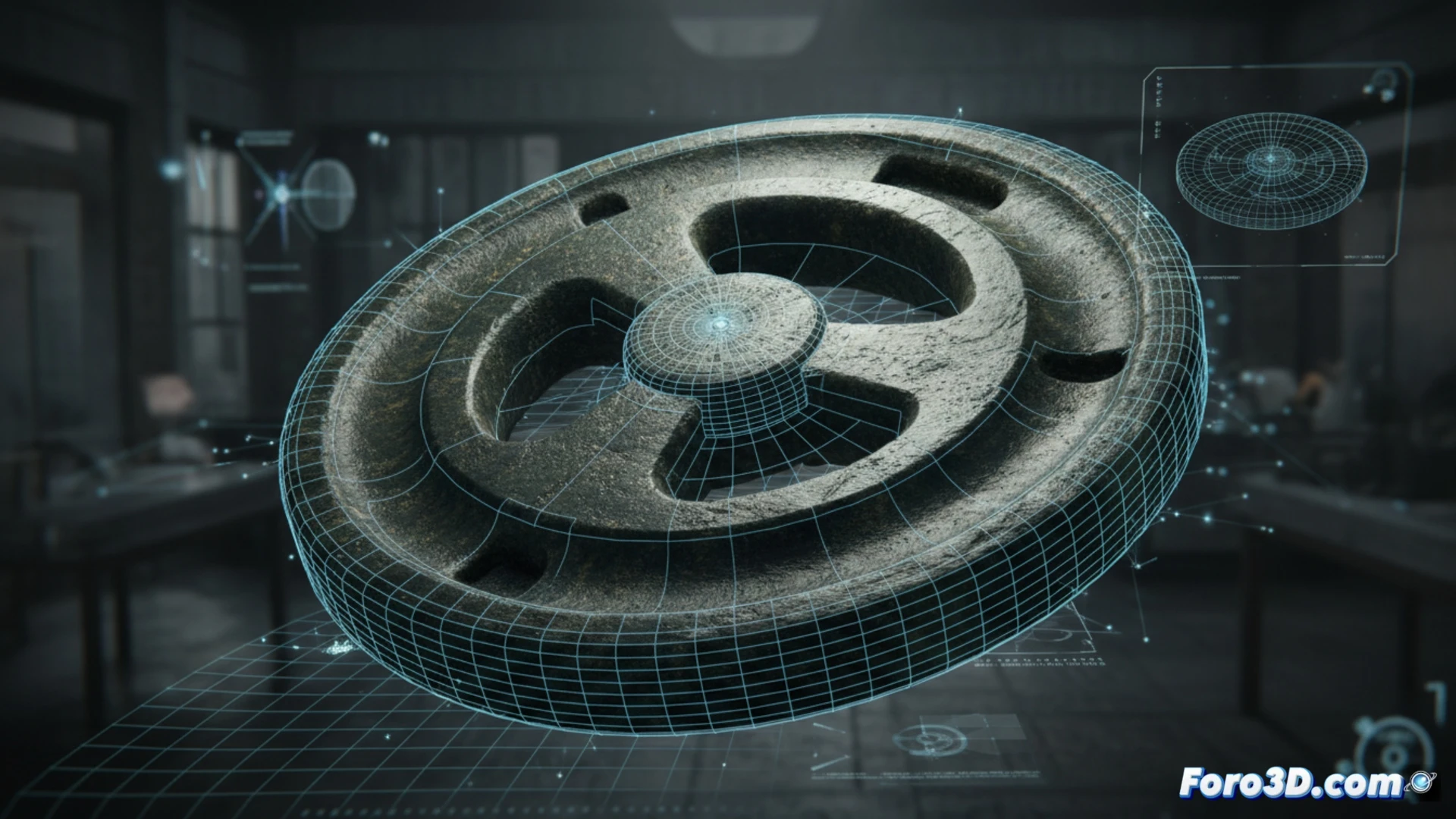
Photogrammetry and Geometric Analysis of the Artifact 🌀
The process begins with photogrammetric capture of the disk, generating a high-density point cloud that reconstructs every millimeter of the schist. This 3D model allows isolating the three curved lobes and measuring tilt angles with submillimeter precision. By importing the mesh into simulation software, the digital model can be rotated at high virtual speeds to study fluid flow. The results suggest that the shape, far from being decorative, generates efficient axial thrust, opening the debate on whether it is a copy of a lost mechanism or a purely ritual design with accidental physical properties.
The Desert Engineer's Paradox ⚙️
The mystery lies not only in its function but also in its manufacture. Schist is a fragile metamorphic rock; carving its internal curvatures and symmetrical edges without hard metal rotary tools seems an impossible feat for 3000 BC. Digital replicas allow us to test manufacturing hypotheses: from abrasion with sand and copper to the use of primitive lathes. Each failed simulation reinforces the idea that we possess a technological fossil, a piece of a puzzle that digital archaeology is only beginning to piece together.
Is it possible that the tri-lobed geometry of the Sabu Disk, revealed through 3D modeling, functioned as a hydraulic or rotary transmission component, and what digital experiments could confirm this hypothesis against traditional theories of ceremonial use?
(PS: If you dig at a site and find a USB, don't plug it in: it could be Roman malware.)