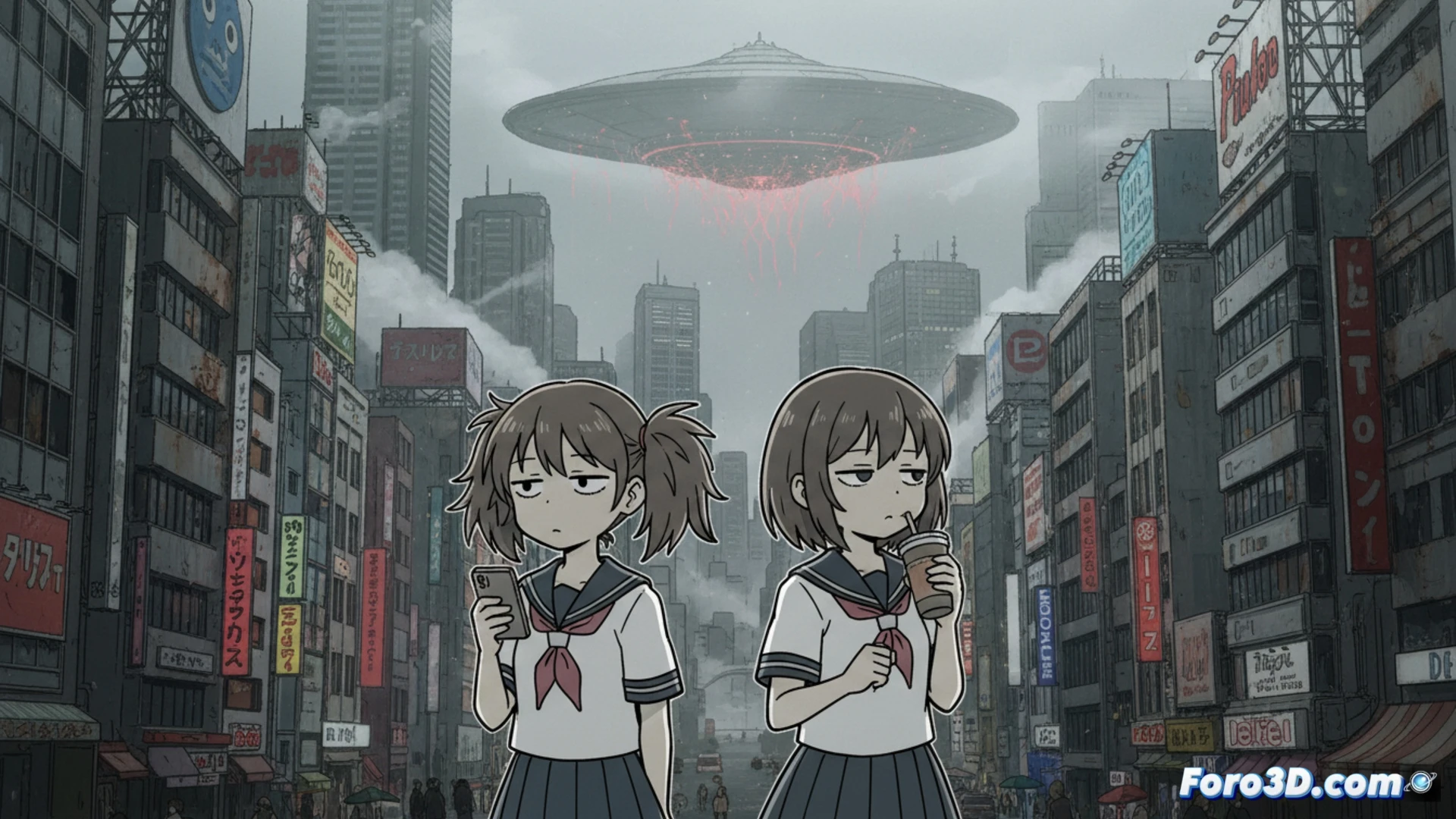
Inio Asano, master of contemporary unease, presents us in Dead Dead Demon's Dededede Destruction with a Tokyo where an alien mothership floats motionless over the city. The extraordinary has become routine. The genius of the work lies not in its science fiction, but in its visual execution. Asano employs a digital technique that juxtaposes hyper-detailed backgrounds, built from real photographs of the city, with characters of a caricatured and simplified design. This aesthetic clash is not a mere whim; it is the main narrative tool that underpins the work's political and social critique.
Technical Juxtaposition: From Real Background to Symbolic Character 🎨
Asano's technique is an exercise in augmented realism. The backgrounds, meticulously rendered from photographs, capture the texture of real Tokyo: the cracked asphalt, the saturated billboards, the humidity in the air. Against this high-definition backdrop, the characters look like paper cutouts, with round faces, large eyes, and almost childlike expressions. This technical mismatch generates an immediate cognitive dissonance in the reader. The physical reality of the world is solid and detailed, while the human beings inhabiting it are flat, almost unreal. It is an inversion of visual logic: the background is an anchor of truth, the figure is an abstraction. This digital treatment reinforces the idea that the characters live in a bubble of forced normalcy, disconnected from the physical anomaly surrounding them.
Alienation as Everyday Landscape 🌫️
This digital contrast becomes the perfect vehicle for Asano's silent political activism. The alien ship, an object of potential mass destruction, is treated visually like just another building or a strange cloud. By drawing the protagonists in a caricatured style within a hyperrealistic world, Asano underscores their powerlessness and their adaptation to the crisis. The technique tells us that the real threat is not the extraterrestrial, but the social indifference that normalizes the anomalous. The digital art here does not seek to impress with its fidelity, but uses that fidelity to highlight human alienation. In a world where everything is detail, human emotion has become a scribble.
How does Inio Asano exploit the contrast between the banality of everyday life and digital violence in Dead Dead Demon's Dededede Destruction to build a social critique of contemporary apathy?
(PS: pixels also have rights... or at least that's what my latest render says)