The recent collapse of a section in a potash mine, caused by freshwater infiltration, has put the mining industry on alert. Unlike an explosion, this disaster was a slow process of chemical dissolution that weakened the salt pillars to their breaking point. Faced with this invisible threat, geotechnical engineering has turned to a combination of LiDAR scanning and numerical simulation to model the progression of the failure and, crucially, calculate the remaining lifetime of the structure before a total collapse.
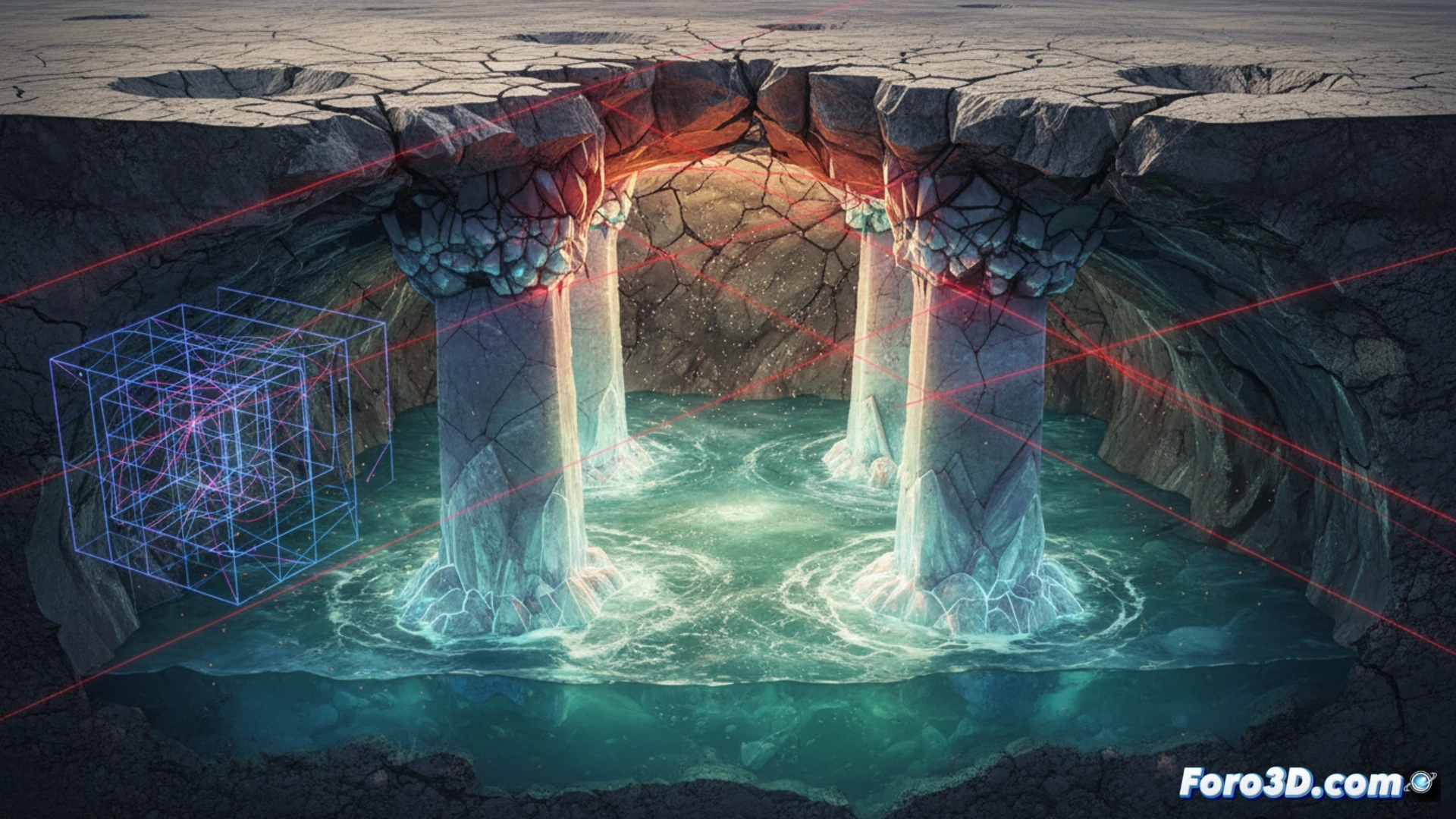
Monitoring the dissolution rate with Maptek I-Site and CloudCompare 🛠️
The methodology employed began with a high-precision topographic survey using the Maptek I-Site scanner, specifically designed for hostile mining environments. This system captured massive point clouds of the affected salt pillars. The comparative analysis was performed in CloudCompare, where historical scans were aligned with post-infiltration data. The volumetric difference between both models allowed quantifying the exact rate of surface dissolution in millimeters per day. This data is critical, as salt dissolves at a predictable rate in contact with freshwater, but the speed varies depending on the pressure and flow rate of the infiltration. With this measured rate, the geomechanical model was fed.
Predictive simulation in FLAC3D: the collapse clock ⏳
The Itasca FLAC3D software took the dissolution data and the actual geometry of the pillars to simulate stress redistribution. The model revealed that, as the cross-section of the salt was reduced, the stress on the remaining material exceeded its creep strength. The simulation allowed projecting over time the exact point where deformation became unstable. The result was a timeline of imminent failure: a remaining lifetime ranging from weeks to months. This prediction not only explains the collapse that occurred but also allows planning evacuations or injecting sealing grouts to extend the mine's operational life.
How can LiDAR monitoring be integrated with FLAC3D simulations to predict the exact point of collapse in a potash mine subjected to dissolution by freshwater infiltration?
(PS: Simulating catastrophes is fun until the computer melts down and you are the catastrophe.)