The Codex Gigas, popularly known as the Devil's Bible, is one of the most enigmatic medieval manuscripts in history. Weighing 75 kilograms and standing 92 centimeters tall, its legend claims it was written in a single night by a monk who sold his soul to Satan. Today, digital archaeology offers a unique opportunity to unravel its secrets without touching its fragile parchment pages.
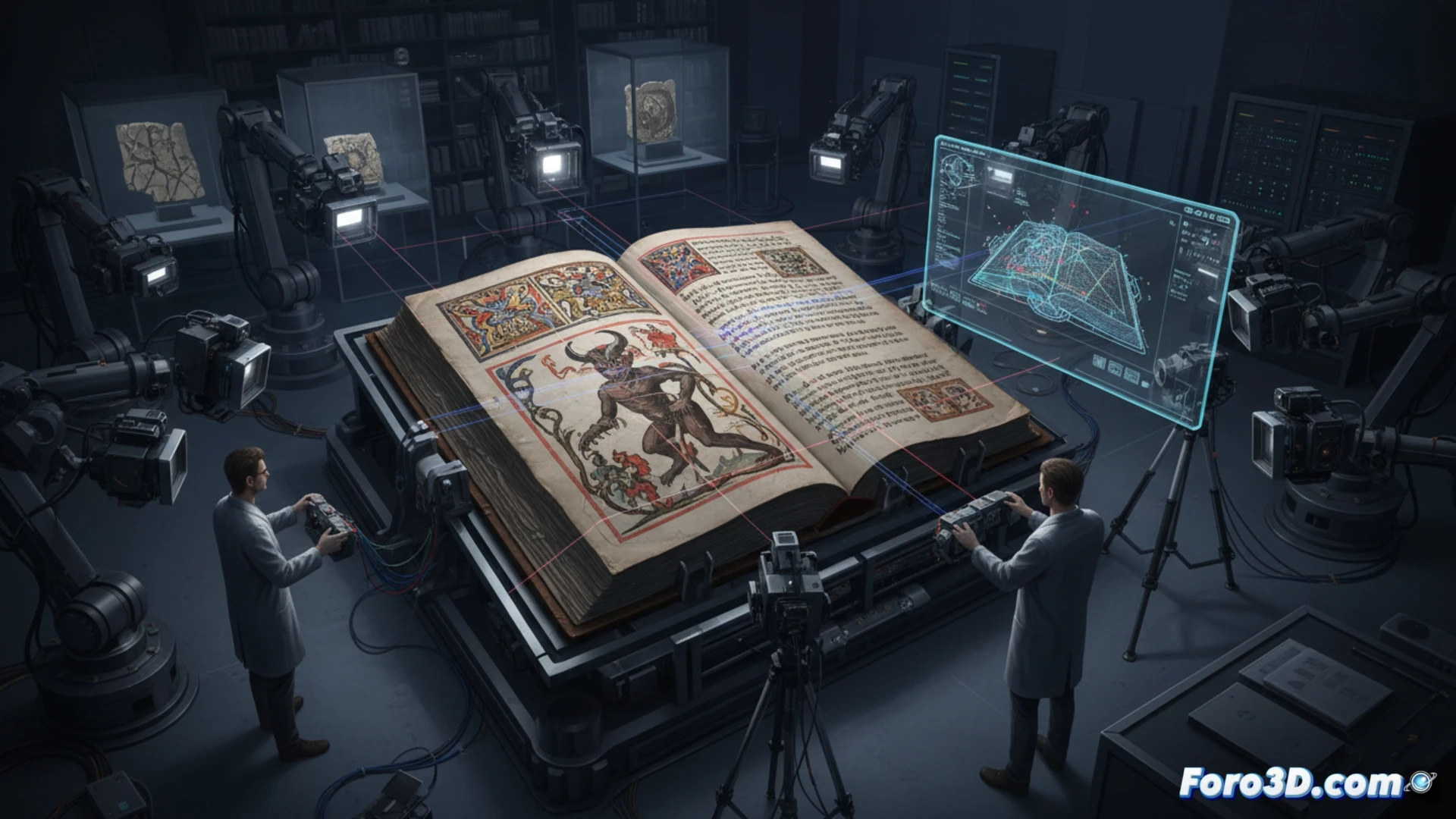
Photogrammetry and 3D scanning for virtual preservation 📜
The application of high-resolution photogrammetry techniques would allow capturing every detail of the Codex Gigas, from the cracks in the leather to the faded ink of its 310 folios. A 3D scan with structured light could generate a precise volumetric model of its wooden and metal binding, while reflectance transformation imaging (RTI) would reveal the texture of the famous demon illustration. This digital twin would not only facilitate paleographic study without risk of deterioration but also allow researchers worldwide to access the missing pages and analyze the chemical composition of the pigments through virtual spectroscopy.
Legend versus digital evidence 🔍
Digital archaeology not only preserves but also reinterprets. By digitizing the Codex Gigas, we could contrast the legend of the cursed monk with objective data on writing speed and calligraphy uniformity. A 3D layer overlay analysis could demonstrate that the manuscript was the work of several scribes, dismantling the myth of the diabolical night. Ultimately, technology returns to us the ability to admire its physical grandeur while uncovering the human truth it conceals.
What was the greatest technical challenge in 3D scanning the pages of the Codex Gigas without damaging its medieval binding and preserving the legibility of its original ink?
(PS: If you dig at a site and find a USB, don't plug it in: it could be Roman malware.)