A small black dot inscribed on a birch bark from the 3rd or 4th century AD represents the first documented use of zero as a number in human history. This finding, contained in the Bakhshali Manuscript, not only rewrites the history of mathematics but also poses a major technical challenge: how to preserve an extremely fragile organic support without losing a single stroke of its valuable information.
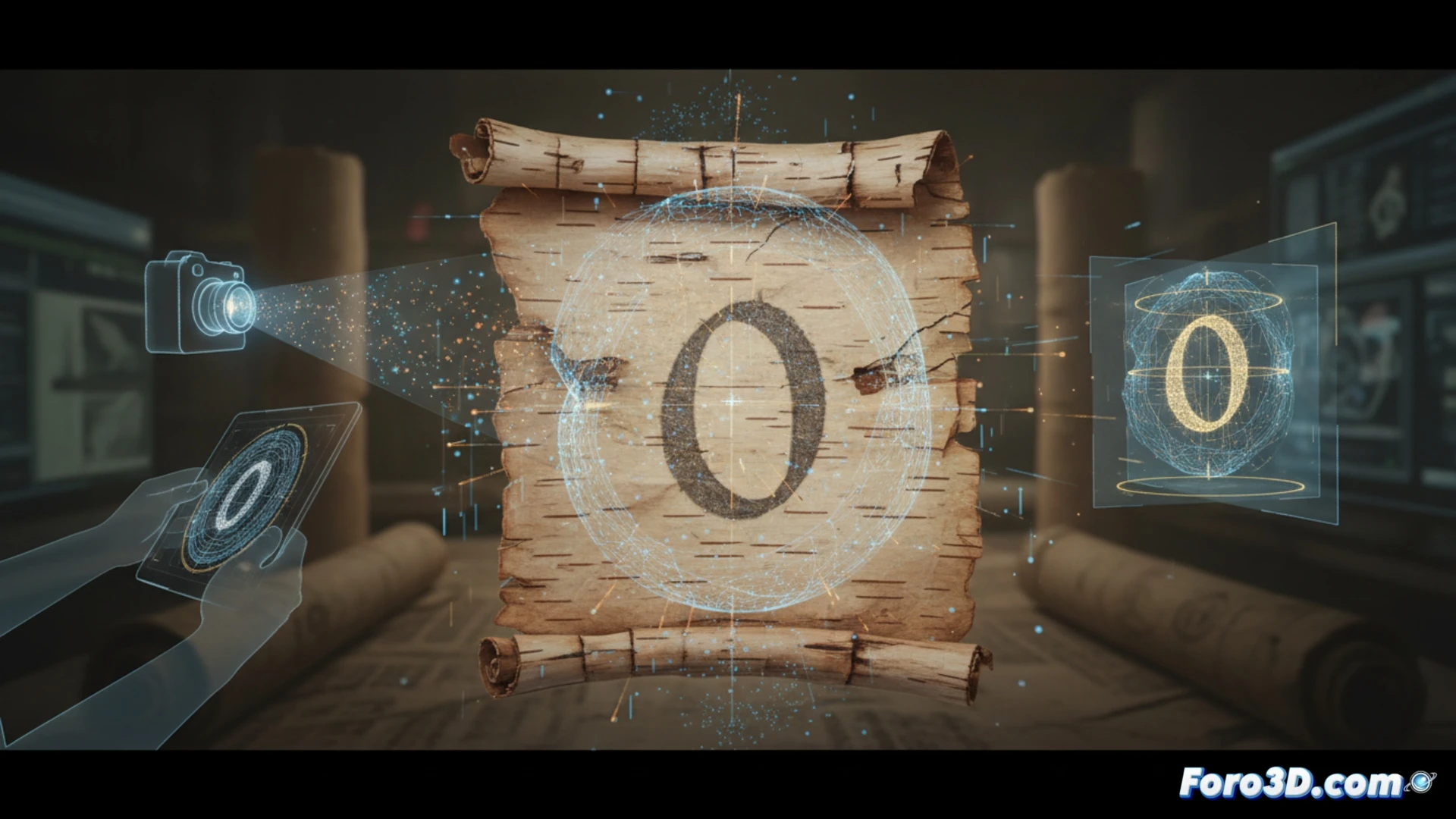
High-resolution photogrammetry for organic heritage 📜
The conservation of the manuscript, composed of birch bark fragments that disintegrate with humidity and light, makes direct handling impossible. The solution lies in multi-camera photogrammetry and structured light 3D scanning. The process involves capturing hundreds of images with cross-polarized lighting to eliminate reflections. Subsequently, the reconstruction software generates a high-density polygonal mesh that reproduces every crack and relief on the surface. This digital model allows applying equalization and virtual relief filters to read the Sanskrit inscriptions without physical contact. Submillimetric precision ensures that the dot representing zero, barely a few millimeters in size, is distinguishable from any imperfection in the support.
Beyond conservation: a mathematical legacy in 3D 🧮
Digitizing the Bakhshali Manuscript is not just an act of preservation but a revolution in academic accessibility. A textured 3D model allows mathematicians and paleographers worldwide to rotate, zoom in, and analyze the text without risking damage to the original. We can observe how the concept of emptiness, represented by that small circle, was integrated into complex arithmetic operations. Digital archaeology returns to us, layer by layer and vertex by vertex, the exact moment when humanity decided that nothingness could be counted.
What specific technical challenges does the three-dimensional digitization of the birch bark of the Bakhshali Manuscript present to preserve the tiny black dot of zero and its original context without deteriorating the organic support
(PS: and remember: if you can't find a bone, you can always model it yourself)