The 2024 sighting in the Nazca Ridge marks a milestone for marine biology. For the first time, a remotely operated vehicle (ROV) captured high-definition footage of the elusive Magnapinna squid in the South Pacific. Its characteristic angled elbows and extremely long arms, which can exceed eight meters, have been the holy grail for researchers. Now, 3D technology allows us to go one step beyond video.
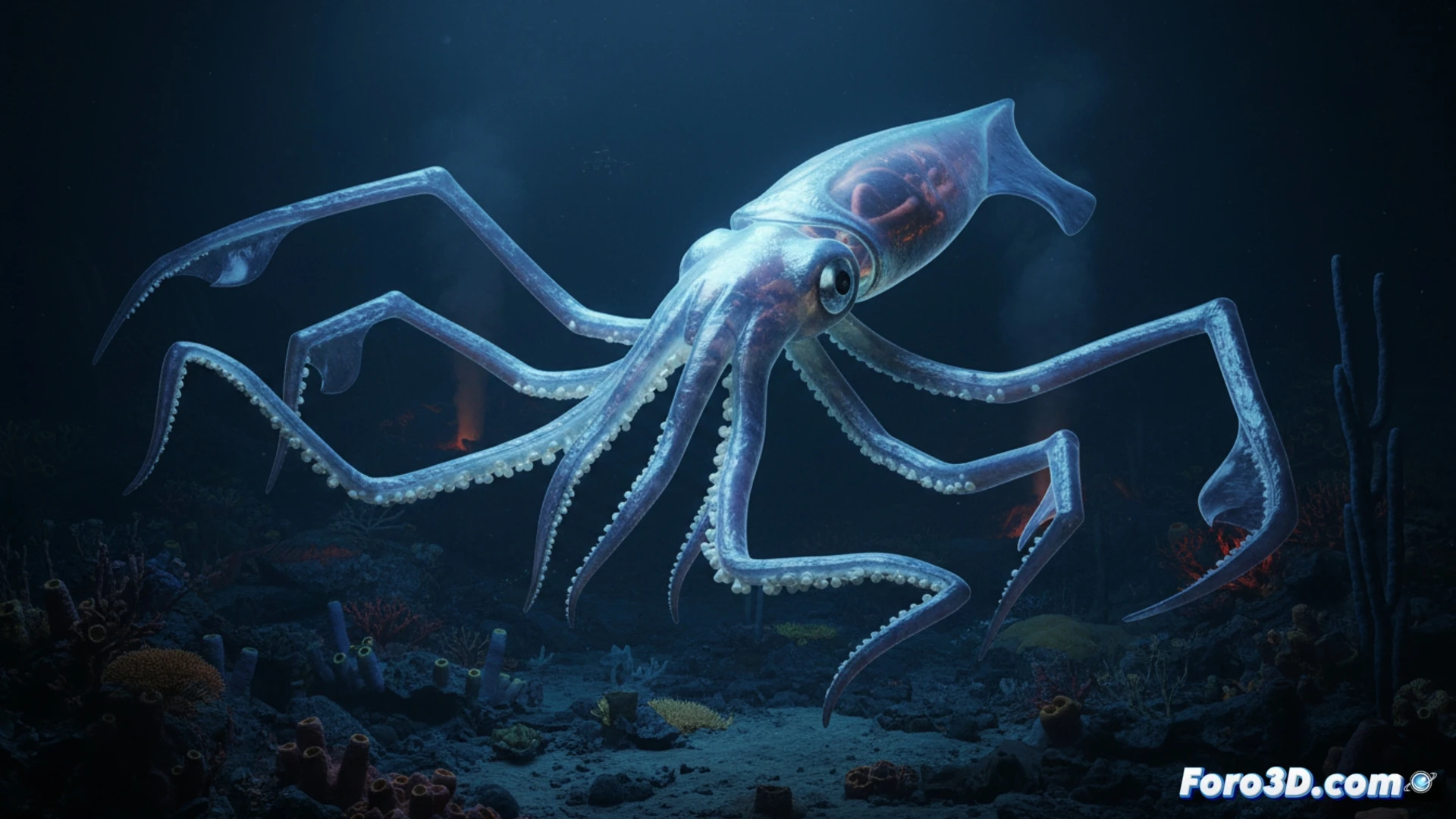
Photogrammetry and anatomical modeling: digitizing the enigma 🦑
Using the ROV frames, teams apply photogrammetry to generate a polygonal mesh of the specimen. This process analyzes the deformation of soft tissues and the arrangement of suckers under extreme pressure conditions. Subsequent anatomical modeling allows isolating the jet propulsion system and the muscular structure of the arms, solving a key mystery: how it keeps those elbows rigid in an environment without a skeleton. Fluid simulation in scientific visualization software replicates the currents of the Nazca Ridge, offering a visual hypothesis of its passive hunting, where it deploys its appendages like a living fishing net.
Digitization as a remote conservation tool 🌊
This 3D model is not just a visual spectacle; it is an accessible morphometric database for biologists worldwide. By not requiring the capture of the animal, stress on a nearly unknown species is avoided. Recreating its habitat on the Nazca Ridge allows studying its vertical migrations and its relationship with seamounts. In the end, 3D technology brings us closer to the unreachable, transforming a brief sighting into a permanent scientific record that challenges the limits of ocean exploration.
What technical limitations were faced when reconstructing the morphology and behavior of a Magnapinna squid from ROV images captured at over 6000 meters depth in the Nazca Ridge
(PS: modeling manta rays is easy, the hard part is making them not look like floating plastic bags)