45 years ago, beneath the subsoil of Seville, the Metro works unearthed a millenary secret: the remains of an 11th-12th century Andalusian ship. Now, a team of researchers is applying cutting-edge 3D technology to digitally reconstruct it. The project, led by the Archaeological Museum of Seville, seeks to unveil the secrets of Islamic shipbuilding without touching the fragile original timbers, immersing us in the trade and navigation of Al-Andalus.
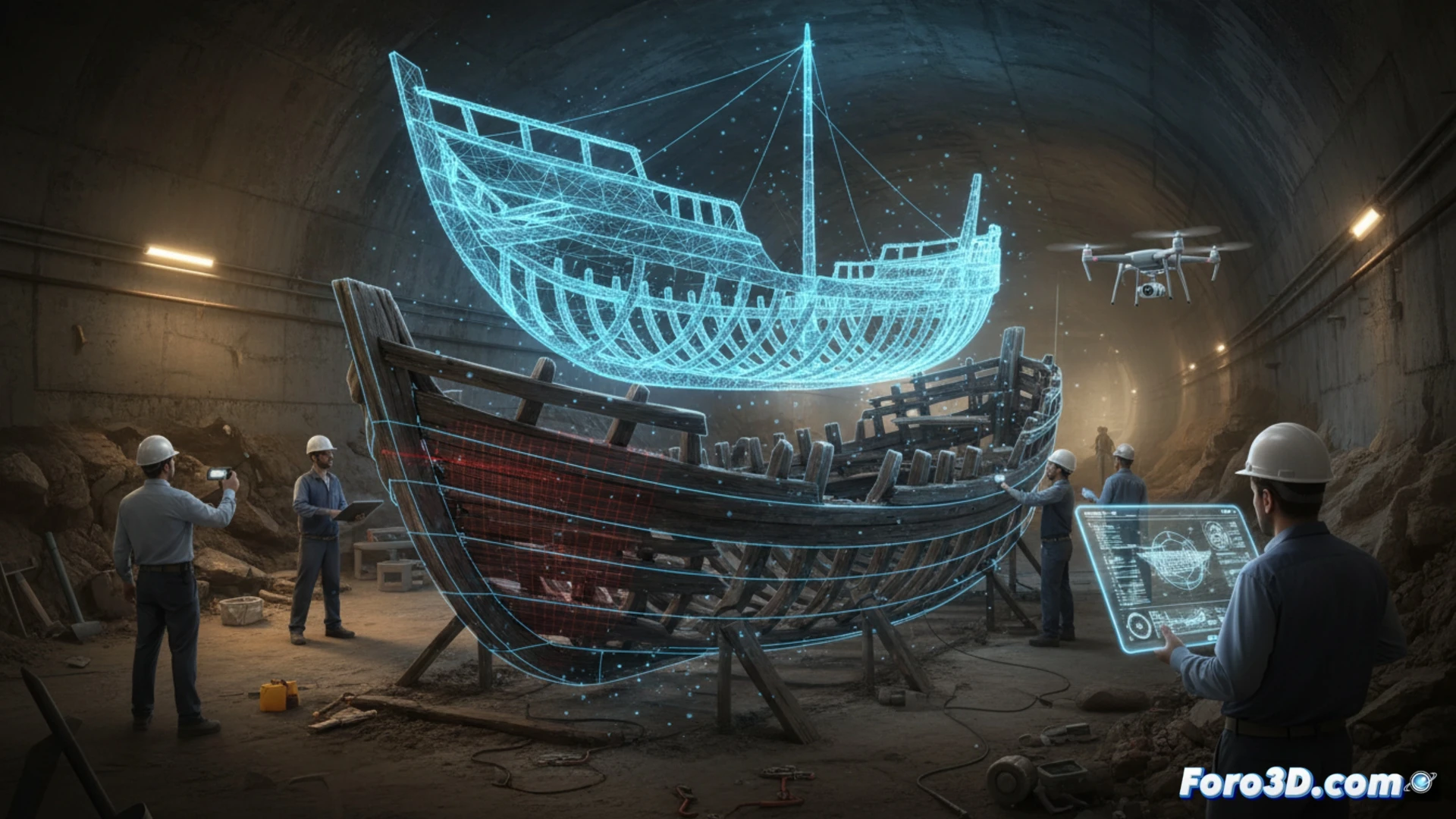
Photogrammetry and laser scanning: the digital autopsy of wood 🛠️
The digitization process of the so-called Cathedral Ship combines two fundamental techniques. First, high-resolution photogrammetry, which captures hundreds of convergent images to generate a textured point cloud with millimeter precision. Subsequently, 3D laser scanning is used to record the geometry of the most complex pieces, such as the frames and the keel. This digital twin allows naval archaeologists to virtually section the structure, analyze the copper and wood joints, and even simulate the hydrodynamic behavior of the hull. Unlike physical manipulation, the 3D model allows studying clinker construction techniques and the assembly of the planking without accelerating the degradation of the remains, which date from an era when Seville was a commercial emporium of the Caliphate. Researchers already compare this case with the digital reconstruction of the Uluburun shipwreck, highlighting that the Andalusian wood offers unique data on the evolution of the lateen-rigged ship.
A virtual bridge between the museum and the public 🌐
Beyond technical analysis, the project represents a revolution in heritage dissemination. The 3D model will allow creating an immersive experience where visitors to the Archaeological Museum of Seville can virtually navigate the deck, observe the simulated cargo of amphorae and goods, and even disassemble the ship piece by piece to understand its assembly. This digital accessibility not only democratizes knowledge but also guarantees the preservation of the fragile legacy. As the project's archaeologists point out, 3D technology acts as a digital Noah's Ark, safeguarding the memory of Andalusian naval carpentry for future generations, while the world watches science and history sail together into the past.
What specific technical challenges does the 3D digitization of a fragmented Andalusian ship, buried for centuries beneath the urban fabric of Seville, present?
(PS: If you dig at a site and find a USB stick, don't plug it in: it could be Roman malware.)