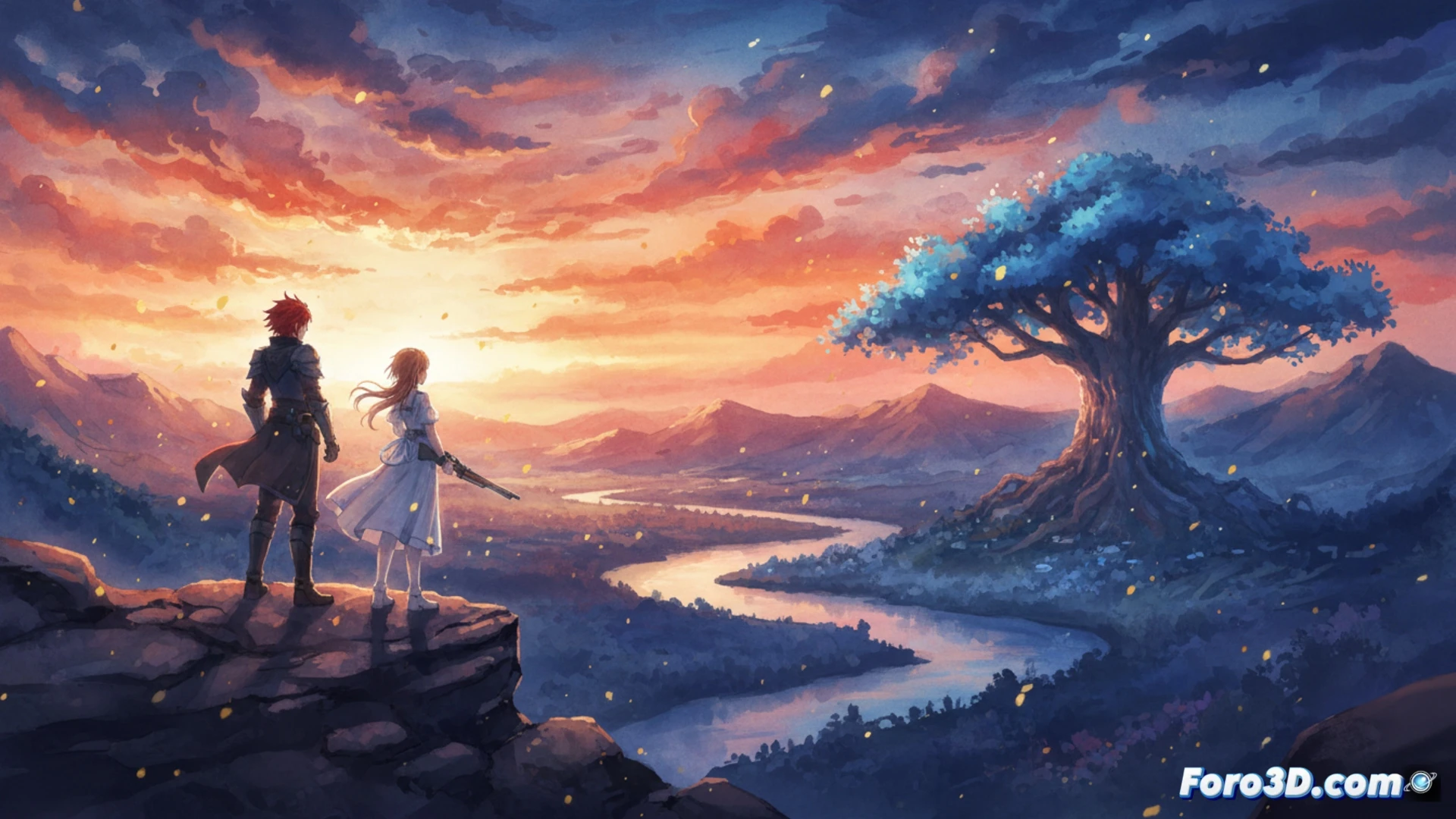
The Tales of Arise team achieved a visual milestone by translating the aesthetic of watercolor painting into a real-time engine like Unreal Engine 4. The key lies in the Atmospheric Shader, a rendering system that dynamically blurs outlines and saturates colors. This approach not only beautifies the world but also optimizes the art direction by hiding the geometric limitations of low-resolution models, offering a coherent and painterly visual experience.
Maya Workflow and Photoshop Brushes 🎨
3D modeling was done in Autodesk Maya, where characters and environments were created with topology designed for smooth shading. However, the real secret lies in texturing: the team developed custom digital brushes in Photoshop that mimic the stains and transparencies of watercolor. These brushes were applied to color and normal maps, and then integrated into the engine's Atmospheric Shader. The shader interprets these textures as pigment layers, applying a light dispersion effect that makes edges blend and colors mix in real-time, simulating the drying of paper.
Lessons for Art Direction in UE4 🖌️
Tales of Arise demonstrates that visual style depends not only on the engine but on the symbiosis between 2D and 3D tools. By delegating the aesthetic to the Atmospheric Shader, the developers reduced the load of high-resolution polygons and textures, saving rendering resources. The lesson is clear: a workflow that prioritizes digital painting over photographic realism can be more efficient and visually impactful. For any studio, investing in non-photorealistic shaders and calibrating brushes in Photoshop is a viable path to stand out in a saturated market.
In a real-time engine like Unreal Engine, what was the biggest technical challenge to replicate the fluidity and transparency of watercolor without sacrificing performance in dynamic scenes?
(PS: a game developer is someone who spends 1000 hours making a game that people complete in 2)