The development of The Last Case of Benedict Fox represents a fascinating case study for independent creators. The team achieved a Lovecraftian horror aesthetic inspired by early 20th-century art using a hybrid workflow between Blender, Substance Painter, and Unity. This article breaks down the key modeling, texturing, and lighting techniques that allowed a small studio to achieve striking visual quality in real-time. 🎮
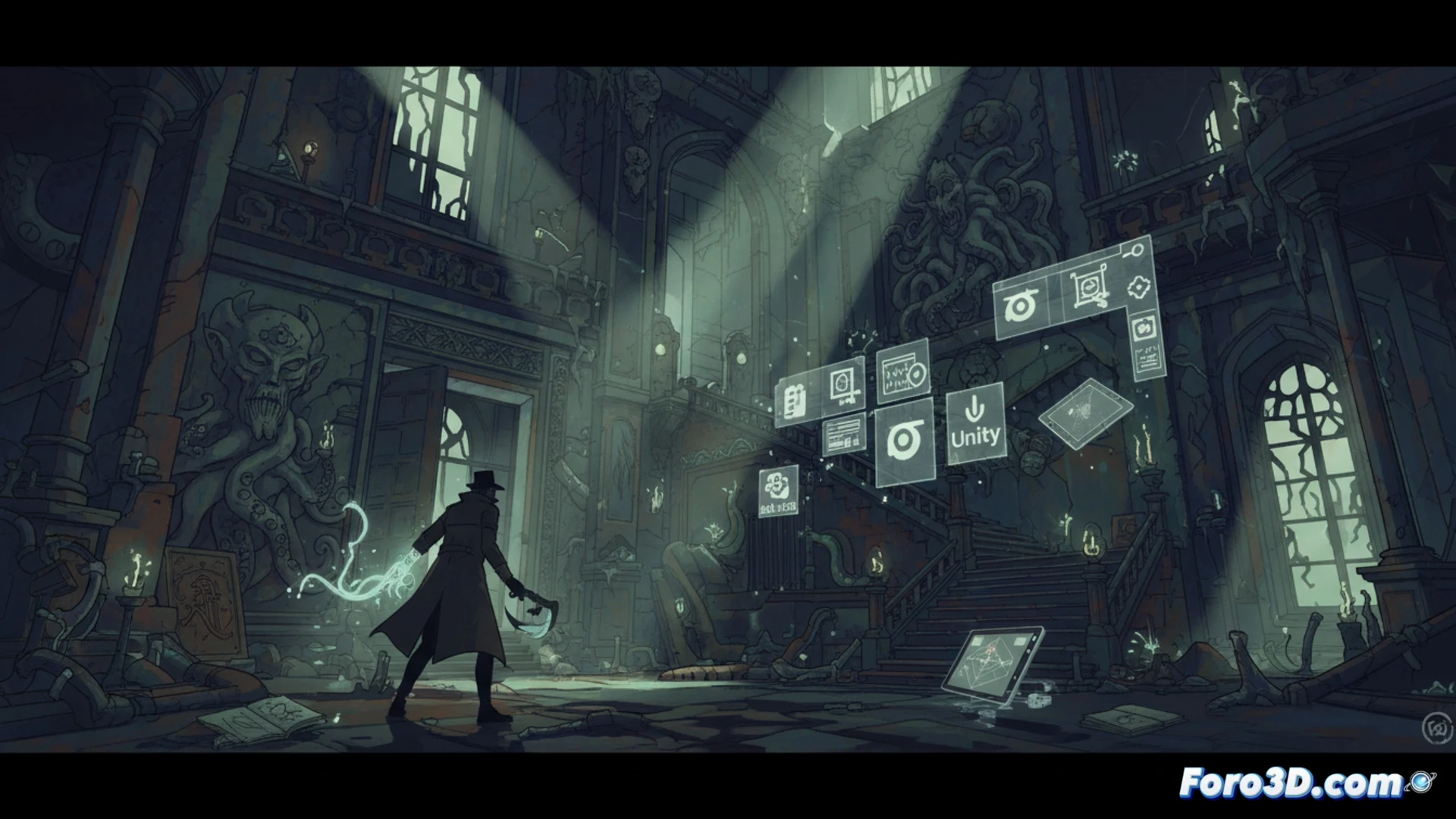
Modeling in Blender and Texturing in Substance Painter for 2.5D 🎨
The foundation of the visual style lies in 2.5D modeling. In Blender, artists built scenes with limited depth but a high level of geometric detail in the foreground, creating three-dimensional dioramas that feel painterly. Subsequently, in Substance Painter, the focus was not on photorealism but on imitating painterly textures: thick brushstrokes, organic wear, and muted colors. The key was exporting normal and roughness maps that, combined with a limited color palette, reinforced the sensation of a living painting. Optimization for Unity was achieved through texture atlases and polygon reduction in background elements.
Volumetric Lighting and Optimization in Unity 💡
Volumetric lighting in Unity is the soul of the Lovecraftian atmosphere. The team implemented dense fog and dynamic light rays using Unity's Volumetric Fog system, but with an optimization trick: instead of real-time calculations for each particle, pre-calculated light volumes were used combined with a cascaded shadow system for static objects. This allowed maintaining performance without sacrificing visual depth. The final integration with Photoshop was used to adjust post-processing tones, making each scene look like a moving nightmare illustration.
How does the team behind The Last Case of Benedict Fox combine Lovecraftian aesthetics with the depth of 2.5D without sacrificing performance in engines like Unity or Unreal Engine for an indie project?
(PS: a game developer is someone who spends 1000 hours making a game that people complete in 2)